ADP Jobs Miss, Gold Holds: Warsh Live from Sintra

featured 175352

Private employers added 98,000 jobs in June, below May’s 122,000 and under the 110,000 expectation. A weak payroll number would normally give gold room to rally, yet the price of gold is holding around $4,040 per ounce, up roughly 0.8% on the day. Markets appear to be discounting the ADP print and focusing on the … Read more

War Drives Gold to Its Worst Quarterly Drop Since 2013

featured 175238

Gold began the second quarter around $4,700 per ounce. By June 30, 2026, the price stood at about $4,015 — a roughly 14% drop for the quarter. That decline marks the weakest quarterly performance for gold since the dramatic sell-off in Q2 2013, when markets reacted to changes in Federal Reserve policy expectations. The commonly … Read more

Garner Predicts $3,600 Gold Floor — Will Prices Fall Further?

featured 175331

Key Takeaways Gold has retraced roughly 28% from its January 2026 peak near $5,589 as the Federal Reserve signals a tighter-dollar approach under new Chair Kevin Warsh. Warsh, confirmed by the Senate in May 2026, has publicly prioritized shrinking excess liquidity and reducing the money supply — a policy that directly challenges the long-running monetary … Read more

Why OCBC Cut Its Gold Price Forecast by $740

featured 175299

Gold is trading at $4,023 this morning. OCBC (Oversea-Chinese Banking Corporation), one of Southeast Asia’s largest banks, has just cut its year-end gold forecast sharply — from $5,100 to $4,360 — citing higher real yields, a stronger U.S. dollar, and a more hawkish Federal Reserve. These are the same macro forces that typically push model-based … Read more

Fed Dot Plot Shows 18 Dots; Chair Withholds His

featured 175138

Key Takeaways The Federal Reserve’s June 17 FOMC dot plot included 18 projections, not 19. Chair Kevin Warsh chose not to submit a forecast — the first time a sitting Chair has withheld a dot since the tool was introduced in 2012. Nine of the 18 submitted dots indicate at least one rate hike in … Read more

Gold vs Savings Account: Which Is Outpacing Inflation?

featured 175154

Key Takeaways A savings account protects your cash balance. Gold preserves purchasing power. They serve different purposes. As of May 2026, the Consumer Price Index rose 4.2% year-over-year. The national average savings rate is 0.38%. That implies a real return near negative 3.8% for the average saver. High-yield savings accounts may offer around 4.20% APY. … Read more

Why Gold Is So Expensive: 5 Factors Driving Its Price

featured 175189

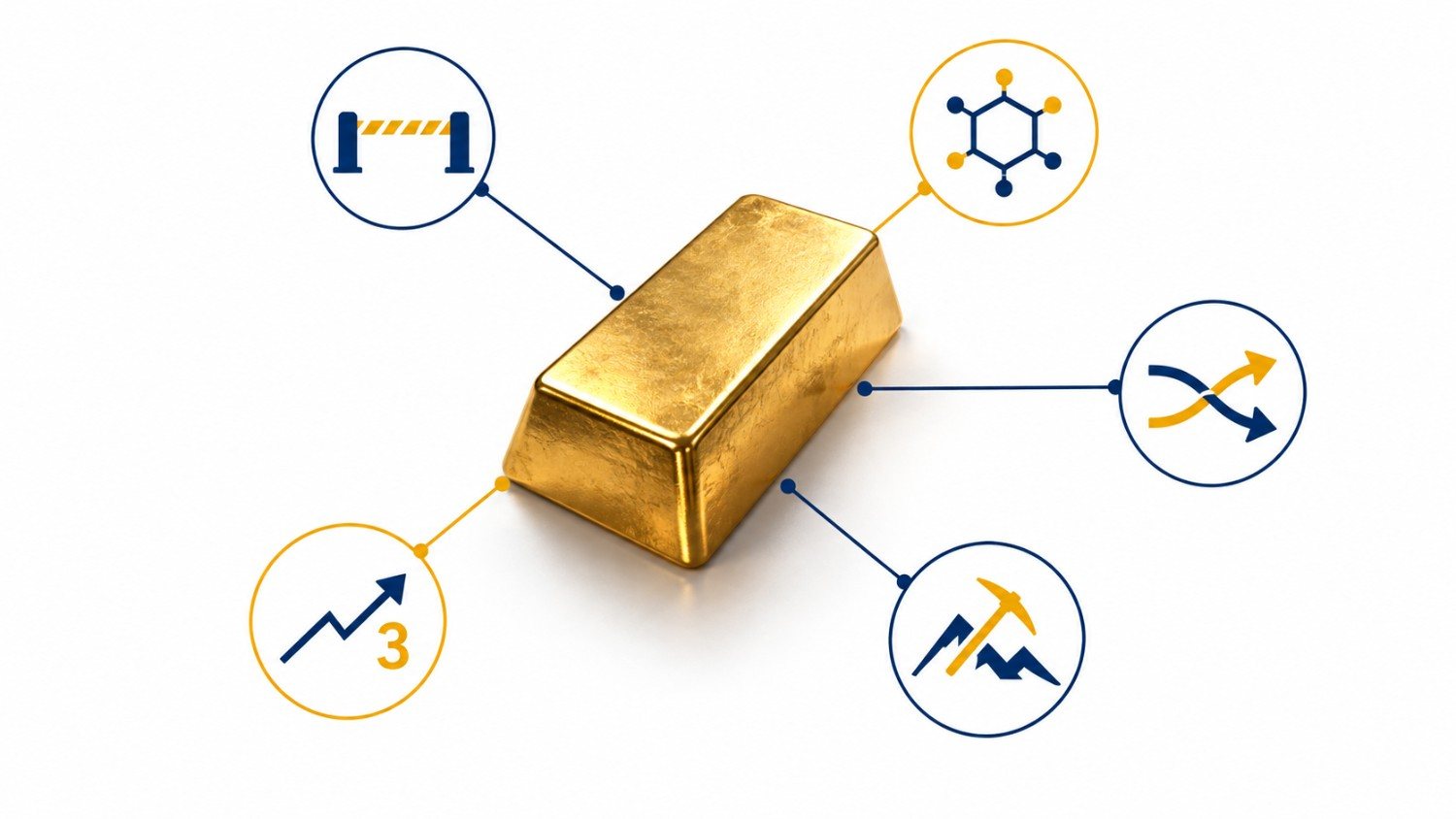
Key Takeaways All the gold ever mined — about 220,000 tonnes — would fit in a cube roughly 22 meters on each side [World Gold Council, 2025]. Annual mined supply grows only about 1.8% per year and cannot be meaningfully accelerated. Gold’s zero nominal yield becomes attractive when real interest rates compress toward zero. Historical … Read more

172,000 Jobs Beat Forecast, Thursday Report Could Move Gold

featured 175164

A stronger-than-expected jobs report is pushing gold’s paper price lower. The connection is straightforward: robust hiring reinforces the Federal Reserve’s hawkish stance, higher interest rates increase the opportunity cost of holding a non-yielding asset like gold, and leveraged futures traders often sell quickly in response. That dynamic is already underway — gold is down about … Read more

Gold Posts Worst Week of 2026 as Central Banks Signal Record Buying

featured 175117

Gold fell about 5% this week to $4,044 per ounce, marking its steepest weekly decline of 2026. That move, however, contrasts sharply with central bank behaviour this year. The World Gold Council’s Central Bank Gold Reserves Survey, published June 16, 2026 and covering 76 institutions, found that 89% of reserve managers expect their gold holdings … Read more

Seigniorage: How Inflation Acts as a Hidden Tax on Your Cash

featured 175110

Key Takeaways Seigniorage is the government’s profit from issuing currency — effectively an inflation tax on every dollar you hold. A $100 bill costs only a few cents to produce; the government captures the difference as seigniorage. Under the classical gold standard (roughly 1880–1914), inflation was minimal. After 1971, when the dollar was no longer … Read more