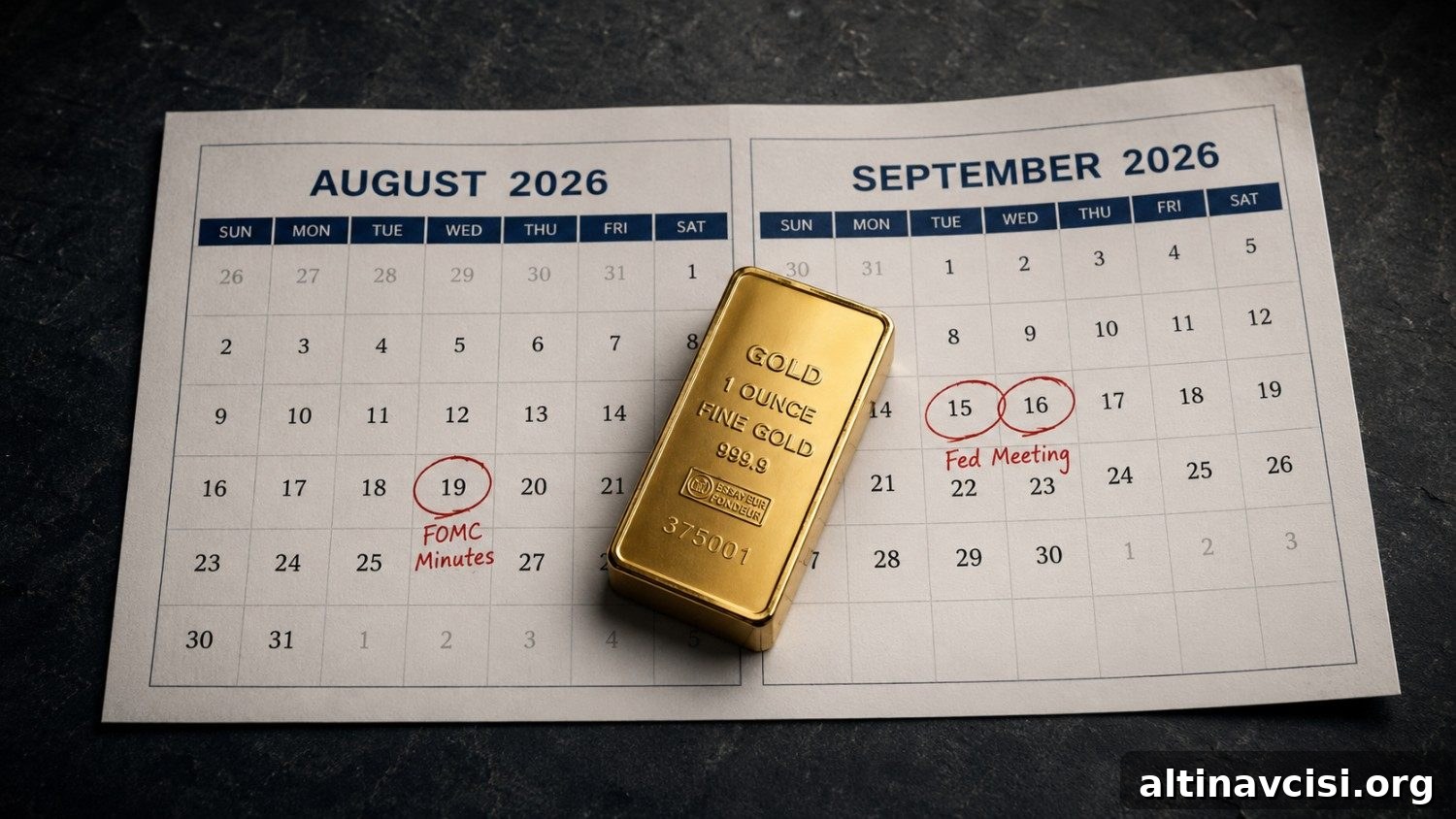
The Federal Reserve voted 9–3 to hold interest rates at its July 29 meeting. Three members dissented and preferred an immediate hike. Since that decision, two key inflation reports—released in mid-August—came in softer than expected. Those reports have given the majority who favored a pause a clearer, data-driven rationale heading into September.
Gold has reacted to this shift in expectations.
As of the morning of Friday, August 14, gold traded near $4,383 per ounce, up roughly $33 on the day. Silver was near $65.05 per ounce, rising about $0.57. Gold posted a monthly gain exceeding 10%, marking one of its strongest August performances in years. That rally was driven primarily by a repricing of September rate expectations following the softer inflation prints.
Gold Spot Price — 30-Day Trend (July 15 – August 14, 2026)
Two consecutive soft inflation prints pushed gold to two-month highs
Gold spot price
CPI / PPI release
Source: goldsilver.com/price-charts/
Why Is the Gold Price Up Today?
The immediate catalyst is a two-part sequence of softer inflation readings. The Bureau of Labor Statistics reported that the Consumer Price Index (CPI) rose 3.4% year-over-year in July, a small deceleration from June’s 3.5% and just a 0.1% increase month-over-month. The following day, the Producer Price Index (PPI) for final demand showed no month-over-month increase in July, down from a +0.5% reading in May. Together, these reports shifted market expectations about the pace of future rate hikes.
Market pricing responded quickly. Tools tracking Federal Reserve policy probabilities showed a marked increase in the odds that the Fed will hold rates at its September meeting, rising sharply compared with a month earlier. That change in expectations flows directly into real yields—the difference between nominal interest rates and inflation expectations. When markets expect fewer rate hikes, real yields tend to compress, reducing the opportunity cost of holding non-yielding assets like gold. Historically, gold can reprice roughly $40 to $60 per ounce for each 25 basis points of real-yield compression, a relationship that helps explain the recent move higher.
Silver’s stronger performance alongside gold is also noteworthy. The gold-silver ratio narrowed from above 70 in late July to about 67.4 on the morning of August 14. Silver benefits from both monetary and industrial demand, so when rate expectations ease, silver often outperforms gold.
The Edge Every Investor Needs
Smarter precious metals investing starts here. The Nuggets Newsletter delivers market insights, Fed updates, trends, and educational content.
What Do the FOMC Minutes Mean for Gold and Silver Investors?
The Federal Reserve will release the minutes from its July 29 meeting on Tuesday, August 19 at 2:00 p.m. ET. That release is a key near-term event for precious metals traders. The July decision recorded a 9–3 vote to hold, but the minutes will reveal the language used by the dissenting members and the deliberations behind the majority’s stance.
If the minutes show the three dissenters used conditional language—signaling they would support a hike only if inflation data picked up—the case for a September pause will strengthen. Conversely, if their notes show a stronger push to resume tightening or materially revised inflation projections, markets may retrace part of this week’s gains. Since public remarks from Fed officials, including those at recent conferences, have not settled the September question, the minutes will be the first detailed account of internal committee dynamics.
What Does This Mean for Physical Gold and Silver Holders?
On the surface, prices are higher because inflation readings softened. More deeply, these prints influence how much room the Fed has to tighten policy without creating fiscal strain. U.S. government interest payments are approaching record levels this fiscal year, and higher rates would raise debt-servicing costs materially. In that light, softer data that supports a hold gives the Fed political and economic cover to be patient.
Gold’s rise is not evidence that inflation is solved; rather, it reflects growing market expectations that the Fed cannot tighten as aggressively as some members would prefer. That structural dynamic is independent of any single report and is rooted in the broader fiscal and balance-sheet context. Physical holders should view current price moves as a reaction to changing expectations about real yields and policy trajectory, not as confirmation that inflation has been permanently controlled.
Market participants should watch other scheduled data, such as the University of Michigan preliminary August consumer sentiment reading, and monitor live spot prices to see how markets adjust in real time.
SOURCES
1. Bureau of Labor Statistics — Consumer Price Index Summary, July 2026 (released August 12, 2026). bls.gov/cpi
2. Bureau of Labor Statistics — Producer Price Index, July 2026 (released August 13, 2026). bls.gov/ppi
3. CME Group FedWatch Tool — September 2026 FOMC rate probabilities, as of August 14, 2026.
4. Federal Reserve — FOMC Statement, July 29, 2026; FOMC minutes release schedule, August 19, 2026.
5. GoldSilver — Live Gold and Silver Spot Prices, August 14, 2026.
6. University of Michigan, Surveys of Consumers — July 2026 final reading; August 2026 preliminary schedule.
7. Market commentary and forecasts referenced for context on August 14, 2026.
Disclaimer: This article is for informational purposes only and does not constitute investment advice. Past performance is not indicative of future results. Always consult a qualified financial advisor before making investment decisions.
You May Also Like:
- Jackson Hole Is 14 Days Away. What Warsh Says Could Move Gold More Than Any Inflation Print.
- Gold Hit a Two-Month High. Then It Pulled Back. The PPI Data That Caused Both Moves Is What Matters.
- Two Soft Inflation Prints. Gold Is Still Below $4,500. One Number Is Keeping It There.
- China Bought the Most Gold Since 2023 in July. Here’s Why.
- Five Unrelated Forces All Moved Gold and Silver Higher Today. That Doesn’t Happen Often.
- Gold Climbs 1% Ahead of July CPI. Here Is Why the Print Matters More Than the Number.