Key Takeaways
- The Austrian Gold Philharmonic has been produced annually since 1989 by the Münze Österreich — one of the world’s oldest continuously operating government mints
- Struck in .9999 fine (24-karat) gold, it carries the highest purity available in a major sovereign bullion coin
- The World Gold Council declared it the world’s best-selling gold coin in 1992, 1995, 1996, and 2000
- It is the only major bullion coin denominated in euros and carries legal tender status in Austria, where it is backed by the Austrian government
- Available in five sizes from 1/25 oz through 1 oz — all IRA-eligible under U.S. tax law
- Over 14 million coins, totalling approximately 329 tonnes of gold, have been distributed worldwide through 2012 (World Gold Council)
The Austrian Gold Philharmonic has earned its reputation through consistency and purity. First issued in October 1989 by the Münze Österreich, this coin became Europe’s leading bullion coin and has remained a favored choice for investors seeking recognized, liquid, and highly pure physical gold. Its design and specifications have stayed steady, making it an enduring, easily tradable store of value as currencies and monetary policy evolve.
This article explains the coin’s history, specifications, design elements, investment rationale, and practical considerations such as premiums, liquidity, and IRA eligibility.
What Is the Austrian Gold Philharmonic?
The Austrian Gold Philharmonic, known in German as the Wiener Philharmoniker, is a sovereign bullion coin struck annually by the Austrian Mint (Münze Österreich) in Vienna. Authorized by the Austrian National Council and first released on October 10, 1989, it was created specifically for investors who want to hold physical gold in a trusted, market-recognized form. Standard bullion issues are valued primarily for metal content rather than collectible attributes.
All Philharmonics are struck in .9999 fine gold, placing them among the purest mainstream bullion coins. The 1 oz version has a €100 face value and is legal tender in Austria. Being denominated in euros gives the coin extra recognition across European markets.
Why Did Europe Choose the Philharmonic?
When it launched, the Philharmonic addressed a European preference for coins with the highest possible gold purity. Competing coins of the era, like the South African Krugerrand and the U.S. Gold Eagle, used lower fineness alloys. The Philharmonic’s .9999 purity proved decisive for many buyers who preferred minimal or no alloying metals.
The market adopted the Philharmonic quickly. Within a year it was the best-selling bullion coin in Europe, and within a few years it achieved top global sales rankings. During periods of intense demand — for example around the 2008 financial crisis — its sales outpaced several older bullion programs. By 2012, more than 14 million coins had been distributed globally, reflecting strong, sustained investor demand.
Who Makes the Austrian Gold Philharmonic?
The Münze Österreich mints the Philharmonic in Vienna. The mint traces its origins back many centuries and has operated through multiple political eras. Today it is a subsidiary of Austria’s central bank (Oesterreichische Nationalbank). That institutional backing gives buyers confidence: the coin’s weight and purity are guaranteed by a sovereign mint rather than a private refiner.
While the Austrian Mint does not regularly publish detailed annual production for the gold Philharmonic, industry observers estimate that 1 oz output ranges widely depending on demand, with materially higher mintages during market surges.
What Does the Philharmonic Look Like?
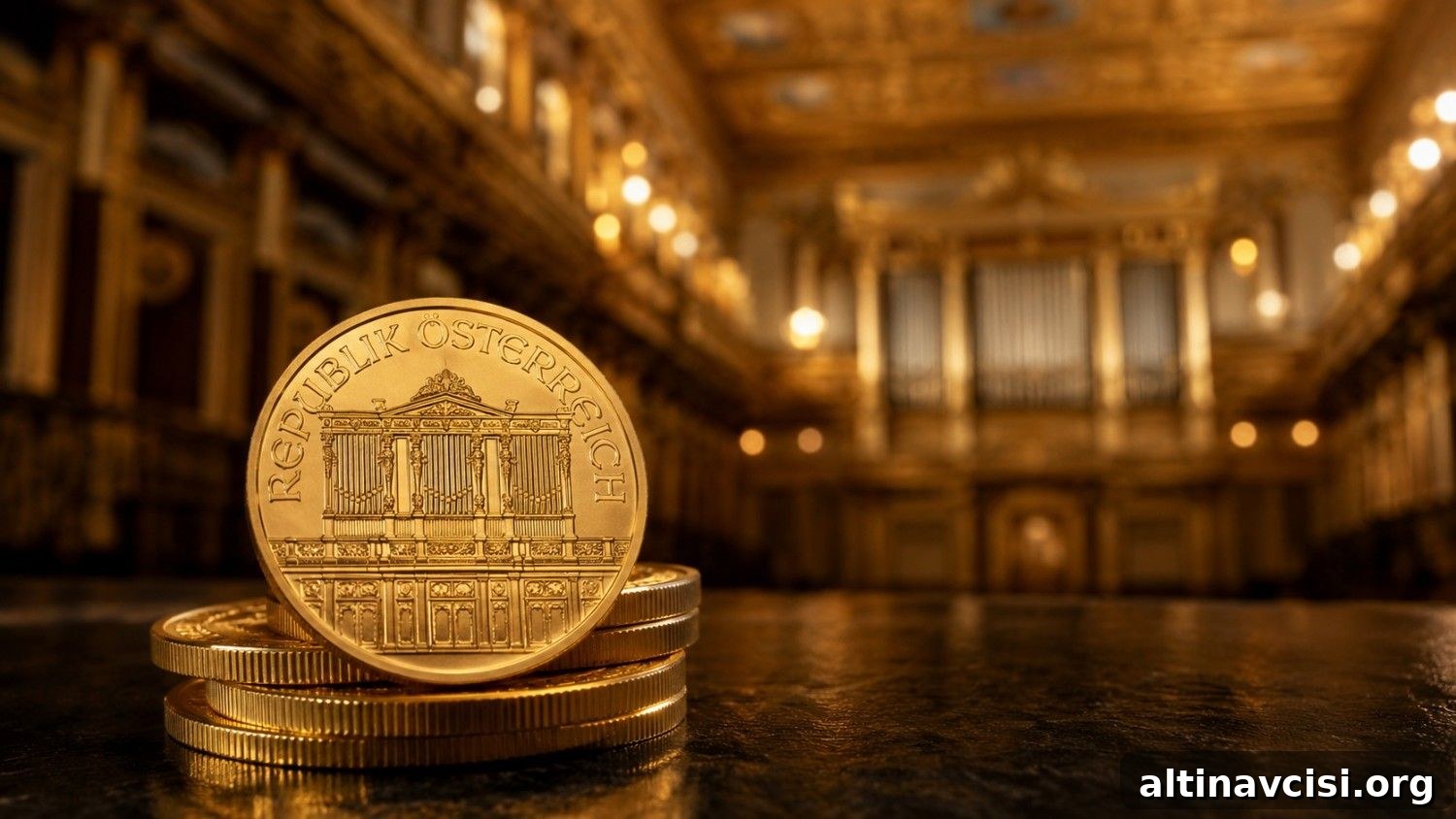
The coin’s design, created by Thomas Pesendorfer, has remained unchanged since 1989, reinforcing the Philharmonic’s image as a stable bullion product. The obverse depicts the Great Pipe Organ of the Musikverein’s Golden Hall, accompanied by the year of issue, face value, and the inscription REPUBLIK ÖSTERREICH.
The reverse features an arrangement of orchestral instruments: a central cello, flanked by violins, and including a Vienna horn, harp, and bassoon in the background. The inscription WIENER PHILHARMONIKER appears across the top. These motifs emphasize Austria’s musical heritage and make the coin instantly recognizable.
What Sizes Are Available?
The Philharmonic is available in five sizes, all struck at .9999 fine gold with the same design:
- 1 oz (31.1 g) — €100 face value, 37 mm diameter
- 1/2 oz (15.55 g) — €50 face value, 28 mm diameter
- 1/4 oz (7.78 g) — €25 face value, 22 mm diameter
- 1/10 oz (3.12 g) — €10 face value, 16 mm diameter
- 1/25 oz (1.24 g) — €4 face value, 13 mm diameter
The 1 oz coin makes up the bulk of trading volume and generally carries the lowest premium over spot. Fractional sizes have higher per-ounce premiums but offer flexibility for incremental purchases and smaller transactions.
Is the Austrian Gold Philharmonic IRA-Eligible?
Yes. Standard bullion-issue Austrian Gold Philharmonics meet U.S. IRS fineness requirements for self-directed precious metals IRAs. The IRS requires a minimum fineness of .995 for gold held in an IRA; the Philharmonic’s .9999 purity exceeds that threshold. Coins held in an IRA must be stored with an approved trustee and depository; collectors’ or proof issues priced for rarity rather than metal content typically do not qualify.
How Does the Philharmonic Compare to the American Gold Eagle?
Both are sovereign gold coins, but they differ in purity and market characteristics. The Philharmonic is .9999 fine gold (24 karat) with no alloy additions. The American Gold Eagle has .9167 fineness and includes copper and silver for added durability. Both 1 oz versions contain one troy ounce of pure gold, but the Eagle’s gross weight is higher due to the alloy metals. Depending on market and region, the Philharmonic often trades at tighter premiums over spot for buyers focused purely on gold content. The Eagle benefits from strong domestic recognition and distribution in the United States.
What Does Buying the Austrian Gold Philharmonic Actually Mean?
Purchasing a Philharmonic gives you a defined quantity of high-purity gold in a globally recognized, fungible form. Dealers and exchanges around the world accept and price the coin quickly, and its sovereign legal tender status reduces uncertainty about authenticity. Gold held in coin form serves as a hedge against currency debasement and monetary policy shifts; an ounce of gold represents a constant measure of metal regardless of fiat changes.
The Austrian Mint’s long history of converting metal into trusted money underscores the Philharmonic’s role as a modern, liquid, and IRA-eligible means of holding physical gold.
The Knowledge That Changes Everything

Two essential guides — free. Understand why gold matters and why fiat currencies can lose value over time.
Stay On Top of Gold & Silver Prices
Get important market alerts sent straight to your inbox.
People Also Ask
How much is a 1 oz Austrian Gold Philharmonic worth today?
The value of a 1 oz Austrian Gold Philharmonic follows the gold spot price. Dealers add a premium over spot that typically ranges depending on quantity and market conditions. The coin’s €100 face value is nominal; trading value is set by the metal content, which is worth many times the face amount.
Where is the Austrian Gold Philharmonic minted?
The coin is struck at the Austrian Mint (Münze Österreich) in Vienna. The mint operates as a subsidiary of Austria’s central bank and has a long institutional history, which supports buyer confidence in minting standards and guarantees.
Is the Austrian Gold Philharmonic a good investment?
As a widely held, liquid sovereign gold coin with .9999 purity, the Philharmonic functions effectively as a means to hold physical gold. It does not generate income; its primary role is to preserve purchasing power and provide a durable, market-recognized form of physical gold. For investors seeking maximum gold content per unit spent, it is often an efficient choice.
What is the difference between the Austrian Gold Philharmonic and the American Gold Eagle?
Both are government-backed gold coins containing one troy ounce of pure gold in their 1 oz formats. The main differences are purity (.9999 vs. .9167), denomination (euros vs. U.S. dollars), and typical premium structure. Eagles include alloy metals for durability; Philharmonics are pure 24-karat gold. Market preference and regional recognition influence which coin carries a tighter premium at any given time.
Sources
Münze Österreich (Austrian Mint), World Gold Council, USAGOLD, CoinWeek, BullionStar, and U.S. Internal Revenue Code §408(m) provide the primary references underpinning the factual content in this article. Specific sales figures and historical rankings cited above reflect those industry and institutional sources.
Disclaimer: This article is for informational purposes only and does not constitute investment advice. Past performance is not indicative of future results. Consult a qualified financial advisor before making investment decisions.
You May Also Like:
- Two Inflation Numbers Come Out Every Month. The Fed Only Cares About One.
- Why Your Commodity ETF Gives You Almost No Gold — and What That Costs You
- American Gold Buffalo Coin: The Complete Guide to the U.S. Mint’s Purest Gold
- The Fed Printed $7 Trillion. Velocity Kept It Quiet. That’s Changing.
- Most 401(k)-to-Gold-IRA Rollovers Lose 20% Immediately. Here Is Why — and How to Avoid It.
- Gold Just Climbed to a 7-Week High. One Number Changed Everything.
- The Jobs Report Did What Iran Couldn’t: Move Gold and the Fed in the Same Direction