Gold Price Jumps 6% This Week — One Number Tomorrow Decides

Gold rose about 6% this week, closing Wednesday at $4,247 and briefly touching $4,300 for the first time in seven weeks. That move was driven by a single surprise jobs release on Wednesday morning, progress on a potential shipping corridor through the Strait of Hormuz, and a Federal Reserve facing a real policy dilemma. To understand what tomorrow’s U.S. nonfarm payroll (NFP) report could do to gold and silver, it helps to follow the chain of cause and effect that pushed prices higher this week.
What broke the market open this week?
On Wednesday morning ADP reported that private-sector employers added only 44,000 jobs in July, far below consensus near 70,000 and well under the revised June reading of 95,000. That unexpected shortfall altered market odds for a September Fed rate increase.
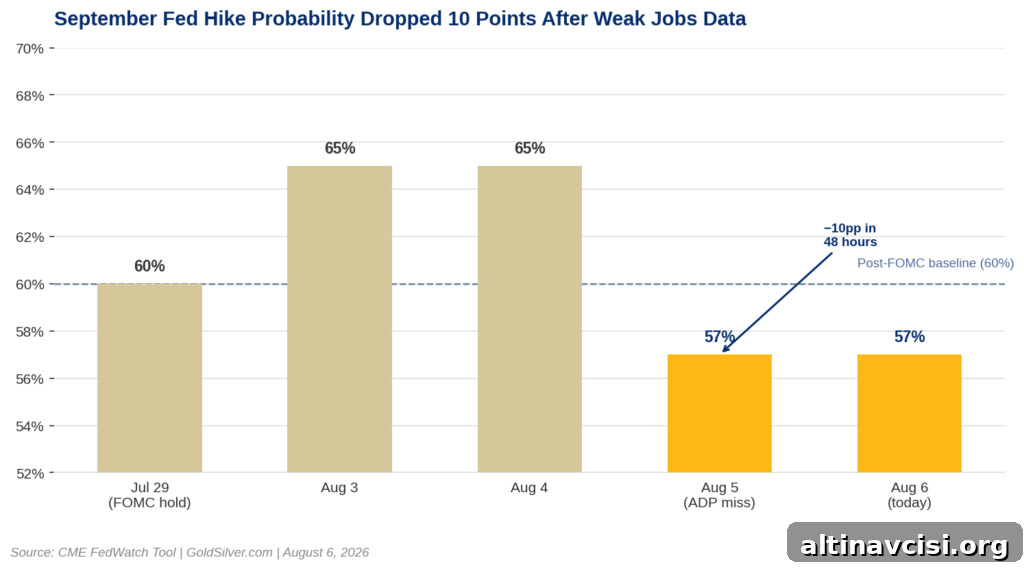
Before the ADP release markets placed roughly a 67% chance on a September Fed rate hike; by Thursday morning that probability had fallen to about 57%, according to CME Group FedWatch calculations cited by major news outlets. That roughly 10-percentage-point swing occurred in less than 48 hours and set the stage for the gold rally.
The transmission mechanism is straightforward. Lower odds of additional Fed tightening typically push Treasury yields down. Lower yields reduce the opportunity cost of holding non‑yielding assets like gold. If the dollar weakens alongside yields, the bullion rally intensifies. This week both yields and the dollar fell: the US Dollar Index traded near 99.65, a six‑week low, which helped gold climb about 6% over four sessions.
The Edge Every Investor Needs
Smarter precious metals investing starts here. The Nuggets Newsletter delivers market insights, Fed updates, global trends, and educational content to help you stay informed.
Does a weak ADP report guarantee a weak NFP?
No — ADP and the Bureau of Labor Statistics use different methods and cover different samples. ADP’s private payroll series can point to a direction but does not reliably predict the exact BLS NFP print.
For example, ADP’s revised June estimate showed +95,000 private jobs while the BLS reported +57,000 total nonfarm jobs for the same month — a gap of 38,000. ADP’s July miss therefore signals a slowdown in private hiring but does not ensure tomorrow’s official number will match that shortfall.
Current consensus for July NFP centers near 80,000 new jobs, up from June’s +57,000. Major forecasts range widely — from about 20,000 to 120,000 — leaving room for big market reactions depending on the actual print.
ADP’s report did more than miss on headline hiring: its Pay Insights showed that job‑changers saw year‑over‑year pay growth of 7.0% in July — the fastest pace since August 2025 — while pay for job‑stayers was around 4.4%. That divergence matters: hiring cooled, yet wage pressure among the most mobile workers accelerated. The Fed watches both hiring and wage dynamics closely.
How will tomorrow’s NFP move gold and silver?
The market reaction generally follows three steps.
First, the NFP print updates expectations for a September rate move. A soft reading near or below 80,000 would further reduce the probability of a hike and likely support gold. A strong report above 120,000 would reverse much of the week’s rate repricing and could push gold lower.
Second, Treasury yields react almost immediately after the 8:30 a.m. ET release, and gold tends to follow yields in real time during major data events.
Third, silver usually amplifies gold’s moves. This week silver rallied roughly 6.7% versus gold’s 6.0%, illustrating that pattern. Silver benefits from both monetary drivers (yield and dollar dynamics) and an industrial component; if NFP prints soft, silver would likely outperform gold again.
What is the second force behind this week’s move?
A second important influence is the evolving situation in the Strait of Hormuz. Iran and Oman reportedly agreed on coordinates for a potential shipping corridor, and oil prices fell to about $74 per barrel, a three‑week low. Lower energy costs ease one component of inflation and weaken the case for more Fed tightening.
But the agreement remains a framework rather than a fully negotiated deal: details about the corridor’s scope, inspection rules, and naval roles are unresolved. Past signals around Hormuz have reversed, so markets are pricing partial progress rather than a settled outcome.
What does this mean for gold and silver holders?
The structural drivers of precious‑metals demand remain intact. Central banks continued to buy aggressively: according to the World Gold Council’s Q2 2026 Gold Demand Trends report, sovereign purchases reached 289 tonnes in the second quarter — a quarterly record and a 62% increase year‑over‑year. That accumulation occurred while gold traded near $4,000, about 28% below the January record of $5,589.38, showing that official buyers remain in the market despite short‑term data surprises.
Tomorrow’s NFP is a tactical event that will move prices in the near term. A single payroll release cannot change long‑term fiscal trends, structural dollar pressures, or the diversification rationale that motivates central bank buying. Those larger forces do not reset at 8:30 a.m.
This week’s roughly 6% gain reflects a market that repriced one key variable: the probability of a September rate hike. The NFP will determine whether that repricing holds or reverses.
Stay on Top of Gold & Silver Prices
Get timely market alerts delivered to your inbox.
SOURCES
1. ADP Research — ADP National Employment Report: Private Sector Employment Increased by 44,000 Jobs in July; Annual Pay was Up 4.4%, August 5, 2026
2. CME Group — FedWatch Tool — September 2026 Federal Reserve Rate Hike Probability, accessed August 6, 2026
3. Bureau of Labor Statistics — The Employment Situation — June 2026, July 2, 2026
4. World Gold Council — Gold Demand Trends Q2 2026, July 30, 2026
5. Reuters coverage of Hormuz deal reporting August 5–6, 2026
6. Investing.com coverage of gold market moves, August 6, 2026
7. GoldSilver — Live Gold and Silver Spot Prices, August 6, 2026
Disclaimer: This article is for informational purposes only and is not investment advice. Past performance is not indicative of future results. Consult a qualified financial advisor before making investment decisions.
You may also like:
- Why Is Silver Outperforming Gold? A 6-Year Deficit
- Hormuz. ISM. Hecla. Barrick. Five Things That Moved Gold and Silver Today
- Jobs Missed. Gold Hit $4,200. Silver Hit $62
- South Korea’s Central Bank Breaks a 13-Year Gold Buying Drought
- Gold and Silver Hold While Hormuz Talks Continue, a Vessel Is Hit, and JOLTS Falls
- Why Gold Is Holding Near $4,067 Ahead of a Jobs Week That Could Trigger a Rate Hike
- Manufacturing Hits a Four-Year High — Why Gold Didn’t Move
Popular Topics
Picked from the archive
-
01
 Topics
Bond King Jeffrey Gundlach’s Gold Signal for Investors
-
02
Topics
Federal Reserve Goes Silent: Why Gold Investors Don’t Need It
-
03
Topics
Do Gold ETFs Mean You Own Physical Gold?
-
04
Topics
Gold, Silver and Stagflation: 5 Market Signals to Watch
-
05
Topics
Silver Price Outlook May 2026: Focus on Trends, Not Numbers
-
06
Topics
How the Federal Reserve Shrunk the Dollar’s Value 97% Since 1913
-
07
Topics
BEA Removed Silver From GDP: What It Means
-
08
Topics
South Korea’s Central Bank Resumes Gold Purchases After 13 Years