Trump’s Polysilicon Tariff Slams Silver’s Top Industrial Buyer

Most coverage of the Trump administration’s proposed polysilicon tariff has focused narrowly on solar panels and semiconductor chips. That view misses an important link further down the supply chain: silver. Polysilicon begins a production chain that ends with silver paste — the conductive material applied to virtually every photovoltaic cell. Changes at the start of that chain can ripple through to silver demand, so investors in the metal should pay close attention.
As of August 6, 2026, silver was trading near $61.39 per ounce, slightly lower on the day. The metal has underperformed gold’s recent rally, and the new tariff developments are part of the explanation.
What Is the Polysilicon Tariff and Why Does It Matter for Silver?
The administration is preparing to impose a 15% tariff, together with minimum import price floors, on polysilicon and its downstream products — wafers, solar cells, and finished modules. The measure follows a year-long Commerce Department investigation under Section 232 of the Trade Expansion Act and is intended to address national security concerns in critical supply chains. Reports indicate an announcement could come very soon.
Polysilicon is the ultra-pure silicon used at the start of two vital supply chains: solar photovoltaics and semiconductor chips. The solar industry consumes the vast majority of global polysilicon production, while the semiconductor sector uses a smaller but strategically important share. Because polysilicon is a foundational input to solar panels, any policy that raises the cost or restricts the supply of polysilicon can affect solar manufacturing — and therefore the silver that goes into each panel.
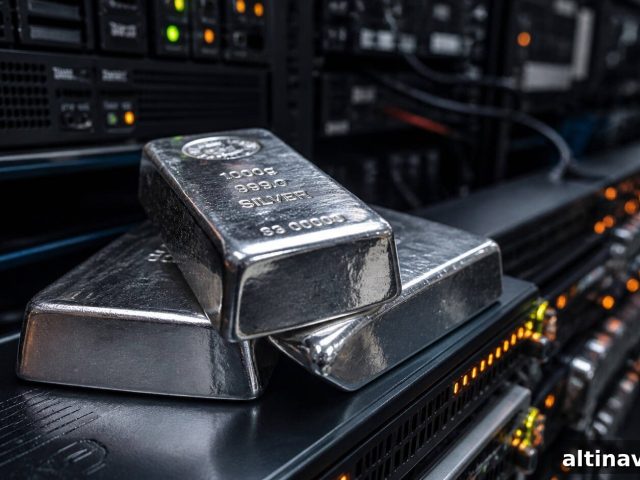
Solar panels require silver paste on the front and back contacts of each photovoltaic cell to collect and conduct electricity. Without silver on those contacts, the generated current cannot be efficiently transmitted. For that reason, the solar industry is the single largest industrial consumer of silver globally.
How Much of Silver’s Demand Does Solar Actually Drive?
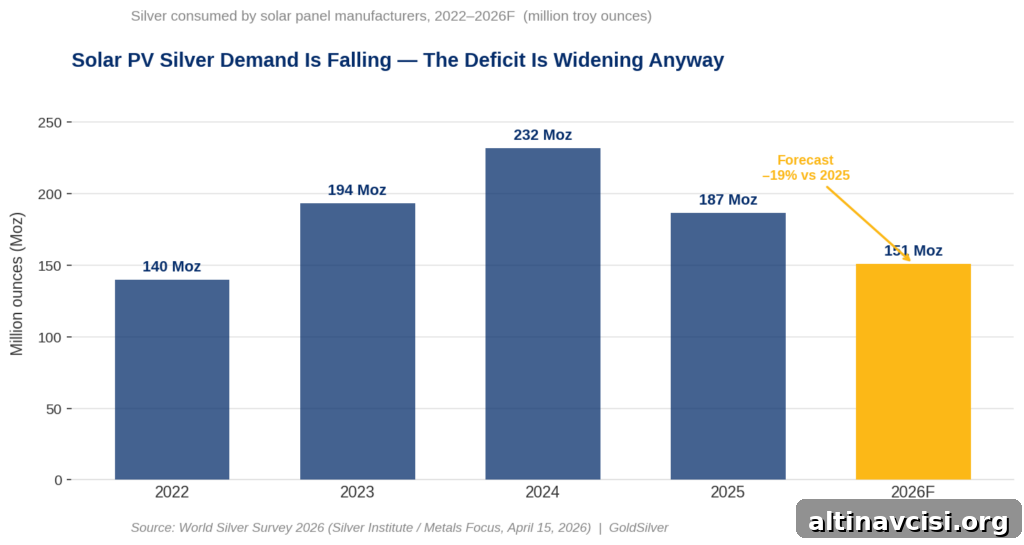
In 2025 the solar sector consumed about 186.6 million ounces of silver, down from a record near 232 million ounces in 2024, according to the World Silver Survey 2026. Solar has represented about 29% of all industrial silver demand in recent years, making it larger than electronics, automotive, and brazing combined.
The forecast for 2026 is more nuanced. Analysts expect solar photovoltaic silver demand to fall to roughly 151 million ounces — a decline of about 19% — because manufacturers have been reducing the amount of silver paste used per cell, a practice known as “thrifting.” With silver trading above $80 per ounce earlier in 2026, many producers accelerated thrifting to cut material costs. Thrifting reduces the silver content per panel but is different from full substitution: panels still require silver for their conductive contacts.
The key takeaway is that solar demand for silver was already contracting before the polysilicon tariff appeared. The tariff adds a new layer of uncertainty on top of an existing trend of declining silver use per panel.
What Does the Tariff Actually Do to Silver Demand?
The tariff affects silver demand in two opposing ways.
In the near term, higher import costs will raise expenses for U.S. solar developers. China supplies roughly 93% of global polysilicon capacity and a majority of manufacturing for wafers, cells, and modules. Many Chinese-made solar components already face steep tariffs, and additional Section 232 measures and price floors would further increase downstream costs. The likely result is slower U.S. solar installations and therefore less short-term silver consumption tied to new panels.
Over the longer term, the administration’s stated aim is to encourage reshoring: rebuild domestic polysilicon production at firms already operating in the U.S. and attract cell and panel manufacturing back onshore. If that shift happens, more panels will be built in the United States using normal commercial supply channels, creating a steadier, domestic source of silver demand. In sum, near-term effects point to weaker demand, while a successful reshoring effort would support more durable domestic demand for silver over several years.
Is There a China Retaliation Risk for Silver?
China has already responded to other recent U.S. trade actions with targeted measures, such as new export controls and restrictions on certain U.S. entities. Although those steps were prompted by earlier policies rather than the polysilicon tariff specifically, the pattern of escalation matters. If the tariff leads Beijing to adopt additional countermeasures that affect manufacturing inputs, the silver market could face further demand volatility. China is not only the dominant solar manufacturer but also a major consumer of silver in electronics and electric vehicle components, so any broadening of trade restrictions could influence demand beyond solar alone.
What Does This Mean for the Structural Case for Silver?
The tariff does not change the fundamental supply picture for silver. The World Silver Survey 2026 reports a sixth consecutive annual supply deficit of about 46.3 million ounces, and since 2021 the market has drawn down roughly 762 million ounces from above-ground stocks. Those figures reflect a persistent structural imbalance in which demand has generally exceeded supply.
Industrial demand accounts for roughly 58% of total silver consumption, meaning policy shifts that affect manufacturing — tariffs, trade measures, and reshoring incentives — have meaningful impacts on silver’s supply-demand balance in ways that gold’s market typically does not experience.
There is also a policy tension in the United States: it seeks to both reduce Chinese solar imports and rebuild domestic manufacturing capacity. Those aims require polysilicon to be costlier for importers while simultaneously becoming economically viable for domestic producers. Resolving that contradiction will require clear industrial policy on materials and manufacturing inputs; no specific U.S. policy for silver supply currently exists. For investors holding physical silver as part of a diversified or sound-money allocation, neither short-term outcome necessarily undermines the structural case, but successful reshoring would be notably more bullish for U.S.-based silver demand over a five-year horizon.
What Should Silver Investors Watch Next?
Three developments will help clarify the outlook:
- Official tariff details: The precise scope of the tariff, any product exemptions, and how price floors are defined will determine whether impacts are concentrated on specific imports or spread across the supply chain.
- Industry reaction: Watch U.S. solar developers for announcements of project delays, cancellations, or cost pass-throughs. Large pipeline disruptions would signal immediate demand weakness for silver.
- China’s response: Any additional countermeasures that target materials or manufacturing inputs used in U.S. supply chains could add a supply component to the current demand story for silver.
Stay Informed on Gold & Silver
Receive timely market updates and alerts directly to your inbox.
Sign up with a trusted market newsletter to get price moves, policy updates, and industry insights. (Form removed from this version.)
SOURCES
1. Reuters — US reporting on potential polysilicon tariffs and price floors, August 2026.
2. Silver Institute / Metals Focus — World Silver Survey 2026, April 2026.
3. Multiple news reports on China’s trade countermeasures, August 2026.
4. U.S. government announcements on earlier tariff actions affecting polysilicon and wafers.
Disclaimer: This article is provided for informational purposes only and does not constitute investment advice. Past performance is not indicative of future results. Consult a qualified financial advisor before making investment decisions.
You May Also Like:
- Gold’s recent rally and the indicators that will decide whether it holds.
- The multi-year supply deficit driving silver’s performance.
- Key events moving gold and silver prices today.
- How jobs data and monetary policy are influencing precious metals.
- Central bank purchases and their effects on gold markets.
Popular Topics
Picked from the archive
-
01
 Topics
Bond King Jeffrey Gundlach’s Gold Signal for Investors
-
02
Topics
Federal Reserve Goes Silent: Why Gold Investors Don’t Need It
-
03
Topics
Do Gold ETFs Mean You Own Physical Gold?
-
04
Topics
Gold, Silver and Stagflation: 5 Market Signals to Watch
-
05
Topics
Silver Price Outlook May 2026: Focus on Trends, Not Numbers
-
06
Topics
How the Federal Reserve Shrunk the Dollar’s Value 97% Since 1913
-
07
Topics
BEA Removed Silver From GDP: What It Means
-
08
Topics
South Korea’s Central Bank Resumes Gold Purchases After 13 Years