Why Social Security’s 3.6% Raise Was Deliberately Delayed

Last verified October 2026.
The relationship between the Social Security Cost-of-Living Adjustment (COLA) and inflation is largely one of timing. The 3.6% COLA for 2027 was calculated from prices measured in July, August and September 2026, and the Social Security Administration (SSA) announced it on October 14, 2026. Those higher benefit amounts apply to payments for December and arrive in recipients’ accounts starting in January. For savers and households, that means income is updated once a year while prices change each month; the COLA reflects a specific past period rather than current or future inflation.
As of Friday, October 16, 2026, gold closed at $4,165.61, a 3.8% decline from a year earlier (GoldSilver price charts).
Key Takeaways:
- SSA established the 2027 COLA at 3.6% on October 14, 2026, based on the Consumer Price Index for Urban Wage Earners and Clerical Workers (CPI-W) measured in July–September 2026.
- The Bureau of Labor Statistics reported CPI-W rose 3.9% over the twelve months to September 2026. Because the COLA formula averages the three months of the third quarter, the official increase can be lower than a single-month reading.
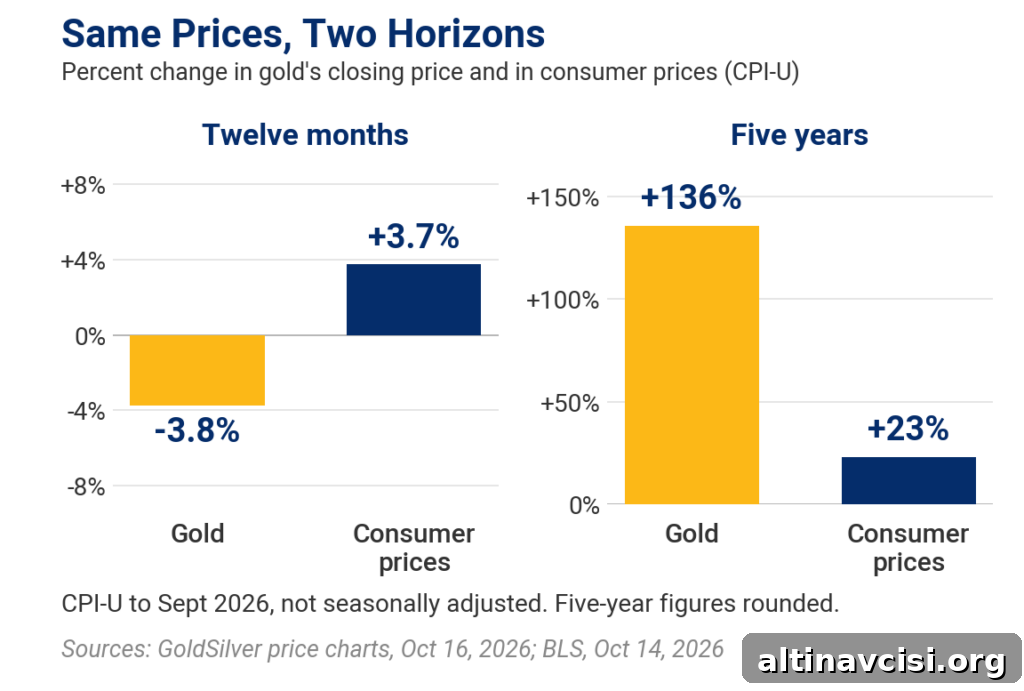
- Gold’s twelve‑month price change to October 16, 2026 was down 3.8%, while over five years it rose roughly 136%. Over the five-year span to September 2026, the CPI-U rose about 23% (BLS, October 14, 2026).
How the Social Security COLA Is Calculated and When It Is Paid
By law, SSA uses the Consumer Price Index for Urban Wage Earners and Clerical Workers (CPI-W) to determine the COLA. The calculation compares the average CPI-W for the third quarter of the current year with the same quarter a year earlier. Once SSA determines the COLA, the increase is applied to benefits payable for December and those higher payments are distributed beginning in January. The 2027 COLA affects roughly 76 million people receiving Social Security and Supplemental Security Income benefits. The average retired worker’s monthly benefit will increase by $75, from $2,095 to $2,170, according to SSA’s 2027 fact sheet.
Social Security COLA vs. Inflation: Why the Increase Often Feels Late
A common reaction is that a 3.6% increase is modest or that a $75 rise is insufficient. Those observations describe the outcome but not its timing. The BLS reported on October 14, 2026 that CPI-W rose 3.9% over the twelve months to September 2026 — a figure still above the official 3.6% COLA. Because the COLA averages three months, a late-month acceleration in prices can leave the calculated raise lower than recent single-month readings. In other words, the formula worked as designed, but it measures a past quarter rather than the most recent price changes.
Looking back, COLAs have varied. January 2021’s increase was 1.3%, then inflation surged and the January 2023 COLA reached 8.7%. Subsequent COLAs were 3.2%, 2.5% and 2.8% (SSA history). Each of those increases arrived after the prices that produced them, so recipients always receive an adjustment that lags the market.
Household experiences also vary because the headline inflation rate masks wide differences across categories. For example, gasoline rose 34.2% over twelve months while food increased about 2.5% (BLS, October 14, 2026). That divergence explains why some households feel much more financial strain than the aggregate CPI suggests.
Does Gold Keep Up with Inflation?
Gold does not track inflation perfectly on every time horizon. Over the twelve months to October 16, 2026, gold’s closing price fell 3.8% while the consumer price index (CPI-U) rose 3.7% over the twelve months to September 2026. However, over a five-year span the relationship flips: gold rose roughly 136% from October 15, 2021 to October 16, 2026, while the CPI-U rose about 23% from September 2021 to September 2026. That five-year perspective shows gold preserving and even increasing purchasing power relative to the aggregate basket of goods over that period.
Start and end dates matter. Measuring from different daily closing prices can change short-term comparisons. For long-term assessment, analysts often look at what a single ounce of gold buys over many years rather than annual comparisons, because gold’s role as a store of value is best judged across extended periods.
A fair observation is that gold underperformed in the specific year the COLA covers. Both the COLA and gold’s price are backward-looking snapshots taken through different windows; neither predicts future inflation or future precious metals prices.
What to Track After the COLA Is Announced
After SSA posts the COLA notice, there is not much to actively monitor beyond the dates and your personal account. People with a my Social Security account can view the official notice online beginning in late November 2026, and higher benefit payments arrive in January 2027. Those milestones are important for household budgeting, but there are no further COLA updates until the next annual calculation.
Consider which parts of your finances are adjusted by automatic formulas like the COLA and which are not. Income sources tied to formulas update on set schedules; other assets and expenses will continue to respond to market conditions and personal decisions. It’s useful to set a plan, revisit it periodically, and adjust as circumstances change.
Stay On Top of Gold & Silver Prices
Get important market alerts sent straight to your inbox.

SOURCES
1. Social Security Administration – 2027 Cost-of-Living Adjustment (COLA) Fact Sheet – October 14, 2026
2. Social Security Administration – Cost-of-Living Adjustment (COLA) Information for 2027 – October 14, 2026
3. U.S. Bureau of Labor Statistics – Consumer Price Index, September 2026 News Release – October 14, 2026
4. U.S. Bureau of Labor Statistics – Consumer Price Index, September 2021 News Release – October 13, 2021
5. Federal Reserve Board – FEDS Notes: Why Gold Didn’t Actually Overtake Treasury Securities as the World’s “Favorite” Reserve Asset – September 3, 2026
6. GoldSilver – Gold Price Chart, Daily Closing Prices (selected dates)
Disclaimer: This article is for informational purposes only and does not constitute investment advice. Past performance is not indicative of future results. Always consult a qualified financial advisor before making investment decisions.
You May Also Like:
- How Gold’s Correction Impacted Portfolios
- Central Bank Gold Buying: Why 39 Tonnes Matters
- Investors Turn to Treasuries as AI Stocks Slide
- London Gold Vault Holdings Rose 3.78% in Q3. What Changed?
- Gold Rebounds Above $4,130: What Changed for Owners?
Popular Topics
Picked from the archive
-
01
 Topics
Store Gold at Home Securely: Safes, Security and Insurance
-
02
Topics
Xi Arrives in Washington as Gold and Silver Tumble
-
03
Topics
Gold Near $4,330 as 70% Rate-Hike Odds Rise, China Intervenes
-
04
Topics
Five Major Institutions Issue Identical Warning on Gold Selloff
-
05
Topics
Silver vs Gold 2026-2031: 5-Year Investment Outlook
-
06
Topics
October Gold and Silver Selloff: Impact for Long-Term Holders
-
07
Topics
Federal Reserve Votes Wednesday: Track the Vote Tally
-
08
Topics
COMEX Silver First Notice Day: Key Events to Watch April 30