Why Investors Choose the Vienna Philharmonic Gold Coin
Key Takeaways
- The Austrian Gold Philharmonic has been minted annually since 1989 by the Münze Österreich, one of the world’s oldest continuously operating government mints.
- Struck in .9999 fine (24‑karat) gold, it ranks among the highest-purity sovereign bullion coins.
- The World Gold Council reported it among the world’s best-selling gold coins in multiple years in the 1990s and 2000s.
- It is the only major bullion coin denominated in euros and carries legal tender status backed by the Republic of Austria.
- Available in five sizes from 1/25 oz through 1 oz, and all standard bullion issues are eligible for inclusion in a U.S. self-directed precious metals IRA.
- Through 2012, over 14 million Philharmonic coins—approximately 329 tonnes of gold—had been distributed globally, illustrating its widespread adoption.
The Austrian Gold Philharmonic (Gem: Wiener Philharmoniker) has built a long-standing reputation as one of Europe’s leading gold bullion coins. First released in October 1989 by the Münze Österreich, the Philharmonic became popular quickly because it combined very high purity with recognizable sovereign backing. Its design has remained consistent since launch, its purity has stayed at .9999 fine gold, and its role as a trusted, liquid form of physical gold for investors has only strengthened as monetary systems and fiat currencies have evolved.
This article provides a concise guide for anyone considering the Philharmonic: it explains the coin’s history, who mints it, its specifications and design, how it compares to other bullion coins, why investors choose it, and practical considerations such as premiums, liquidity, and IRA eligibility.
What Is the Austrian Gold Philharmonic?
The Austrian Gold Philharmonic is a sovereign bullion coin produced by the Austrian Mint (Münze Österreich) in Vienna. Authorized by Austria’s National Council and first issued on October 10, 1989, the coin was designed for investors seeking a pure, government-backed form of physical gold. Unlike collector issues, standard Philharmonics are priced primarily on their gold content rather than rarity or numismatic value.
Every bullion Philharmonic is struck at .9999 gold purity, placing it in the top purity tier alongside a small group of major modern bullion programs. The 1 oz Philharmonic carries a €100 face value and is legal tender in Austria. That euro denomination makes the Philharmonic unique among large international bullion series and gives it particular recognition across European markets.
The Knowledge That Changes Everything

Two essential guides — free downloads to help you understand why gold matters and how fiat currencies behave over time.
Why Did Europe Choose the Philharmonic?
When the Philharmonic appeared in 1989, European buyers preferred coins with the highest possible gold content and little or no alloy. At that time, many popular sovereign coins were struck at lower purities—for example, the South African Krugerrand and the U.S. Gold Eagle are both less than 24 karat. The Philharmonic’s .9999 fineness offered a clear purity advantage, and the market response was immediate: by 1990 it was the best-selling bullion coin in Europe, and it later ranked among the world’s top sellers in several years.
Sales through 2012 indicate broad acceptance: more than 14 million coins—roughly 329 tonnes of gold—were distributed worldwide. Those figures reflect sustained investor preference for a coin that delivers maximum gold content per piece and comes from a mint with deep institutional roots.
Who Makes the Austrian Gold Philharmonic?
The Philharmonic is produced by the Münze Österreich (Austrian Mint) in Vienna. The mint traces its origins back to medieval times and has operated through long spans of European history. Today it functions as a fully owned subsidiary of Austria’s central bank, the Oesterreichische Nationalbank. That institutional backing gives buyers confidence: the Philharmonic is a product of a sovereign mint, with government assurance of weight and purity rather than a private refiner’s guarantee.
While the Austrian Mint does not publish exact annual mintage figures for the gold Philharmonic in the same way some other mints publish theirs, industry observers estimate that annual 1 oz production typically ranges from several hundred thousand coins in normal years to higher volumes during spikes in demand.
What Does the Philharmonic Look Like?
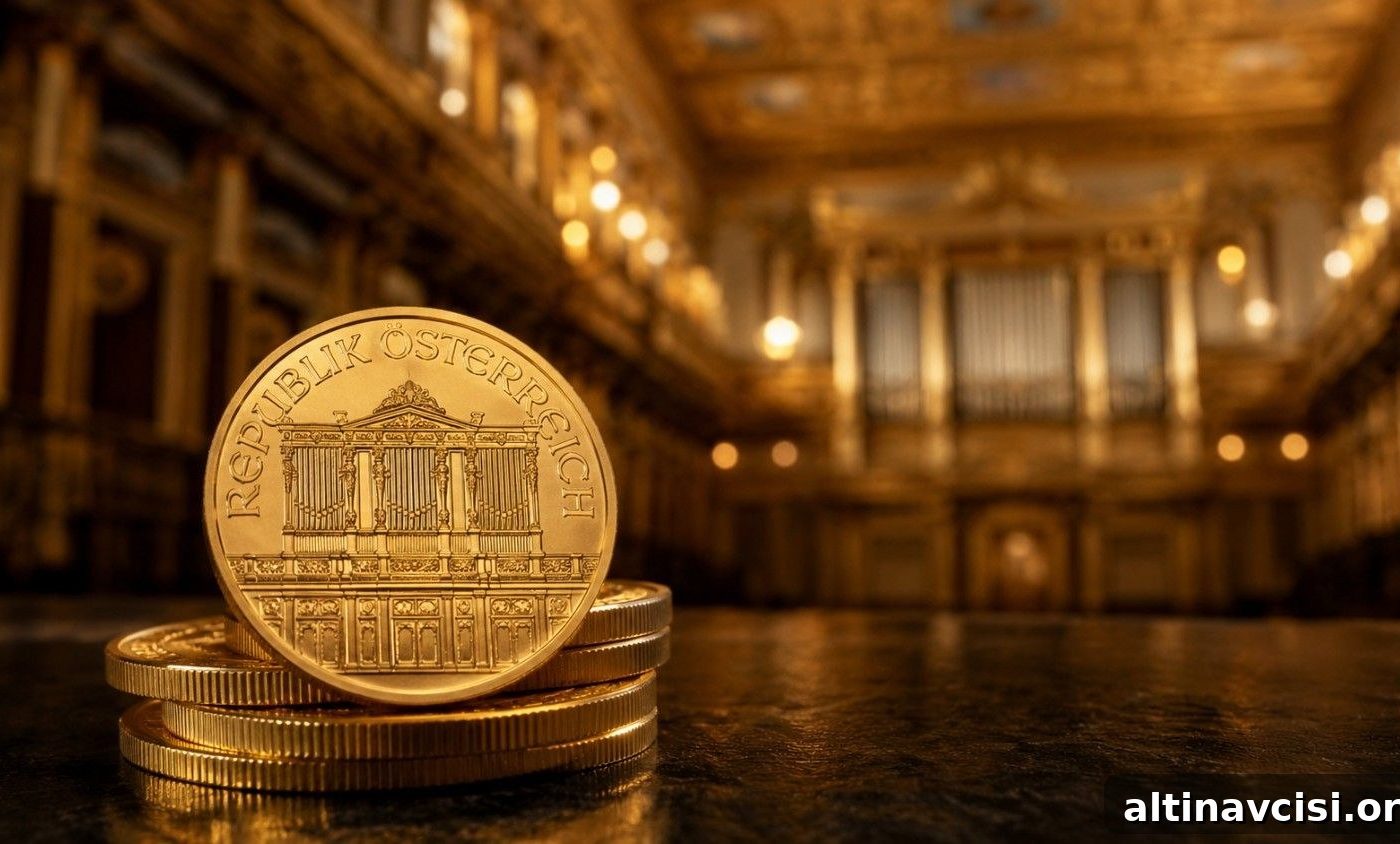
Thomas Pesendorfer, the Austrian Mint’s chief engraver at the time of issue, designed both faces of the coin. The obverse displays the Great Pipe Organ of Vienna’s Musikverein Golden Hall, shown in architectural detail with the year of issue, face value, and the inscription REPUBLIK ÖSTERREICH.
The reverse presents an arrangement of orchestral instruments: a central cello with violins, a Vienna horn, a harp, and a bassoon in the background. The top of the reverse reads WIENER PHILHARMONIKER. The classical music theme reinforces the coin’s national identity and aids broader recognition among collectors and investors.
What Sizes Are Available?
The Philharmonic is available in five standard bullion sizes. All are struck in .9999 fine gold and share the same design:
- 1 oz (31.1 g) — €100 face value, 37 mm diameter
- 1/2 oz (15.55 g) — €50 face value, 28 mm diameter
- 1/4 oz (7.78 g) — €25 face value, 22 mm diameter
- 1/10 oz (3.12 g) — €10 face value, 16 mm diameter
- 1/25 oz (1.24 g) — €4 face value, 13 mm diameter
The 1 oz coin dominates trading volume and generally carries the lowest premiums over spot on a per-ounce basis. Fractional sizes cost more per ounce but provide flexibility for smaller purchases and easier subdivision when selling.
Is the Austrian Gold Philharmonic IRA-Eligible?
Yes. Standard bullion-issue Austrian Gold Philharmonics meet U.S. Internal Revenue Service fineness requirements for precious metals held in self-directed IRAs. The IRS requires a minimum fineness (for gold) of .995 for IRA acceptance; the Philharmonic’s .9999 purity comfortably meets that threshold. Because the coin is sovereign legal tender and produced by a government mint, it fulfills the custodial and eligibility conditions that most IRA custodians require. Collectible, proof, or otherwise non-standard versions priced for rarity rather than metal content may not qualify.
How Does the Philharmonic Compare to the American Gold Eagle?
Both coins are government-backed bullion, but they differ in key ways. The Philharmonic is .9999 fine gold (24 karat) with no alloy; the American Gold Eagle is .9167 fine and contains copper and silver to increase durability. Each of their 1 oz versions contains one troy ounce of pure gold, but the Eagles have a greater gross weight due to alloys. The Philharmonic often trades with tighter premiums in international markets focused on pure gold content, while the Eagle benefits from strong domestic demand and recognition within the United States.
What Does Buying the Austrian Gold Philharmonic Actually Mean?
Purchasing a Philharmonic means acquiring a defined, widely recognized weight of gold in a form that dealers, exchanges, and institutional buyers accept and price readily. Its sovereign legal tender status and consistent design reduce doubts about authenticity and purity compared with privately minted products.
In a monetary environment where fiat currencies expand and purchasing power can be eroded over time, owning physical gold serves as a store of value rather than an income-producing asset. The Philharmonic offers a straightforward, IRA-eligible way to hold that store of value in a globally tradable form, backed by a mint with a long institutional history.
Stay On Top of Gold & Silver Prices
Get important market alerts sent straight to your inbox.
People Also Ask
How much is a 1 oz Austrian Gold Philharmonic worth today?
The market value of a 1 oz Philharmonic is tied to the gold spot price, with dealers adding a premium. At the time referenced in the original article (August 13, 2026), the reported spot price was approximately $4,368 per troy ounce, and typical dealer premiums ranged from about 2% to 5% depending on order size and market conditions. The €100 face value printed on the coin is a nominal legal-tender amount and is far below the coin’s intrinsic metal value.
Where is the Austrian Gold Philharmonic minted?
The Philharmonic is struck at the Austrian Mint (Münze Österreich) in Vienna. The mint, located at Am Heumarkt 1, operates as a subsidiary of Austria’s central bank and maintains the institutional continuity that underpins the coin’s sovereign status.
Is the Austrian Gold Philharmonic a good investment?
As a pure, sovereign bullion coin, the Philharmonic is an efficient way to hold physical gold. It is highly liquid, widely recognized, and typically trades at competitive premiums relative to other coins. It is intended to preserve purchasing power rather than generate income, so suitability depends on an investor’s objectives and portfolio allocation. Prospective buyers should consult a financial advisor when considering gold as part of a broader investment strategy.
What is the difference between the Austrian Gold Philharmonic and the American Gold Eagle?
Both are government-issued gold bullion coins containing one troy ounce of pure gold in their 1 oz formats, but they differ in purity, domestic recognition, and typical premium levels. The Philharmonic is .9999 fine and denominated in euros; the Gold Eagle is .9167 fine and denominated in U.S. dollars, with alloy metals added for durability. Each appeals to different buyer preferences and regional markets.
SOURCES
1. Münze Österreich — Official product specifications and institutional history.
2. World Gold Council — Best-selling gold coin rankings and industry data.
3. Vienna Philharmonic (coin) — Historical distribution and mintage summaries as reported through 2012.
4. USAGOLD — Sales and market commentary about sovereign bullion coins.
5. CoinWeek — Articles and numismatic context about the Vienna Philharmonic bullion coin.
6. BullionStar — Institutional background on the Austrian Mint and central bank ownership.
7. U.S. Internal Revenue Code §408(m)(3) — IRS standards for IRA-eligible precious metals.
8. Gold price charts referenced in the original article for dated spot-price context.
Disclaimer: This article is for informational purposes only and does not constitute investment advice. Past performance is not indicative of future results. Consult a qualified financial advisor before making investment decisions.
You May Also Like:
- Two Inflation Numbers Come Out Every Month. The Fed Only Cares About One.
- Why Your Commodity ETF Gives You Almost No Gold — and What That Costs You
- American Gold Buffalo Coin: The Complete Guide to the U.S. Mint’s Purest Gold
- The Fed Printed $7 Trillion. Velocity Kept It Quiet. That’s Changing.
- Most 401(k)-to-Gold-IRA Rollovers Lose 20% Immediately. Here Is Why — and How to Avoid It.
- Gold Just Climbed to a 7-Week High. One Number Changed Everything.
- The Jobs Report Did What Iran Couldn’t: Move Gold and the Fed in the Same Direction
Popular Topics
Picked from the archive
-
01
 Topics
Gold Prices Stabilize Amid Saudi-Iran Tensions
-
02
Topics
Why Gold Held Steady After Trump’s Economic Pressure on Iran
-
03
Topics
Oil Drops 11% as Gold Rises: What Investors Need to Know
-
04
Topics
3 Questions Investors Must Ask Before Buying Any Asset in 2026
-
05
Topics
Silver Surges Past $70 Amid Conflicting GDP Data
-
06
Topics
What’s Moving Gold and Silver Prices This Week
-
07
Topics
How FOMC Minutes and Jackson Hole Could Move Gold
-
08
Topics
Two Investors Ran Debt Math Separately and Chose 15 Percent Gold