Stablecoin Issuer Outspent Central Banks on Gold Last Year
Every trading desk in the world is waiting for one sentence from Wyoming this week. At the same time, the Federal Reserve’s public agenda points in a different direction.
The Federal Reserve Bank of Kansas City convenes its annual economic policy symposium in Jackson Hole from Thursday, August 27 to Saturday, August 29, 2026. New Fed Chair Kevin Warsh will deliver his first keynote address on Friday morning. Markets are focused on whether the hiking cycle is finished or merely paused. That is a valid question, but it is not the central topic on the official programme.
Key takeaways
- Jackson Hole’s 2026 theme is payments and financial innovation, not the current level of interest rates.
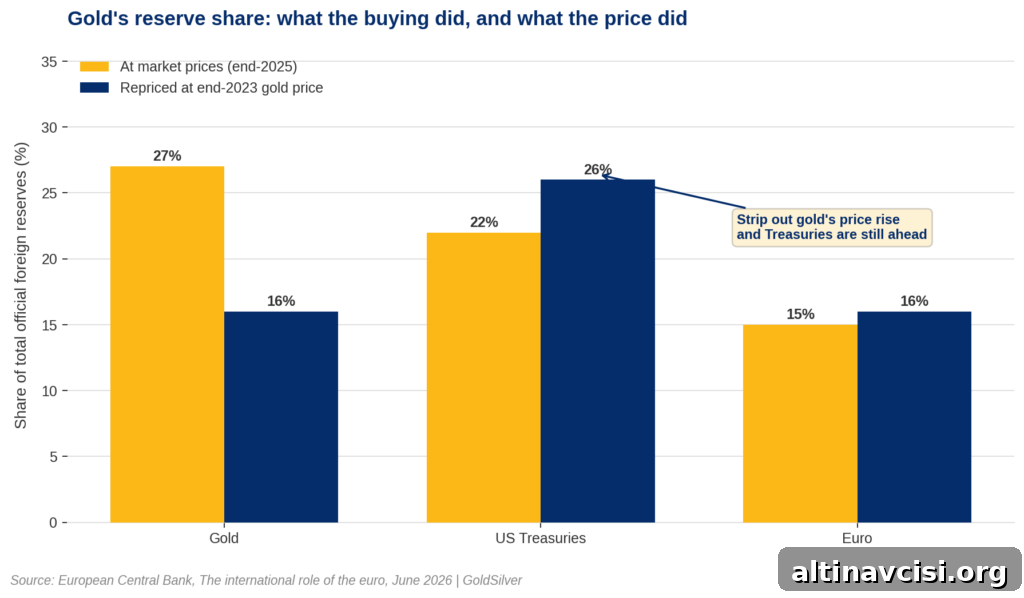
- In its June 2, 2026 report, the European Central Bank recorded gold at 27% of total official foreign reserves at the end of 2025, ahead of US Treasuries at 22%.
- The ECB’s 27% headline figure and its price-adjusted 16% figure answer different questions: the former shows gold’s share today, the latter isolates how much metal was actually acquired.
- According to attestations referenced in the ECB report, the stablecoin issuer Tether bought more than 100 tonnes of gold in 2025—more than any single central bank that year.
What is the Fed actually discussing at Jackson Hole?
This year’s Jackson Hole theme is “Financial Innovation: Implications for Payments and Policy.” That theme is more than window dressing: the Kansas City Fed invites roughly 120 central bankers, policymakers and economists from over 70 countries specifically to discuss it. The selection of attendees and papers is driven by the theme, which signals where the institution believes attention should be focused.
The detailed programme has not been fully posted, so the exact papers and speakers remain unknown. Still, the broad issues are clear: who will be allowed to issue dollars, which payment rails will underpin settlement, and whether privately issued digital money will change how a policy rate is transmitted to households and businesses.

The Edge Every Investor Needs
Smarter precious metals investing starts here. The Nuggets Newsletter brings you essential market insights, Fed updates, global trends, educational videos, and more.
Why are central banks buying gold?
Central banks buy gold because it carries no issuer risk — ownership of physical metal is a claim on the metal itself, not on another institution. The European Central Bank quantified that preference in its June 2, 2026 report on the international role of the euro: at the end of 2025, gold accounted for 27% of total official foreign reserves, overtaking US Treasuries at 22% and the euro at 15%.
That ownership characteristic — that gold cannot be reissued, frozen, or redeemed at a third party’s discretion — is fundamental. Whatever conclusions the Fed reaches about payment rails and digital money, that basic property of physical gold is not within the Fed’s remit to change.
Is gold’s 27% share real, or just the gold price?
A reserve share can rise for two reasons: central banks can add to holdings, or the market price of the asset can increase. Gold’s price jumped roughly 60% in 2025 and about 30% in 2024. Those price gains make existing holdings worth far more even if no additional metal was bought.
The ECB separated these effects by revaluing the same holdings using end-2023 gold prices. That removes the price rally from the calculation and isolates actual buying. On that price-adjusted basis, gold represents 16% of official reserves, roughly level with the euro and behind Treasuries at 26%.
Both numbers are valid but answer different questions: the 16% figure shows how much metal central banks actually added, while the 27% headline tells you how much of the world’s reserve buffer is currently made up of gold. Reserve managers typically report and manage against the latter number.
Does a rising share mean central banks actively chose gold?
There is a third dynamic the arithmetic alone cannot reveal. Institutions that normally maintain target allocations will rebalance when one asset’s price runs up. Allowing gold’s share to drift from 20% to 27% — and choosing not to trim holdings — is itself an active decision. Many reserve managers effectively did choose not to sell; several also bought more.
The ECB reports that official-sector purchases totaled around 850 tonnes in 2025, at record prices. It suggests some buying reflects efforts by central banks to strengthen balance sheet resilience amid rising geopolitical risks. The report is transparent about gold’s limitations: price volatility, no yield, storage costs, and the constrained ability of supply to expand on demand during liquidity crises.
Why did a stablecoin issuer outbuy every central bank?
One striking detail in the ECB report links monetary-policy concerns to payments innovation. Poland was the largest official-sector buyer in 2025 at roughly 100 tonnes; yet Tether, the largest stablecoin issuer, reported buying more than 100 tonnes that year. In other words, a private company issuing a dollar-pegged token acquired more physical gold in 2025 than any single central bank.
That fact deserves cautious interpretation. Tether is a private issuer and has faced regulatory settlements in the past; its disclosures rely on quarterly attestations rather than full audits. The tonnage cited in the ECB report comes from Tether’s own auditor attestations, according to the ECB’s source note, not from an independent consolidated audit.
Read the purchase as evidence of demand for reserve-like assets, not as an endorsement of private issuers. A token backed by a company’s balance sheet remains a claim on that company, not on the underlying metal. Still, the issuer’s choice to hold unencumbered gold is notable: it signals that even private issuers value assets without third-party credit risk.
Do faster dollars mean fewer dollars?
No. Faster settlement and new payment rails extend the reach and usability of the dollar without changing the aggregate number of dollars in circulation. The ECB’s June 2026 report estimated stablecoin market capitalisation above $300 billion at the end of 2025, a roughly 50% increase from the previous year. Most of those tokens are backed by dollar-denominated assets, so innovation expands the dollar’s footprint rather than shrinking the supply.
ECB researchers add that stablecoin adoption can weaken and complicate monetary policy transmission, making policy less predictable and less effective. That is why a conference on payments is, effectively, also a conference about monetary policy.
Scale matters: the ECB notes that only about $400 billion of stablecoin retail payments settle annually, while global cross-border retail transactions total roughly $44 trillion. The new rails are real and growing, but they remain early-stage relative to the global payments landscape.
Can a Fed chair change gold’s case?
Some market participants hope Warsh might signal something negative for gold this week. No one can know the contents of an unpublished speech in advance. What a chair can influence, however, is the opportunity cost of holding non-yielding assets.
Federal Reserve H.15 data showed the ten-year inflation-indexed Treasury at 2.35% on August 20, 2026. Holding gold implies forgoing that positive real yield. Yet large speculators have been willing to pay that carry: CFTC Commitments of Traders data for August 18, 2026 showed a net long position of about 222,000 gold contracts, up roughly 22% in three weeks.
Paying positive real carry to hold an asset that yields nothing is not primarily an inflation wager; it is a judgment about the durability and credibility of the monetary unit itself.
For context, gold traded in the mid-$4,600s as of August 25, 2026, approximately 17% below the record high reached on January 28, 2026. That places current movement as a recovery within a larger drawdown rather than a fresh peak.
SOURCES
1. European Central Bank — The International Role of the Euro, June 2, 2026
2. Federal Reserve Bank of Kansas City — 2026 Economic Policy Symposium: Financial Innovation, Implications for Payments and Policy, August 27 to 29, 2026
3. Federal Reserve Board — H.15 Selected Interest Rates, August 20, 2026
4. Commodity Futures Trading Commission — Commitments of Traders, COMEX Gold, August 18, 2026
5. GoldSilver — Gold and Silver Price Charts, August 25, 2026
Disclaimer: This article is for informational purposes only and does not constitute investment advice. Past performance is not indicative of future results. Always consult a qualified financial advisor before making investment decisions.
You May Also Like:
- Two Investors Ran the Debt Math Separately. Both Landed on 15% Gold.
- Gold Nears $4,700, Silver Holds Above $69. Why Is Everyone Waiting on One Friday Speech?
- Gold Hits 3-Month High as Oil Falls Ahead of Bessent’s Iran Sanctions Announcement
- Gold’s Speculative Crowd Hit a 60-Week High. Almost Nobody Bought.
- Gold Hit a Three-Month High. Silver Hit a Two-Month High. One Story Connects Them.
- The National Debt Hit $40 Trillion. Jefferies Just Turned Bullish on Gold.
- Gold Fell and Silver Rose on the Same Report. Here Is the Mechanism.
Popular Topics
Picked from the archive
-
01
 Topics
Gold Prices Stabilize Amid Saudi-Iran Tensions
-
02
Topics
Why Gold Held Steady After Trump’s Economic Pressure on Iran
-
03
Topics
Oil Drops 11% as Gold Rises: What Investors Need to Know
-
04
Topics
3 Questions Investors Must Ask Before Buying Any Asset in 2026
-
05
Topics
Silver Surges Past $70 Amid Conflicting GDP Data
-
06
Topics
What’s Moving Gold and Silver Prices This Week
-
07
Topics
How FOMC Minutes and Jackson Hole Could Move Gold
-
08
Topics
Two Investors Ran Debt Math Separately and Chose 15 Percent Gold