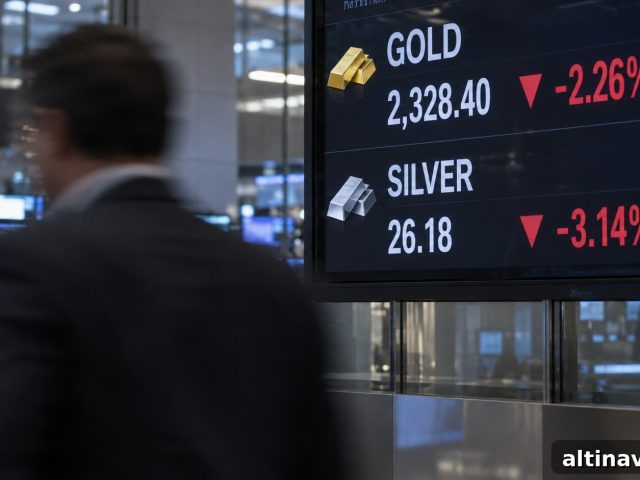
Investors Flock to Treasuries as AI Stocks Slide

AI stocks have come under pressure, prompting investors to rethink where they seek safety. As technology shares cooled, U.S. Treasury bonds rallied, while gold’s reaction has been more mixed. This divergence raises an important question: when confidence in the stock market falters, why do government bonds and physical gold often behave differently?
Key takeaways
- Selling pressure tied to AI-related names has driven flows into Treasury bonds as investors reassess lofty technology valuations.
- Falling yields can support gold by lowering the opportunity cost of holding non-yielding bullion, but gold and bonds do not always move in tandem.
- Physical gold and Treasury securities expose holders to different risks and practical considerations, even when both attract defensive demand.
Why are investors selling AI stocks?
Investors are increasingly questioning whether the large expenditures on artificial intelligence will generate the revenue and profit growth needed to justify extremely high valuations. These doubts extend beyond pure software companies to chipmakers, data-center operators, and startups with heavy financing and long paths to profitability.
When expectations for rapid future growth are trimmed, capital can rotate out of high-beta technology names and into assets perceived as more defensive. That reallocation often benefits government bonds and certain defensive equities, pushing Treasury prices higher and yields lower even when inflation remains a concern.
Why did Treasury bonds rally?
Treasury bond prices and yields move in opposite directions: when demand for existing fixed-rate Treasuries rises, their market prices climb and their yields fall because coupon payments stay the same. During periods of heightened uncertainty about economic growth, investors often accept lower yields in exchange for the relative safety of government-backed, contractual payments.
That said, Treasuries are not free of market risk. Long-duration bonds can lose significant market value if yields rise. The recent bond rally simply illustrates how quickly markets can shift from inflation-focused worries to growth concerns, and how those shifts affect interest-rate sensitive assets.
How is gold responding to the AI selloff?
Gold has drawn attention as Treasury yields softened, but its movement has not been uniform. Spot gold and futures can diverge at times because they are measured using different instruments and timestamps. Lower Treasury yields reduce the opportunity cost of holding non-yielding bullion, which can be supportive for gold prices, but other factors also matter.
A weaker U.S. dollar tends to buoy gold, since bullion is priced in dollars and becomes cheaper for holders of other currencies. Inflation expectations and real yields — nominal yields adjusted for inflation — are central to gold’s comparative appeal. Finally, short-term liquidity needs and flows into or out of exchange-traded products can create price volatility that does not always reflect longer-term trends.
What makes physical gold different from Treasury bonds?
Treasury securities are contractual obligations of the U.S. government: they promise scheduled interest payments and return of principal at maturity. Their market prices are sensitive to changes in interest rates, inflation expectations, and macroeconomic outlooks.
Physical gold operates differently. Bullion has no issuer and pays no interest; its value derives from the metal itself and global supply-and-demand dynamics. Ownership of physical gold also introduces practical considerations that Treasuries do not: custody, insured storage, delivery logistics, dealer spreads, and transaction costs.
Because each asset carries distinct risk exposures, investors should not assume that a flight to safety will lift all defensive assets equally. Treasuries offer contractual cash flows and high liquidity in bond markets, whereas gold can serve as a hedge against currency weakness, inflation surprises, or systemic risk but with different liquidity characteristics and holding costs.
What should gold owners watch next?
Owners of physical gold should track several key variables:
- Whether Treasury yields continue to fall as investors reassess growth expectations tied to AI and broader technology spending.
- Movements in the U.S. dollar and in real yields, since both materially affect gold’s relative attractiveness.
- Liquidity conditions and flows into and out of precious-metals products, which can amplify short-term price swings.
It is also important to distinguish between a temporary rush to safety and a sustained change in market trends. The AI-driven market rotation has revived debate over where investors should park capital during uncertainty, but it does not guarantee that every defensive asset will rise simultaneously. For gold holders, the practical question is which portfolio risks bullion helps diversify and which exposures remain unaddressed by owning physical metal.
Stay on top of gold & silver prices
Sign up for timely market alerts and updates about precious metals, inflation, and market trends.

Sources
1. MarketWatch — coverage of investor flows from AI stocks into bonds and defensive equities.
2. The Wall Street Journal — reporting on Treasury moves and factors supporting gold futures.
3. U.S. Department of the Treasury — daily yield curve data and historical rates.
4. GoldSilver — spot price snapshots and precious-metals charts.
Disclaimer: This article is for informational purposes only and does not constitute investment advice. Past performance is not indicative of future results. Consult a qualified financial advisor before making investment decisions.
You may also like
- London gold vault holdings and quarterly changes
- Why gold rebounds and what it means for long-term owners
- How inflation affects wealth preservation strategies
- Short-term price reactions: gold, silver and CPI surprises
Popular Topics
Picked from the archive
-
01
 Topics
Store Gold at Home Securely: Safes, Security and Insurance
-
02
Topics
Xi Arrives in Washington as Gold and Silver Tumble
-
03
Topics
Gold Near $4,330 as 70% Rate-Hike Odds Rise, China Intervenes
-
04
Topics
Five Major Institutions Issue Identical Warning on Gold Selloff
-
05
Topics
Silver vs Gold 2026-2031: 5-Year Investment Outlook
-
06
Topics
October Gold and Silver Selloff: Impact for Long-Term Holders
-
07
Topics
Federal Reserve Votes Wednesday: Track the Vote Tally
-
08
Topics
COMEX Silver First Notice Day: Key Events to Watch April 30