Households Cut Inflation Forecasts to 3.7% as Gold Prices Fall

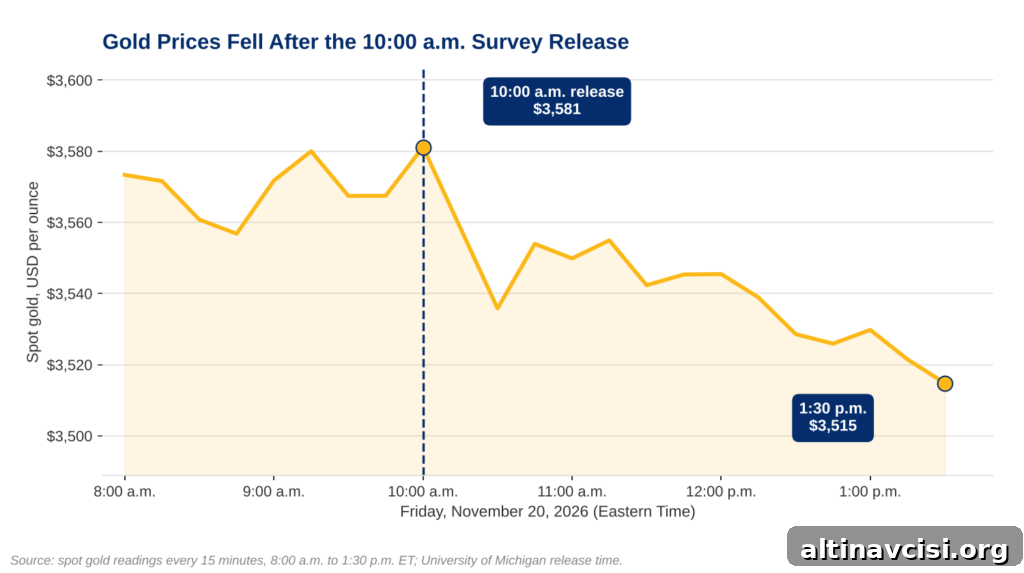
On Friday, November 20, 2026, inflation expectations reported by the University of Michigan fell sharply while gold prices continued to slide. The survey showed that households cut their one-year inflation forecast by a full percentage point to 3.7%, the lowest monthly reading since February. That survey closed before several hawkish Federal Reserve comments that circulated later in the week. By 1:30 p.m. ET the spot price of gold was trading near $3,515 an ounce.
Key Takeaways
- Households’ one-year inflation expectation fell to 3.7% in November from 4.7% in October, the largest one-month decline since June 2025.
- The bond market’s 10-year breakeven inflation rate stood at 2.16% on November 19 and has traded in a narrow band since early November.
- Gold dropped roughly 1.9% between the 10:00 a.m. survey release and mid-afternoon, slipping from about $3,581 to $3,515 an ounce.
What Did the University of Michigan Survey Report on Friday?
The University of Michigan’s November final results showed that households now expect 3.7% inflation over the next year, down from 4.7% in October. Long-run inflation expectations also eased, falling to 3.3% from 3.5%. Falling gasoline prices contributed to the decline: national averages slid from above $4 a gallon toward roughly $3.75 by the survey’s close, which likely helped lower near-term consumer inflation expectations. Despite the drop, the one-year figure remains above February’s 3.4% reading and higher than any monthly reading in 2024.
How Did Gold Prices Move When the Survey Came Out?
The survey release did not reverse gold’s decline. Intraday readings show the spot price at $3,567.46 at 9:45 a.m. ET, $3,581.18 at 10:00 a.m. around the survey release, and then down to $3,535.81 by 10:30 a.m., continuing its slide to roughly $3,514.80 by 1:30 p.m. Silver also fell, moving from $42.54 at 10:00 a.m. to about $41.02 an ounce by mid-afternoon.
Timing alone does not prove causation. Market reports cited competing forces: stronger bets on future Fed hikes, forced selling in other markets, and technical pressures related to a separate technology-sector selloff that spilled into precious metals. Earlier in the month, the same survey movement had pushed rate-hike expectations higher; this decline did not immediately reverse those market expectations.
Why Do Inflation Expectations and Gold Prices Sometimes Move Apart?
Research from the Federal Reserve Bank of Chicago finds that gold prices often fall when expected inflation drops and when long-term real interest rates rise. That study shows correlation rather than definitive causation, and it notes the relationship with real rates appears more clearly in data after 2001. In practice, lower household forecasts do not automatically translate into higher gold prices.
Market measures differ: the 10-year breakeven inflation rate—calculated as the nominal 10-year Treasury yield minus the inflation-protected yield—was around 2.16% on November 19, well below households’ long-run 3.3% expectation. Several Fed officials have cautioned that breakevens, which track CPI-linked expectations, can be hard to interpret when CPI and PCE inflation diverge.
Real yields have been an influential driver lately. From November 9 to November 18, the 10-year real yield rose from about 2.66% to 2.88%, increasing the opportunity cost of holding non-yielding assets like gold. Even so, on Friday the nominal 10-year Treasury yield eased roughly 10 basis points to near 4.95%, yet gold still fell—showing that yields alone did not fully explain that day’s move.
Do Lower Inflation Expectations Mean the Fed Will Skip a Rate Hike?
Not necessarily. The Fed’s October meeting minutes, published November 18, reported that most participants still viewed additional rate increases as likely appropriate, even though medium- and longer-term inflation expectations were generally consistent with the Fed’s 2% goal. Some policymakers remain concerned that high inflation could become entrenched in household expectations. In public comments shortly after those minutes, Fed officials reiterated the possibility of further tightening if inflation stays too high. At the time, market pricing still showed a high probability of a quarter-point increase at the Fed’s December meeting.
Because the University of Michigan survey closed on November 16, it did not capture the Fed minutes or later officials’ remarks; survey results therefore reflected conditions and sentiment prior to that additional information entering the market.
What Would Make Inflation Expectations Matter for Gold Prices Again?
Inflation expectations will matter for gold if market indicators converge with household forecasts or if the Fed’s policy tone softens. Watch the FRED breakeven and real-yield series, the Fed’s December policy decision, and upcoming consumer sentiment readings for signs of a sustained shift.
Because gold does not pay interest, rising real yields increase the cost of holding it. A persistent decline in inflation expectations would reduce one motive for buying gold. That said, long-run household expectations of 3.3% remain above the 2.8%–3.2% range observed in 2024, so the longer-term purchasing-power argument for owning gold has not disappeared. Friday’s episode shows a better near-term inflation reading did not immediately support gold prices, but it does not erase longer-term drivers that may still favor the metal.
Stay On Top of Gold & Silver Prices
Get timely market alerts and essential updates sent straight to your inbox.

SOURCES
1. University of Michigan Surveys of Consumers — Final results for November 2026
2. Bloomberg reporting on consumer sentiment and gasoline prices
3. Reuters coverage of gold’s market moves and Fed commentary
4. Federal Reserve minutes and officials’ public remarks
5. Federal Reserve Economic Data (FRED) series for breakevens and real yields
6. Federal Reserve Bank of Chicago research on drivers of gold prices
Disclaimer: This article is for informational purposes only and does not constitute investment advice. Past performance is not indicative of future results. Consult a qualified financial advisor before making investment decisions.
You May Also Like:
- What Rising Factory Costs Mean for Gold and Silver
- Why Is Gold Falling With Stocks? Two Forces, Six Sessions
- How Low Can Gold Go After Falling Below $3,700?
- Silver Buy Signal: Why Some Analysts Favor Bearish Talk
- Why Gold Fell Below $3,800 After a Strong Tech Quarter
- Why Some Investors Continue Buying Gold During Pullbacks
- Gold After Hot CPI: What Traders Watch Next
- Physical Gold vs. ETFs vs. Mining Stocks: Which Fits Your Portfolio?
Popular Topics
Picked from the archive
-
01
 Topics
Silver Drops 6% After Jobs Beat; Six-Year Deficit Remains
-
02
Topics
Gold and Silver Slide as Warsh Links AI Boom to Fed Tightening
-
03
Topics
1 Gram Gold Bar Price – It’s Not $140
-
04
Topics
Market Sentiment 48.1, Gold Sells Off – 4.6% Was the Key Number
-
05
Topics
Iran Peace Agreement Drops Oil 5% While Gold Gains 3%
-
06
Topics
Silver Up 3% vs Gold 1.3%: What the Gold-Silver Ratio Means
-
07
Topics
U.S. October Budget Deficit $404B: Impact on Gold Investors
-
08
Topics
How This Week’s Economic Data Surprise Affects Gold Prices