1 Gram Gold Bar Price – It’s Not $140
Last verified September 2026.
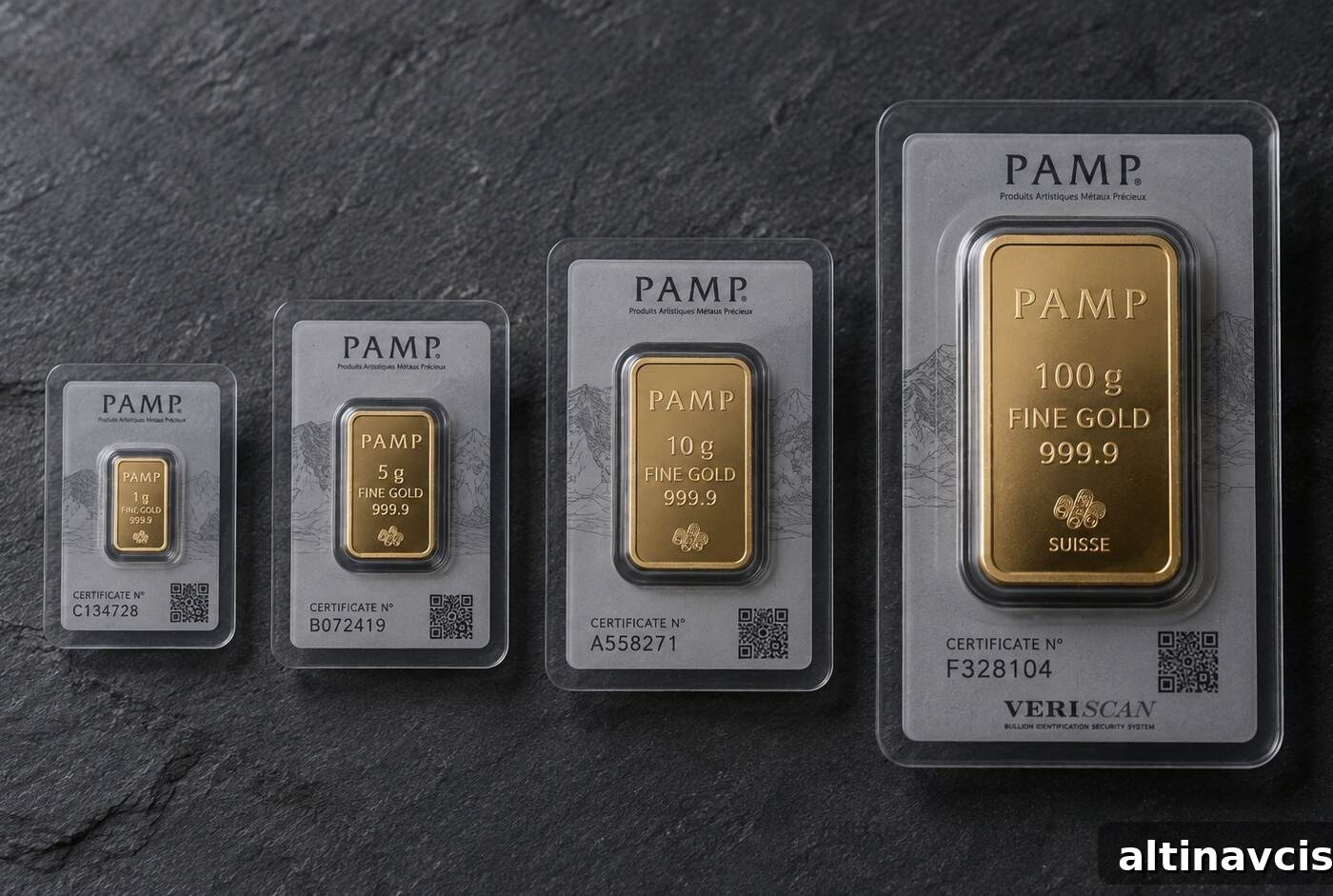
A 1 gram gold bar contains about $140 worth of gold at current spot prices. That modest melt value is the main reason gram bars exist: they make owning physical gold accessible at a price many buyers can afford. By contrast, a one-ounce gold coin today costs several thousand dollars, putting it out of reach for many first-time buyers. Gram bars let people buy real gold in small, tangible increments — but they come with a cost: a significantly higher premium over spot compared with larger bars or coins.
How Much Does a 1 Gram Gold Bar Cost?
To calculate the metal value, divide the spot price by 31.1035, the number of grams in a troy ounce. For example, using a spot price of $4,358.58 per troy ounce (September 22, 2026), one gram of gold is worth about $140.13 in melt value. Retail prices for physical bars and coins are higher because dealers charge a premium to cover fabrication, certification, and distribution.
Typical premiums vary by format. Large bars and standard investment bars often trade at a modest 2–4% over spot, while sovereign coins may carry a 4–8% premium. Gram bars, especially 1 gram pieces, usually command a much higher percentage premium — commonly in the mid-teens to low-twenties percent. Because many production and certification costs are largely fixed, those costs represent a larger share of the final price for a tiny bar. A 1 gram bar with $140 melt value can therefore sell for roughly $160–$180 depending on the seller and packaging.
Why Do Small Bars Cost So Much More Per Gram?
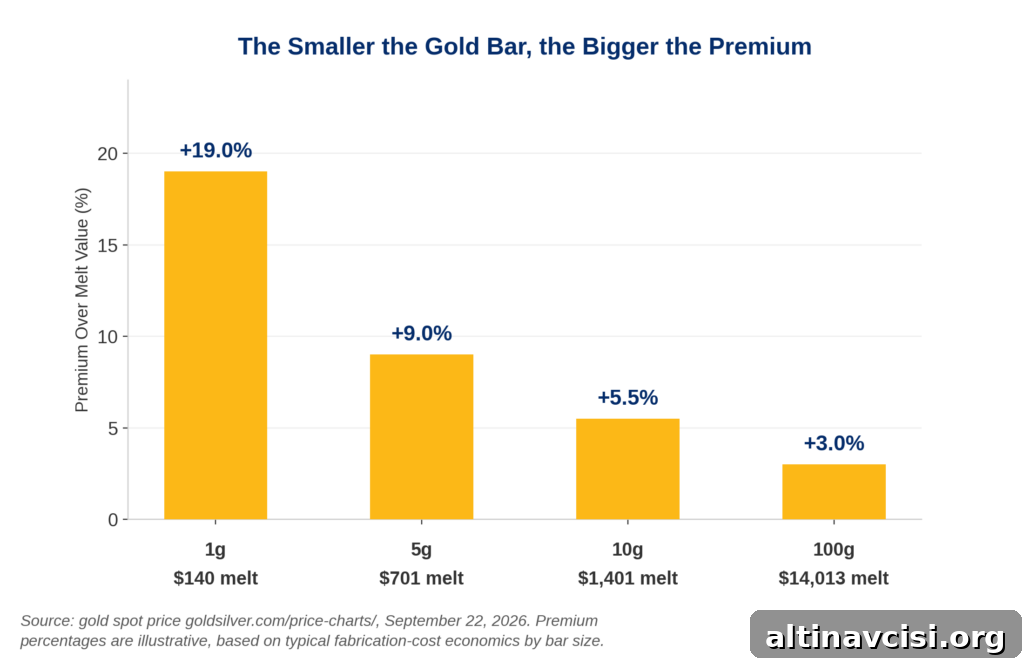
The primary reason is fixed production and certification costs. Processes like stamping, assaying the purity, and sealing bars in tamper-evident packaging require time and resources that do not scale down with weight. Those fixed costs are spread over the metal content. On a 1 gram bar those costs represent a large percentage of the final price; on a 100 gram or 1 kilogram bar they become a small fraction, so the percentage premium falls.
As a result, the premium per gram declines sharply as bar size increases. That is why 100 gram and 1 kilogram bars typically sit at the low end of the premium curve: far more metal absorbs the same administrative and manufacturing expense.
How Many Grams of Gold Can You Buy for $1,000?
Using a melt value of $140.13 per gram, $1,000 would buy about 7.1 grams of pure gold before premiums. After including a typical gram-bar premium in the mid-teens to low-twenties percent, $1,000 realistically purchases roughly 5.8 to 6.2 grams. The difference reflects the fabrication and certification costs built into small-format bullion.
1 Gram vs. 5, 10, and 100 Grams: Where Does the Premium Flatten Out?
Across common sizes you’ll see a consistent pattern:
- 1 gram: melt value about $140. Highest percentage premium of common sizes.
- 5 grams: melt value about $700. Premium decreases noticeably but remains above larger formats.
- 10 grams: melt value about $1,401. Approaches the premium range of standard investment bars.
- 100 grams: melt value about $14,013. The premium curve largely flattens and pricing approaches bulk rates.
In short: each step up in size lowers the cost per gram, and the curve is mostly flat by the 100 gram to 1 kilogram range.
Is a 1 Gram Gold Bar Worth Buying?
It depends on your purpose. As a cost-efficient way to store value, 1 gram bars are the least efficient format. As an entry-level purchase, however, they have clear advantages: affordability, tangibility, and broad global recognition. For someone who wants to own physical metal immediately without waiting to save for a larger coin or bar, a 1 gram piece can be a practical first step.
Be aware of resale dynamics: while gram bars are widely recognized and usually buy back near spot, you are unlikely to recover the full premium you paid. If your plan is long-term accumulation, larger formats give far better metal-per-dollar. If your goal is a first purchase or a gift, a gram bar can make sense.
What Should You Look For in a Gram Gold Bar?
Three features matter most when buying gram bars:
- Purity: Investment-grade bars are stamped .999 or .9999 fine. The weight and purity should be engraved on the bar itself, not only on packaging.
- Assay or tamper-evident packaging: Reputable refiners seal bars in an assay card with a serial number so future buyers can verify authenticity without opening the package.
- Refiner reputation: Bars from well-known, accredited refiners (for example LBMA-accredited producers) are easier to resell. Obscure or unaccredited refiners may require independent testing, which reduces liquidity.
A bar lacking one or more of these elements is not necessarily counterfeit, but it will be harder to sell and effectively carries an invisible liquidity discount.
The Knowledge That Changes Everything
Two essential guides — free. Learn why gold matters and how to protect purchasing power against currency erosion.
Sign-up forms and live widgets removed for clarity. Contact your authorized dealer to request free guides or additional buying resources.
Are Gram Gold Bars a Good Gift?
Gram bars are well suited to gifting. A one-ounce coin is typically a four-figure expense today, so it’s impractical for many occasions. A 1 gram or 2.5 gram bar costs in the range of a quality bottle of wine or a modest piece of jewelry, yet it offers lasting intrinsic value. For milestone events like graduations, christenings, or a child’s first introduction to physical assets, a small gold bar is tangible, memorable, and durable. The higher premium that makes gram bars less efficient for accumulation is less relevant when the objective is introducing someone to ownership rather than maximizing metal per dollar.
Quick Answers
How much is a 1 gram gold bar worth today? At a spot price of $4,358.58 per troy ounce (September 22, 2026), one gram of gold has a melt value of about $140.13. Retail 1 gram bars commonly sell for $160–$175 after typical premiums.
Is buying gold by the gram a good idea? For a first purchase, a small gift, or to learn how physical ownership works, buying by the gram is reasonable. For long-term accumulation, larger bars (100 g or 1 kg) are more cost efficient.
Do gram gold bars hold their value? The gold content tracks spot price like any bullion. The purchase premium is the distinguishing factor — it may not be fully recovered on resale.
How many grams are in a troy ounce? A troy ounce equals 31.1035 grams.
Are gram gold bars a scam? No. Bars from reputable, accredited refiners are legitimate bullion. High premiums reflect real production and certification costs rather than fraud.
Which size has the lowest premium? Generally, bars of 100 grams and larger carry the lowest percentage premium over spot because fixed production costs are spread across more metal.
Why Does Any Amount of Real Gold Still Matter?
The premium discussion is about efficiency, not the core case for owning gold. Whether you buy a gram or a tonne, the metal performs the same monetary function: it preserves purchasing power over long periods in a way that fiat currencies do not always guarantee. Central banks and large institutions continue to diversify into gold, sometimes acquiring hundreds of tonnes annually. Individual savers can participate at their own pace — even one gram at a time — while choosing formats that match their goals for cost, liquidity, and portability.
SOURCES
1. Gold & silver spot price charts (September 22, 2026).
2. Analysis of premiums and pricing for bullion (published and updated in 2026).
3. Bureau of Labor Statistics — CPI-U series (1971–2026).
4. World Gold Council — Gold Demand Trends, full year 2025.
Disclaimer: This article is for informational purposes only and does not constitute investment advice. Past performance is not indicative of future results. Consult a qualified financial advisor before making investment decisions.
You May Also Like:
- What Are Negative Real Interest Rates, and Why Does Gold Thrive in This Environment?
- Cheapest Way to Buy Gold? Measured Live Premiums Across Formats
- How Much Silver Should You Own? Portfolio Allocation Guidance
- Who Owns U.S. Debt? Central Bank Holdings and Trends
- What Is Junk Silver? Old Coins That Can Be Worth Far More Than Face Value
Popular Topics
Picked from the archive
-
01
 Topics
Gold Nears $4,700, Silver Above $69: Markets Eye Friday Speech
-
02
Topics
Why Gold Remains Resilient Amid the First Interest Rate Hike
-
03
Topics
Gold at $4,502: Is This Dip a Buy? BofA Sees $6,000
-
04
Topics
How to Buy Silver Bullion 2026: Coins, Bars and Rounds Compared
-
05
Topics
What’s Driving Gold Prices This Week: CPI, Seoul and Beijing
-
06
Topics
Why Gold Prices Are Falling Amid the Oil War
-
07
Topics
July 2026 Silver Outlook: Two Catalysts Set to Move Prices
-
08
Topics
Silver Appears Weak, Silver-to-Gold Ratio Signals Accumulation