Why Gold Remains Resilient Amid the First Interest Rate Hike

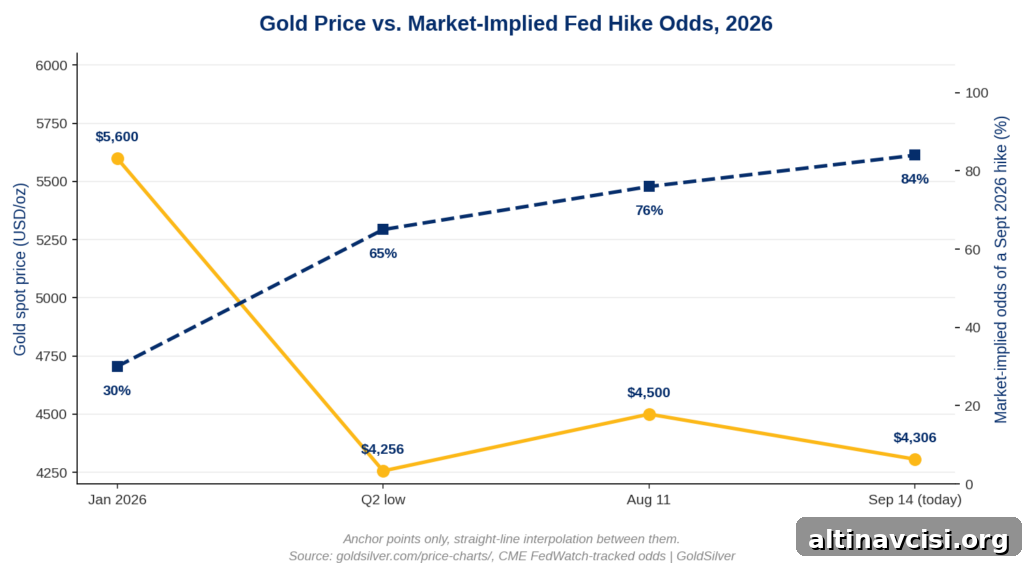
Gold is trading near $4,306 an ounce today, down about 1% from this morning’s open. Silver is near $63.59, off roughly 1.6%. Both metals are pulling back into a Federal Reserve decision that, on paper, looks far more bearish for precious metals than the modest decline currently reflects.
On September 16, the Federal Reserve is widely expected to raise its policy rate for the first time in this tightening cycle. Market-implied odds sit around 83–85% according to fed-funds futures. That is not merely a shift in rhetoric; that is an actual hike. Historically, such an event should drive gold lower and keep it depressed for a while.
Yet that textbook relationship has not held. Gold set an all-time record above $5,600 in January, then corrected roughly 25% through the spring and spent the remainder of the year rebuilding toward the mid-$4,000s. All the while, the market’s own odds of a Fed hike climbed from a coin flip to near certainty. If the traditional link between rates and gold still governed this market, that sequence would not have been possible.
Why Did Gold Stop Reacting to Real Yields?
The old rule was straightforward: gold pays no yield, so when real interest rates rise, the opportunity cost of holding the metal rises and investors rotate into yield-bearing assets. Analysts at major firms, including J.P. Morgan, have documented a breakdown of that relationship since 2022. It continued through 2024 and 2025: gold reached new highs even while real yields on 10-year TIPS stayed firmly positive.
A single year of broken correlation can be a quirk. Three years of the same pattern is more suggestive of a structural shift. That time span crosses multiple Fed regimes and several inflation scares, which points to a change in who sets the marginal price of gold.
The Knowledge That Changes Everything
Two essential guides — yours free. Learn why gold matters and why fiat currencies have a long history of losing purchasing power.
Who Is Buying Gold Instead of Selling Into the Hike?
For most of the post-2008 era, Western investors defined gold’s marginal price. Those investors traded into and out of vehicles like gold ETFs, chasing a rate-driven trade: buy when real yields fell, sell when they rose. That buyer fit the old model.
Starting in 2022, central banks emerged as a major, steady source of demand. Central-bank purchases exceeded 1,000 tonnes in each year from 2022 through 2024 and totaled about 863 tonnes in 2025, according to World Gold Council data. At roughly $60–85 billion per year, those purchases soaked up about a quarter of annual global mine production. A reserve manager building a multi-decade allocation doesn’t liquidate because the Fed raises rates 25 basis points.
A Second Buyer Has Joined the Central Banks
More recently, retail and institutional investors have taken a larger share of the demand alongside central banks. Together, these buyer groups are less sensitive to short-term rate moves than the ETF-driven flows that dominated earlier cycles. Official-sector purchases remain significant — for example, Poland added roughly 51 tonnes in Q2 2026 and China added about 33 tonnes, China’s largest single-quarter buy since late 2023. Neither central banks nor many long-term institutional buyers unwind a position over a single Federal Reserve meeting.
That shift helps explain why major bank price targets have not moved lower as hike odds rose. Several institutions already have year-end or 2026 targets at or above today’s price: Goldman Sachs around $4,900, JPMorgan $4,500 for Q4, Bank of America averaging $4,360, and HSBC averaging $4,560. These desks have priced the expected September 16 hike into their forecasts, reflecting the same structural buyer described above.
What Will the Fed’s September 16 Decision Actually Change?
A rate increase is not irrelevant. An unexpected or materially more hawkish statement than markets expect can push gold lower in the near term. Real yields still matter at the margin. They have simply stopped being the only driver. Over the past three years, a hike has not undermined the broader structural bull case for gold because the marginal buyer has changed.
If you are deciding how much of your savings to hold in physical metal, your choice should follow your hedge objective. If you trade gold as a short-term bet on interest rates, the Fed’s September 16 decision matters greatly and could work against you. If you hold gold as protection against currency debasement, inflation, or counterparty risk, a single Fed meeting was never the central factor. That longer-term, reserve-minded logic explains why central banks themselves are buying.
Stay On Top of Gold & Silver Prices
Get important market alerts sent straight to your inbox.
People Also Asked
Does a Fed rate hike always hurt gold prices?
Historically, higher real yields made gold less attractive by raising the opportunity cost of holding a non-yielding asset. Since 2022, that relationship has weakened as central-bank reserve buying and longer-term institutional demand have grown.
Why are central banks buying gold instead of Treasuries?
Reserve managers are diversifying away from currency and sovereign counterparty risk. That decision is less about short-term yields and more about long-term balance-sheet resilience. These purchases tend to be persistent rather than cyclical.
Have bank gold price targets changed ahead of the September hike?
Major banks that publish gold targets have largely kept their forecasts intact despite rising hike odds. Their models already reflect expected policy moves and the changing composition of demand.
How much gold have central banks bought since 2022?
According to industry demand data, central banks purchased more than 1,000 tonnes in each year from 2022 through 2024 and about 863 tonnes in 2025 — a substantial share of annual mining output.
SOURCES
1. Yahoo Finance — JPMorgan Predicts $2,600 Gold Prices By 2025
2. State Street Global Advisors — Gold 2026 Outlook: Can the Structural Bull Cycle Continue to $5,000?
3. World Gold Council — Gold Demand Trends Q2 2026: Central Banks
4. CBS News — What Is the Highest Gold Price in History?
5. EBC Financial Group — Highest Gold Price Ever: Why Gold Hit $5,600 Faster Than Past Cycles
6. Reuters/Investing.com — UBS Forecasts US Fed Rate Hikes in 2026
7. GoldSilver — Gold Price Outlook September 2026
8. GoldSilver — Explanation of Treasury actions and yield-curve control
9. FOMC schedule and meeting information resources
10. Fed funds rate forecast and probability trackers
Disclaimer: This article is for informational purposes only and does not constitute investment advice. Past performance is not indicative of future results. Always consult a qualified financial advisor before making investment decisions.
You May Also Like:
- How Much Gold Should You Own at 25, 45, or 65?
- Gold Price Outlook September 2026: What the Fed’s September Meeting Means for Your Metals
- Do You Have to Report Gold Stored in a Foreign Vault? FBAR and FATCA Rules Explained
- Tokenized Gold: What It Actually Is, and Where the “Just Like Owning Gold” Pitch Breaks Down
- IRA-Eligible Gold: The Coins and Bars That Actually Qualify
- The No-Home-Storage-IRA Myth: Why the IRS Requires a Depository
- What Is a Gold IRA? The Purity Rule the IRS Never Wrote
- What Is ZIRP (Zero Interest Rate Policy) and How It Changed Gold Forever
Popular Topics
Picked from the archive
-
01
 Topics
What Investors Missed in Warsh’s Report When Gold Jumped $90
-
02
Topics
Why Gold Prices Are Falling Amid the Oil War
-
03
Topics
Silver Surges by a Third Over Gold Ahead of Fed Vote
-
04
Topics
China Moves Gold Reserves After 20-Month Buying Spree
-
05
Topics
Why Gold and Silver Are Rising: Five Reasons Experts Disagree
-
06
Topics
Why Silver Rose Despite JPMorgan’s Demand Warning
-
07
Topics
Why the IRS Requires a Depository for IRA Assets
-
08
Topics
Should You Still Hold Gold in Your Portfolio?