Gold and Silver Slide as Warsh Links AI Boom to Fed Tightening

Kevin Warsh faced a clear task at his first Jackson Hole keynote as Federal Reserve chair: he needed to indicate which half of the Fed’s dual mandate—price stability or maximum employment—concerned him more. He was blunt. “On the price-stability side of our mandate, the numbers are more concerning,” he said, and markets responded immediately: gold fell sharply within minutes.
What did Warsh actually say about inflation?
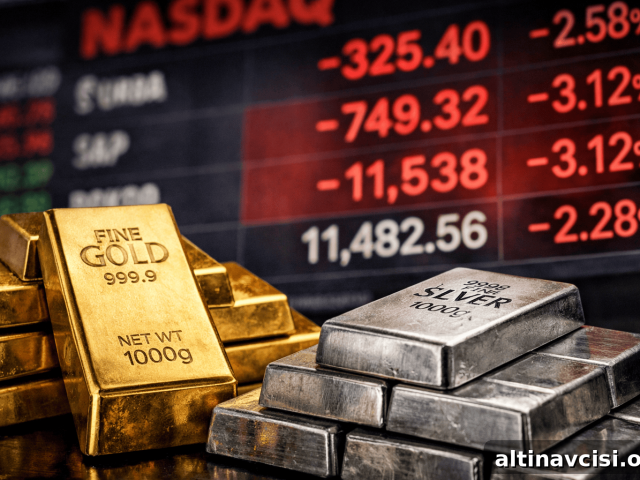
Gold traded near $4,469.61 an ounce following the address, down roughly 2.9% from the morning’s open of $4,601.10. The decline accelerated after Warsh’s remarks and widened through the session. Silver fell even more, around $66.74, down about 3.7%. The gold-silver ratio broadened to approximately 66.97, above the long-run average near 60. Because silver has larger industrial demand exposure, it is typically more sensitive to shifts in interest-rate expectations.
Warsh told the Kansas City Fed’s symposium: “We must be confident that underlying inflation is moving to our objective, clearly and at sufficient speed. Otherwise, we have work to do.” Those were his first extended public remarks since becoming chair in May. He acknowledged that recent inflation readings this summer were “better than expected,” but added they “do not tell me that underlying trends have meaningfully improved.”
That wording is about as close to a reaction function as Warsh has come since taking office. Markets moved quickly: September rate-hike odds rose above 55% from about 35% the previous day, according to widely followed futures-based measures. In short, his emphasis on price stability was read as raising the likelihood of further tightening.
Why did Warsh say financial conditions aren’t restrictive?
The more detailed evidence he cited is worth noting, because much of the initial coverage focused on the hawkish label and immediate market moves. Warsh pointed to robust business investment: spending on equipment and intangible assets is growing at roughly 9%, the strongest pace since 2021, with a sizable portion attributed to the AI-related buildout. Corporate profit growth in the S&P 500 is up by more than 20% year over year, credit spreads remain near the low end of their historical range, and unemployment at 4.1% is, in his characterization, “consistent with full employment.”
It is unusual for a Fed chair to single out an industry-level capex boom—here, AI investment—as a reason to keep fighting inflation. That specific reference signals a data-driven, rather than purely rhetorical, rationale for sustained policy tightening. It goes beyond the generic “hawkish speech” frame and explains why Warsh emphasized the inflation side of the mandate.
Warsh also reiterated his departure from recent Fed communication practices: he continues to avoid explicit forward guidance and an explicit reaction function. “We should not indulge a regime in which market participants are looking primarily to the Fed for their next trade,” he said, arguing for a quieter Fed approach. That stance contrasts with predecessors who used high-profile speeches to hint at pivots or future policy moves.
What happened to Treasury yields after the speech?
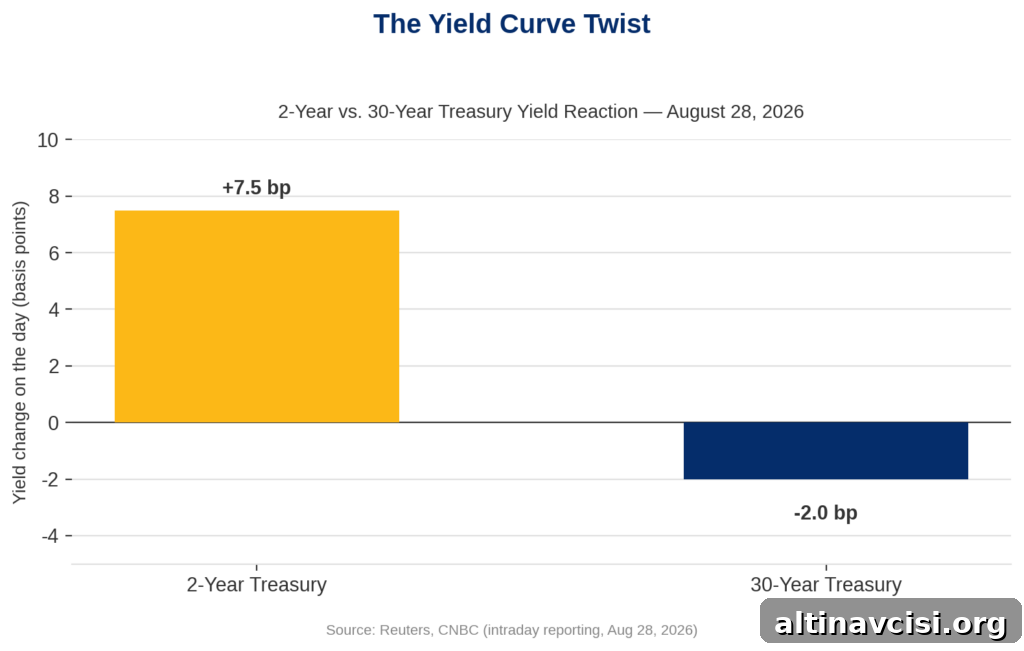
The bond market reaction was not a straightforward “yields all rise” move. Short-term yields showed the clearest response: the 2-year Treasury yield climbed to a one-month high, up roughly 7–8 basis points to about 4.30%, as traders repriced the odds of additional hikes. At the same time, the 30-year yield edged lower by a couple of basis points. That pattern is a curve twist rather than a uniform rise across maturities.
That divergence fits with another policy force at work: the U.S. Treasury has expanded its buyback program for older, long-dated bonds, an effort to restrain long-end borrowing costs. In effect, a more hawkish Fed and a Treasury intervention that helps cap long yields can pull in different directions. On the day of Warsh’s remarks, markets digested both signals simultaneously, producing the observed yield-curve movement.
What does this mean for gold and silver investors?
None of these developments invalidates the longer-term case for holding precious metals, but they do explain the short-term price action. The dollar index rose about 0.4% to roughly 99.55, and when real and nominal interest rates look likely to stay higher for longer, the opportunity cost of owning non-yielding assets like gold increases. That dynamic played out immediately as gold and silver prices fell.
There is a broader political economy story as well: a hawkish Fed prioritizing price stability on one side, and a Treasury actively managing long-term borrowing costs on the other, create a policy tension. When different arms of government apply offsetting pressures, the result can look like financial repression in practice—policies that constrain returns on safe assets while real purchasing power bears the market’s volatility. A single hawkish speech that knocks gold down several percent in one session is consistent with that ongoing tension; it does not disprove it.
What should investors watch next?
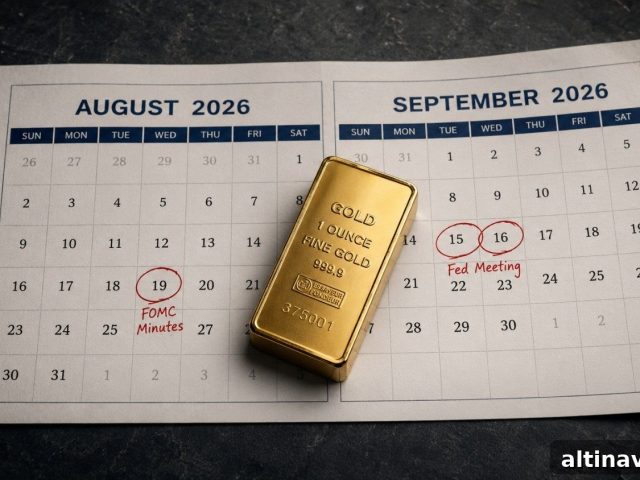
The Federal Reserve’s next policy decision is scheduled for September 15–16. Warsh was careful to caution that his speech “doesn’t necessarily signal” an imminent rate increase, so short-term market odds should be monitored closely. Watch futures-based rate-hike probabilities over the coming sessions and observe whether the Treasury expands its buyback program further if long-end yields rise again.
Most importantly, the next Personal Consumption Expenditures (PCE) inflation report will be the key data point. The PCE is the Fed’s preferred inflation gauge; it will show whether the chair’s claim that “we have work to do” is supported by incoming data or whether those remarks need to be re-evaluated once new evidence appears.
Stay on top of gold and silver prices
Receive timely market alerts and updates delivered to your inbox.
SOURCES
1. Federal Reserve Board — official transcript of Chairman Warsh’s keynote remarks.
2. Associated Press — reporting on Warsh’s quotes about inflation and “work to do.”
3. CNBC — coverage of the speech, 2-year yield movement, and shifts in rate-hike odds.
4. Reuters — reporting on Treasury yield curve moves and dollar index.
5. CNBC — updated September rate-hike odds.
6. Live market commentary and institutional reactions cited in public reporting.
Disclaimer: This article is for informational purposes only and does not constitute investment advice. Past performance is not indicative of future results. Always consult a qualified financial advisor before making investment decisions.
You may also like:
- Five Things Moved Gold and Silver This Week. Only One Was Kevin Warsh.
- The Treasury’s Next Move Isn’t a Rate Cut. It’s a $967 Billion Checking Account.
- Six Paper Claims, One Ounce of Silver: What First Notice Day Reveals
- Five Gold Signals Fired This Week. None of Them Are About Today’s Price.
- Gold Fell 9% the Last Time Warsh Spoke. He’s Back Tomorrow.
- Gold Ran Past Wall Street’s Own Price Targets. Four Banks Disagree on What Happens Next.
- Silver Beat Gold in August. Almost Nobody Said So.
Popular Topics
Picked from the archive
-
01
 Topics
Fed’s September Shift: Impact on Gold Prices
-
02
Topics
5 Catalysts That Moved Gold and Silver This Week
-
03
Topics
Gold Price Tops $5,200, Silver $90 as Inflation Persists
-
04
Topics
Sound Money: Why the Dollar Has Lost 87% Since 1971
-
05
Topics
Gold Price Volatility Back to COVID-Era Levels
-
06
Topics
Gold Jumps 1% – Why July CPI Matters More Than the Headline
-
07
Topics
Why Gold Holds Value: The 5,000-Year Truth Investors Miss
-
08
Topics
Fed Decision Looms: Gold Poised for 8:30 AM Reaction