Gold Prices Jump Past $4,000 as Fed Signals Rate Cut

Daily News Nuggets | Today’s top stories for gold and silver investors
October 29th, 2025
Gold Claws Back Above $4,000 After Trade Talk Selloff
Gold staged a rebound above $4,000 an ounce on Tuesday after tumbling as much as 3.2% on Monday when signs of progress in U.S.-China trade talks briefly reduced demand for safe-haven assets. By Wednesday, spot gold was trading around $4,016 — still well below the record near $4,400 set earlier this month.
Year-to-date, gold has gained more than 54%, driven by strong investment demand amid geopolitical tensions, a softer dollar, and widespread expectations for Federal Reserve rate cuts. That performance has positioned 2025 to be gold’s best year since 1979, when the metal surged amid high inflation and geopolitical turmoil.
Annual Gold Return in Nominal Terms
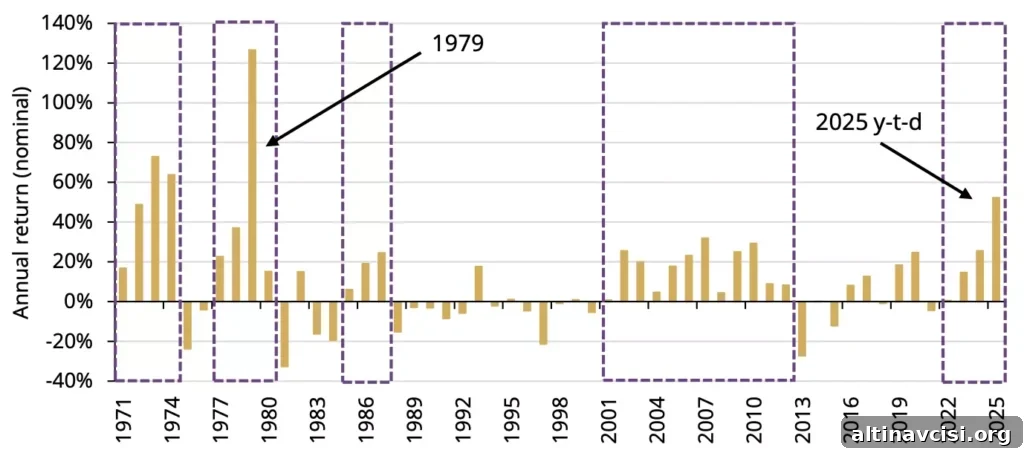
Source: Bloomberg, World Gold Council | Data as of 10/9/25. Based on the LBMA Gold Price PM.
The chart underscores that gold rarely moves in a straight line: steep rallies are frequently followed by extended corrections. The recent trade-related spike in Treasury yields also pressured the non-yielding metal, a reminder that even historic rallies can confront headwinds when bond returns improve.
Silver Bounces Back 2.5% After Trade Talk Whipsaw
Silver has followed gold’s volatile path this week. After sliding about 3.8% on Monday amid optimism over U.S.-China trade discussions, silver rallied roughly 2.5% on Tuesday. Reports that officials from both countries discussed a framework for tariff adjustments reduced some haven buying but the metal recovered as traders weighed broader macro drivers.
Silver’s outlook remains tied to two forces: monetary policy and industrial demand. With the Fed widely expected to cut rates, lower interest rates would reduce the opportunity cost of holding non-yielding assets and support precious metals. At the same time, silver’s significant industrial role makes it sensitive to improvements in manufacturing—so genuine progress on trade and supply chains could boost demand from both investors and industry.
In short, the recent price whipsaw reflects a tug of war between optimism about trade and the persistent influence of monetary policy expectations.
Fed Set to Cut Rates Again — Despite Flying Blind on Jobs Data
The Federal Reserve is widely expected to cut its benchmark rate by a quarter point on Wednesday, marking the second reduction in six weeks. Markets have priced in near certainty for the move, which would put the target range around 3.75%–4.00%. Adding complexity, a government shutdown that began on October 1 has left the Fed without official labor market readings for September and October, constraining its information set.
Policymakers have become increasingly focused on limiting job losses even as inflation remains above target. High-profile corporate layoffs and broader softening in hiring have heightened concerns about the labor market. Lower rates typically weigh on the dollar and make non-yielding assets like gold relatively more attractive—factors supporting precious metals. With markets also expecting another cut in December, the easing cycle may extend into 2026.
America’s White-Collar Workers Face a Silent Recession
White-collar workers have borne a disproportionate share of job losses in recent periods. In 2024, roughly one in four workers who lost jobs came from professional and business services. Unemployment in that sector has risen from about 3.1% to near 4.0%, while several blue-collar industries, including parts of manufacturing and healthcare, have continued hiring.
Large corporations have announced major corporate staff reductions: for example, Amazon disclosed plans affecting thousands of corporate roles, and other retailers have also cut office-based positions. A key driver appears to be rapid adoption of generative AI and automation, which industry studies have suggested could transform or replace a large share of tasks in white-collar roles. LinkedIn and other labor-market reports show hiring for high-salary roles has slowed and senior job searches often take many months, signaling structural shifts in the professional labor market.
These developments matter for the economy and for markets: rising unemployment and a softening white-collar sector can weigh on consumer spending and corporate earnings, while also influencing Fed policy and investor risk appetite.
Nvidia Races Toward $5 Trillion as AI Bubble Debate Intensifies
Nvidia is closing in on becoming the first $5 trillion company, with shares rallying further amid AI optimism. At a major industry event, CEO Jensen Huang downplayed bubble concerns and pointed to substantial revenue potential from the company’s latest chips.
Still, skepticism is rising. Global institutions and central bankers have warned that runaway valuations tied to AI expectations could pose risks if investor sentiment turns. Critics highlight examples of highly valued AI startups and aggressive, debt-fueled spending that rest on projections of future revenue rather than current profits—parallels some draw to past tech bubbles. If the AI trade were to unwind, markets could see a broader selloff, prompting renewed flight-to-safety flows into gold and silver.
For precious-metals investors, watching where risk appetite goes—whether it remains enthusiastic about AI growth or shifts toward safety—will be a key signal for future price moves.
Popular Topics
Picked from the archive
-
01
 Topics
Silver Could Double in 2025 as Dollar Dominance Fades
-
02
Topics
Gold, Silver Gain in Trump-Fed Standoff Over Governor Dismissal
-
03
Topics
Investors Flock to China Gold ETFs as Inflows Hit Record
-
04
Topics
Trump Imposes 25% Tariff on India’s Oil Imports From Russia
-
05
Topics
Record Gold Floods Shanghai as Traders Exploit Futures Arbitrage
-
06
Topics
Gold Prices Hold as Fed Faces Tough Interest Rate Decision
-
07
Topics
Geopolitics, Copper Tariffs and OPEC Plus Drive Oil Prices
-
08
Topics
RBA Warns Inflation Risks Remain Despite Current Calm