Gold Price Forecast 2026: 5-Year Outlook for Investors
Nearly every major bank’s gold price prediction for 2025 pointed higher — but few expected how explosive the rally would become. In October 2025 gold surged past $4,000 per ounce, establishing new historic highs and reinforcing its role as a primary safe-haven asset amid persistent monetary and geopolitical uncertainty.
The performance over the last five years underscores gold’s resilience and its appeal to risk-conscious investors:
- 2020: +24.9%
- 2021: -3.6%
- 2022: -0.31%
- 2023: +13.09%
- 2024: +27.11%
(Source: StatMuse, CME, World Gold Council)
Gold Price 5 Year Chart
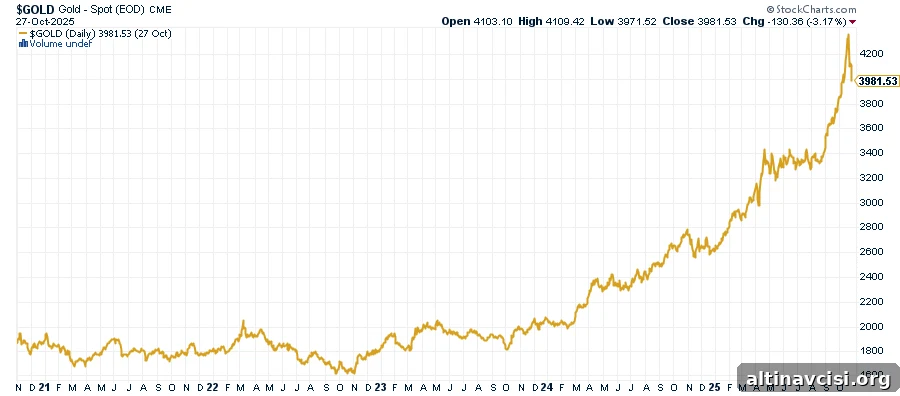
With prices consolidating just below record highs, investors are asking: how much higher can gold go, and how long can this bull market last?
What the Big Banks Are Saying: 2026–2030 Outlook
Market expectations among major financial institutions have shifted upward. Forecasts that once sounded bullish are becoming the new baseline. Several top banks now publish scenarios that see gold reaching $5,000 per ounce in 2026, with at least one set of analyst projections extending toward $6,000 over the medium term.
Representative forecasts from large institutions include:
- HSBC: Projects a “bull wave” that could take gold to $5,000/oz by the first half of 2026, and lifts its average annual forecast accordingly.
- Bank of America: Raised its 2026 target to $5,000/oz, citing policy uncertainty and strong investment demand that underpins higher prices.
- J.P. Morgan: Updated its outlook to project gold averaging roughly $5,055 in Q4 2026, with a longer-term target near $6,000 by 2028 if current macro trends persist.
The bottom line: Baseline forecasts now cluster in the high $3,000s for late 2025 and in the $4,000+ range for early to mid-2026, while several credible desks publish $5,000 scenarios for 2026 and beyond.
What’s Driving Gold Higher?
Three main forces support the bullish case for gold over the near to medium term:
- Central bank demand: Central banks have been aggressive buyers, averaging roughly 710 tonnes per quarter in 2025. Continued official purchases create sustained, structural demand that supports higher prices.
- Inflation and monetary policy: Persistent inflation combined with ongoing monetary expansion (measured by indicators like CPI and M2 money supply growth) tends to favor gold as a hedge against currency debasement and purchasing-power erosion.
- Geopolitical uncertainty: Heightened global tensions and geopolitical instability reinforce gold’s safe-haven status. If geopolitical or economic conditions worsen, safe-haven flows could push prices materially higher—analysts commonly suggest potential upside in the mid-single-digit to low-double-digit percentages from current levels under stress scenarios.
How Much Gold Should You Own? Portfolio Allocation for the Next 5 Years
Appropriate allocation depends on individual goals and risk tolerance. Typical frameworks include:
- Conservative (8–12%): Prioritize wealth preservation and downside protection — suitable when investors place a premium on stability amid economic uncertainty.
- Moderate (5–10%): Balance defensive exposure to gold with growth assets like equities and selective fixed income for diversified returns.
- Aggressive (3–8%): Use gold alongside higher-volatility metals like silver and selective mining stocks for potentially greater upside, acknowledging higher short-term volatility.
Some influential voices on Wall Street have proposed larger allocations. For example, a notable strategist suggested a model that allocates 20% to gold, arguing that bonds may no longer provide the same protection they once did in a high-inflation, low-yield environment. That recommendation reflects a shift in how some portfolio managers view the role of precious metals in modern asset mixes.
Physical Gold, ETFs, or Mining Stocks? Choosing Your Investment Vehicle
For a five-year horizon, investors can choose from several common vehicles, each with trade-offs:
- Physical gold: Eliminates counterparty risk and gives direct control over holdings—preferred for long-term preservation and crisis protection, though storage and insurance are considerations.
- Gold IRAs: Provide tax-advantaged exposure to physical metal for retirement planning, but require adherence to specific custodial rules.
- Gold ETFs: Offer liquidity and ease of trading; convenient for tactical exposure but introduce counterparty and tracking considerations.
- Mining stocks: Deliver leveraged exposure to gold prices and can outperform in strong rallies, but carry company-specific operational and market risks.
The optimal choice depends on your tax situation, storage preferences, and need for liquidity.
Risk Factors Every Gold Investor Should Monitor
Several headwinds could alter gold’s path and should be monitored by investors:
- US dollar strength: A sustained dollar rally generally weighs on dollar-denominated commodities, including gold.
- Geopolitical peace: A broad and sustained resolution of major conflicts could reduce safe-haven demand and pressure prices.
- Policy shifts: More aggressive tightening by major central banks could temper inflation expectations and reduce some demand for gold as an inflation hedge.
- Supply-side responses: Elevated prices can dampen consumer demand and encourage recycling, which may introduce supply-side headwinds over time.
What to Expect from Gold Over the Next 5 Years
Consensus among many large financial institutions points to continued appreciation for gold through 2030, with near-term price targets ranging from roughly $4,000 to $5,000 per ounce and selective scenarios extending beyond. Current market positioning suggests gold remains well-suited as both a defensive asset and a potential growth opportunity over the next five years.
As Gregory Shearer, head of Base and Precious Metals Strategy at J.P. Morgan, summarizes: “We still think risks are skewed toward an earlier overshoot of our forecasts if demand continues to surprise our expectations. For investors, we think gold remains one of the most optimal hedges for the unique combination of stagflation, recession, debasement and U.S. policy risks facing markets in 2025 and 2026.”
For investors considering gold over a multi-year horizon, the combination of strong institutional demand, supportive monetary conditions, and geopolitical uncertainty forms a compelling investment thesis. Still, gold should be used as part of a diversified portfolio strategy rather than relied upon as a single solution. This analysis is informational only and does not constitute investment advice; consult qualified financial professionals before making investment decisions.
People Also Ask
What will gold prices be in 2025 and 2026?
Major institutions expect gold to average in the high $3,000s through late 2025, with several banks forecasting $5,000 per ounce by 2026 in at least some scenarios. Specific forecasts vary by firm and depend on macroeconomic and geopolitical developments.
How much of my portfolio should be in gold?
Advisors commonly recommend a 5–12% allocation depending on risk tolerance; conservative investors may prefer 8–12% for wealth preservation. Some strategists have advocated larger allocations in light of changing bond market dynamics, but recommendations should be tailored to individual goals.
Is it too late to buy gold at $4,000?
While gold’s rally has been strong, many analysts still see upside potential driven by central bank purchases, inflation concerns, and geopolitical risk. Whether to buy depends on your timeframe, risk tolerance, and portfolio construction.
What is driving gold prices higher in 2025?
Key drivers include heavy central bank buying, persistent inflation and monetary expansion, and elevated geopolitical tensions that sustain safe-haven demand.
Should I buy physical gold or gold ETFs?
Physical gold removes counterparty risk and suits long-term preservation and crisis protection; ETFs offer liquidity and trading convenience but carry counterparty considerations. The right option depends on your storage preferences, tax situation, and investment horizon.
This analysis is for informational purposes only and should not be considered investment advice. Past performance does not guarantee future results. Consult qualified financial professionals before making investment decisions.
Popular Topics
Picked from the archive
-
01
 Topics
Dollar Steadies After Jobs Data Shock Sends 90% Odds of Fed Cut
-
02
Topics
Consumer Confidence Hits 4-Month High as Inflation Eases
-
03
Topics
Gold Price Falls Below $3,340 Ahead of Fed Comments
-
04
Topics
Global Oil Prices Steady as Travel Demand Rises, Sanctions Loom
-
05
Topics
Silver Prices Eye Record Highs as Fed Signals Rate Cuts
-
06
Topics
AI Bubble Fears Surge as Gold Price Falls Below 4,000 USD
-
07
Topics
Tariff-Driven Inflation Clouds Fed’s September Rate Decision
-
08
Topics
10-Year Treasury Yield Rises After Tariff News, Services Data