Fed Rate-Hike Odds Doubled This Week; Real Yields Stayed Flat
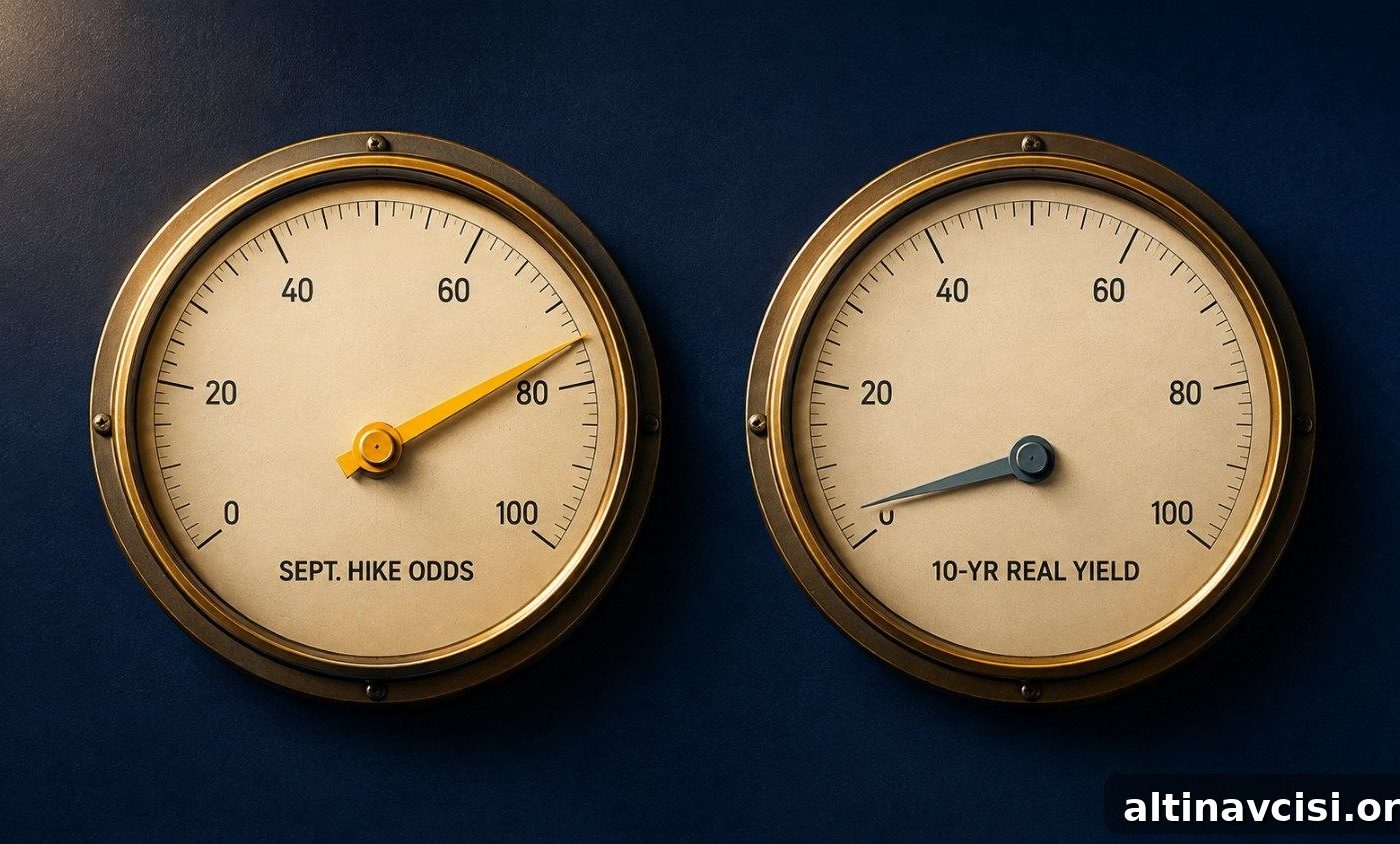
September’s odds of a Fed rate hike leapt from roughly 35% to 57% after a single Friday speech — yet the 10-year real yield that most directly influences gold barely moved, changing by only two basis points that same week. The truth about which signal matters will become clearer over the next four trading days as JOLTS, ADP, ISM and the August jobs report arrive.
Why Does This Week’s Data Matter So Much for Gold?
Gold was trading near $4,427 per ounce on August 31, down modestly from an early session around $4,455. Silver was close to $66.12. Those price moves are small next to the bigger story: the economic calendar. JOLTS job openings and the ISM manufacturing index arrive on Tuesday, September 1. ADP’s private payrolls estimate follows on Wednesday, September 2. The Bureau of Labor Statistics delivers the August jobs report on Friday, September 4. Collectively, these reports are the final major datapoints the Federal Reserve will see before its September 15–16 policy meeting.
Markets repriced quickly after Fed Chair Kevin Warsh’s Jackson Hole address on August 28. Warsh warned that underlying inflation “has not meaningfully improved” and said the Fed still has “work to do.” Within hours, traders pushed the implied probability of a September hike sharply higher. This week’s data will either confirm that shift toward tighter policy or force a partial reversal of those odds.
The Edge Every Investor Needs
Smarter precious metals investing starts here. The Nuggets Newsletter delivers market analysis, Fed updates, global trends, and educational content tailored for precious metals investors.
What Do Economists Expect From This Week’s Jobs Data?
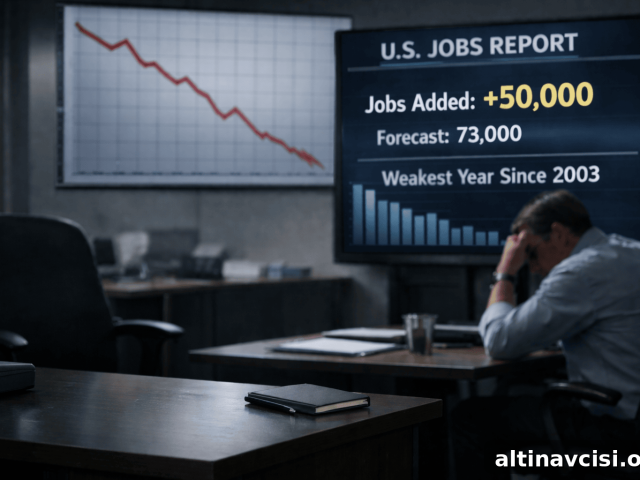
Consensus for August payrolls stood near +55,000 in previews tied to CME FedWatch, with a forecast range spanning roughly -25,000 to +102,000. That follows a difficult July, when the Bureau of Labor Statistics unexpectedly reported a headline loss of 23,000 jobs versus a Dow Jones consensus calling for a gain of 83,000. June’s figure was also revised sharply lower, magnifying the recent downside surprise in monthly payroll data.
Major bank forecasts sit modestly above consensus. Credit Agricole and Goldman Sachs each projected about +65,000 jobs for August, while Wells Fargo expected roughly +80,000, arguing that July’s weakness overstated by atypical declines in leisure, hospitality and local education could partially reverse. None of the bank previews treated a second consecutive negative payroll print as the central expectation; a renewed loss would therefore be a notable surprise.
What Happens If the Fed Hikes After Two Weak Jobs Reports?
Traders are debating this scenario now. Bloomberg Economics’ Anna Wong noted on social media that there is “no modern Fed era precedent” for raising rates after two consecutive negative payroll prints. That observation highlights the policy dilemma: Warsh’s Jackson Hole message emphasized inflation risks rather than labor-market strength, and he has previously signaled that the Fed is “not constrained by market prices.”
If August delivers a second weak payroll print, the Fed faces a stark choice. Will it raise rates to defend inflation-fighting credibility despite a softening labor market, or will it pause and risk appearing to bow to market repricing the Fed just tried to influence? Either decision would carry important implications for markets, policy credibility and financial conditions going into the fall.
Positioning adds another dimension. Commitments of Traders data showed speculative net long positions in gold rising across several weeks in August, climbing from roughly 198,000 contracts to about 243,000 before Warsh’s speech. These speculative positions were built into a hawkish surprise that had not yet been fully priced, increasing the risk that market moves this week are amplified as positions adjust to fresh data.
Why Are Real Yields the Number That Actually Matters?
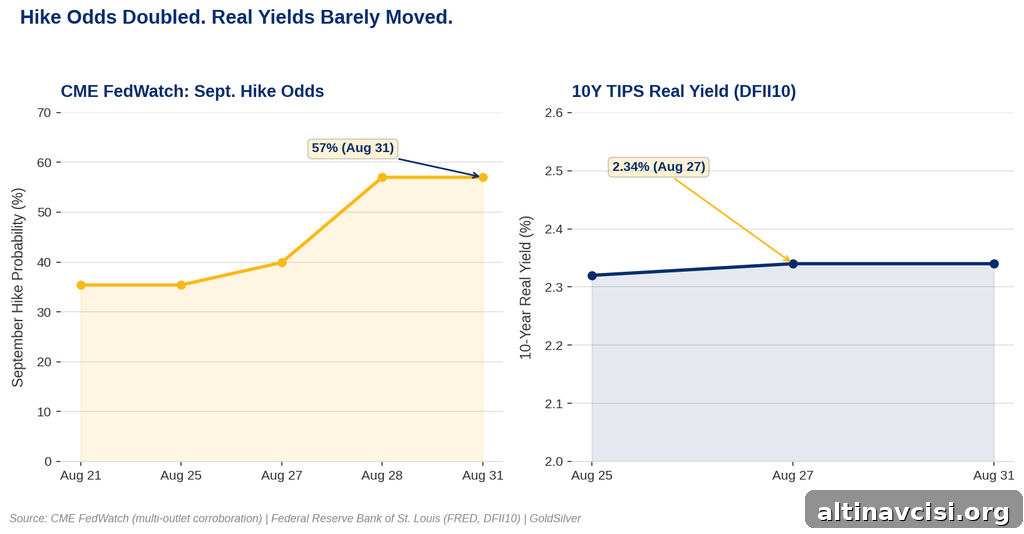
Gold’s price is driven primarily by real yields — the return investors demand after accounting for expected inflation — not by the headline probability of a 25-basis-point Fed move. As of August 27, the 10‑year TIPS real yield sat near 2.34%, essentially unchanged from a week earlier even as market odds of a September hike more than doubled. That divergence implies one of two possibilities: real yields will move sharply to reflect the new policy odds, or the market has concluded that the September decision will matter less for the true cost of capital than the headline probability suggests.
Those two pathways have very different implications for gold. A Fed hike while real yields remain anchored would be one outcome; a hike accompanied by a meaningful real-yield breakout would be another, and more challenging for gold. This week’s labor and inflation signals will help determine which path markets expect the fall to follow.
What Should Investors Watch This Week?
Focus on the sequence of releases, not just Friday’s headline number. The unemployment rate — consensus near 4.1% — and wage growth — consensus near 3.0% year-over-year, down from 3.2% — are the two figures inside the jobs report that will most influence rate expectations. Together they either reinforce the narrative of a stabilizing labor market or complicate it. A report close to consensus would likely keep the Fed’s attention on inflation, while a second weak payroll print would force the very policy dilemma discussed above well before the Fed’s September meeting.
For long-term savers, this week isn’t about finding a one-day catalyst. It’s about how incoming data shapes the market’s assessment of the cost of holding a non-yielding asset like gold over the coming months. Every gold holder is implicitly weighing that trade-off; this week’s releases are likely to tip the balance one way or the other.
Stay On Top of Gold & Silver Prices
Receive timely market alerts delivered to your inbox.
SOURCES
1. Federal Reserve Board — Keynote Remarks by Chairman Warsh at the 2026 Jackson Hole Economic Policy Symposium
2. Time News — Coverage of gold price reaction to hawkish Fed outlook
3. NBC News — July 2026 jobs report coverage
4. FinancialJuice — US NFP preview (4th September)
5. ZeroHedge — Weekly events: jobs, JOLTS, Beige Book and ISM
6. CFTC — Commitments of Traders report, gold (legacy, futures only)
7. Federal Reserve Bank of St. Louis — 10-Year Treasury Inflation-Indexed Security Yield (FRED)
Disclaimer: This article is for informational purposes only and does not constitute investment advice. Past performance is not indicative of future results. Consult a qualified financial advisor before making investment decisions.
You May Also Like:
- COMEX Registered Gold Just Fell Below 15 Million Ounces. It’s Still Refilling.
- Gold Isn’t Falling on a Hawkish Fed. Here’s Why.
- Gold and Silver Sink as Warsh Cites AI Boom to Justify More Fed Tightening
- Five Things Moved Gold and Silver This Week. Only One Was Kevin Warsh.
- The Treasury’s Next Move Isn’t a Rate Cut. It’s a $967 Billion Checking Account.
- Six Paper Claims, One Ounce of Silver: What First Notice Day Reveals
- Five Gold Signals Fired This Week. None of Them Are About Today’s Price.
Popular Topics
Picked from the archive
-
01
 Topics
Gold Holds After CPI and PPI Miss: Market Impact Explained
-
02
Topics
Why Foreign Selling of US Debt Is Driving Gold Prices Higher
-
03
Topics
10% of Gold Sent Abroad, 9% Brought Back Home
-
04
Topics
Why Silver Prices Are Up Today: Iran Deal Alters Fed Policy
-
05
Topics
Gold Price Surge Drives Producers to Seek Larger Share
-
06
Topics
No Tankers Crossed Strait of Hormuz; Oil Tops $89, Gold Flat
-
07
Topics
Why Gold Held Steady After Trump’s Economic Pressure on Iran
-
08
Topics
Gold Gains as Job Growth Slows and Global Expansion Weakens