Why Foreign Selling of US Debt Is Driving Gold Prices Higher

The precious metals market produced one of its most dramatic weeks in years — and the move was deliberate, not accidental.
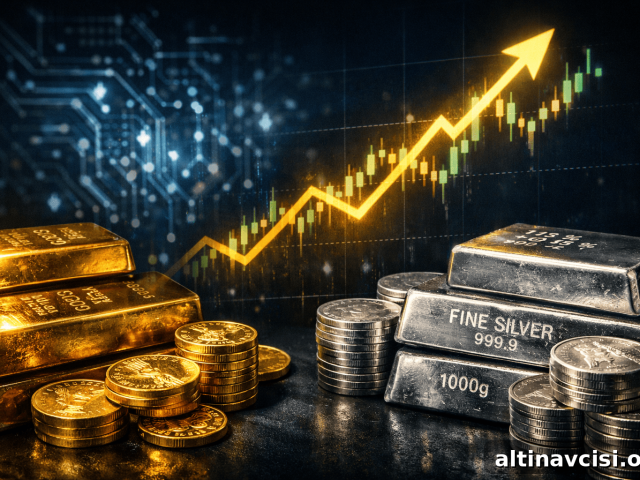
Gold briefly climbed past $4,800 per ounce, reaching a fresh record, while silver pushed toward $95. This was not a speculative blow-off or a purely technical surge. Instead, markets were reacting to a growing trend: foreign selling of U.S. debt. That shift is quietly reshaping global capital flows and investor behavior.
When confidence in government bonds begins to erode, investors don’t wait for headlines — they act.
A Small Sale That Sent a Big Message
Last week, AkademikerPension — one of Denmark’s largest pension funds — announced it will sell its entire $100 million U.S. Treasury holding by the end of the month. The reason given was direct: concerns about U.S. government finances.
In absolute dollar terms $100 million is small. The global Treasury market, however, is dominated by much larger holders: Japan (about $1.15 trillion), China (around $750 billion) and thousands of other institutions with combined holdings in the trillions. AkademikerPension’s position is a tiny sliver in that broader picture.
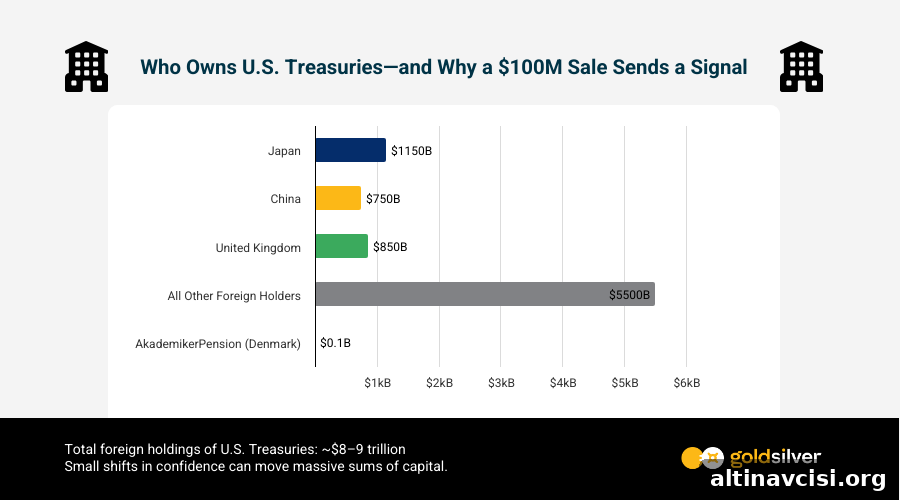
So why did this small sale matter? Institutional investors watch one another closely. When a conservative European pension fund publicly exits Treasuries over solvency concerns, it forces other funds to reconsider their exposure. Even a modest follow-through — a 2–3% shift among foreign holders — could create substantial ripple effects through funding markets.
Why Foreign Selling U.S. Debt Matters More Than the Size
Markets respond more to direction than to absolute amounts. A public move by a respected institution signals a change in perceived risk. If other conservative investors begin to question U.S. Treasuries, the consequences can compound quickly:
- Higher borrowing costs for the U.S. government
- Reduced liquidity in Treasury markets
- Pressure on the U.S. dollar
- Increased scrutiny and pressure on the Federal Reserve
A loss of confidence in sovereign paper does not always reverse quietly. That is the landscape to which gold and silver are responding now.
The Timing Isn’t Coincidental
This development did not occur in isolation. The same week AkademikerPension announced its exit, diplomatic tensions between the U.S. and parts of Europe intensified. Public threats involving tariffs and contentious political rhetoric can amplify already fragile confidence in international financial relationships.
For a Danish pension fund to cite U.S. fiscal concerns shortly after observing strained diplomatic relations is not mere coincidence. It reflects a real-time breakdown of trust that influences capital allocation decisions long before formal policy changes appear.
The Path Toward $5,000 Gold
Major banks have begun to acknowledge scenarios markets are already pricing in. Several large institutions have floated $5,000-per-ounce targets for gold. After the recent surge, these forecasts look less speculative and more like lagging indicators of the changing risk environment.
Gold’s strength is emerging from structural forces rather than a short-lived panic. Key drivers include persistent geopolitical uncertainty, long-term pressure on the dollar, and growing skepticism toward sovereign debt. Foreign selling of U.S. Treasuries is not the sole cause — it is a symptom of a deeper loss of confidence in paper promises.
That is precisely the environment where physical gold and silver have historically performed well.
What This Means for Investors
When global capital questions the safety of government bonds and foreign selling of U.S. debt accelerates, diversification moves from theory to necessity. Physical precious metals do not depend on fiscal discipline, political stability or another party’s solvency. They are non‑counterparty assets that preserve purchasing power when confidence in paper assets falters.
Long-term investors tend to act quietly and early in such environments. If you are considering adding gold or silver to your portfolio, the current market signals warrant attention. Thoughtful allocation to physical metals can reduce portfolio vulnerability to rising interest costs, dollar weakness and sovereign credit concerns.
If you want to assess how physical metals could fit your financial plan, consider speaking with a qualified specialist who can help align allocation with your objectives and risk tolerance.
People Also Ask
Why are foreign countries selling U.S. Treasuries?
Foreign investors reduce Treasury holdings when they have concerns about U.S. fiscal sustainability, rising national debt, or geopolitical uncertainty. Public exits by respected institutions can signal a broader decline in confidence that prompts others to reassess their holdings.
What happens if foreign countries stop buying U.S. debt?
If foreign demand weakens, the U.S. government may need to offer higher yields to attract buyers, increasing borrowing costs and putting pressure on the federal budget. This scenario often leads to a weaker dollar, reduced market liquidity, and greater inflationary pressure — conditions that historically have pushed investors toward physical stores of value like gold and silver.
How much U.S. debt do foreign countries own?
Foreign investors collectively hold a substantial portion of U.S. Treasury securities, measured in the trillions. Major holders include Japan and China, with many other countries and institutions together owning significant amounts. Even small percentage shifts among these holders can translate into hundreds of billions of dollars moving in or out of the market.
Why is gold surging when foreign investors sell U.S. Treasuries?
Gold tends to surge when confidence in paper assets and sovereign debt declines. When institutions question the safety of government bonds, investors rotate into assets that do not rely on a counterparty’s solvency. Gold’s recent advance reflects rising concern about Treasury market dynamics and longer-term dollar stability.
What does Denmark’s pension fund selling Treasuries mean for the dollar?
Denmark’s $100 million sale is small in absolute terms but significant as a public statement from a conservative institution. If similar institutions, sovereign funds or central banks follow even modestly, the combined impact could pressure the dollar, raise borrowing costs and accelerate a shift toward alternative reserve assets. Markets often move on these signals before full capital reallocation occurs.
You May Also Like:
- Why metals outperformed most asset classes in recent years and what it could mean going forward
- How changes in trading rules might influence silver prices
- Reasons driving the rise in silver and likely next steps
- Analysis of the falling gold-to-silver ratio and what it suggests for investors
Popular Topics
Picked from the archive
-
01
 Topics
Gold Prices Up 21%, Silver 25% YTD Amid AI and Inflation Fears
-
02
Topics
Crypto Treasury Firms Flood Wall Street in SPAC Gold Rush
-
03
Topics
ETF Inflows Propel Gold Demand to Highest H1 Levels Since 2020
-
04
Topics
Russia Taps $1B Chinese Gold Market Amid Geopolitical Shift
-
05
Topics
Global Oil Prices Steady as Travel Demand Rises, Sanctions Loom
-
06
Topics
Moody’s Economist: US Economy Nears Recession After Jobs Plunge
-
07
Topics
Silver Price Nears $64 as Fed Debate Intensifies
-
08
Topics
Gold & Silver Prices Today: Iran, Oil Fallout, $1.3B Bet