Gold Price $4,392: Sentiment Plunges to 51, Inflation Fears

The University of Michigan released its preliminary Consumer Sentiment Index for August at 10:00 a.m. ET on Friday, and the reading came in notably below forecasts. The index registered 51, compared with a consensus projection near 54.5 and a final July reading of 55.2. That represents an approximate 8% decline in a single month, reversing two months of improvement.
At the same time, one-year inflation expectations in the survey ticked up to 4.3% from 4.2% in July. This combination — falling consumer confidence alongside rising price expectations — matches the common indicators of stagflation: weakening growth expectations paired with persistent inflationary pressure, a mix closely watched by precious metals investors.
The preliminary Michigan miss altered the market’s trajectory for gold on Friday. Spot gold had slid to an intraday low earlier in the morning but rebounded sharply after the data release. Silver moved in the same direction. These market moves underscore how sensitive precious metals are to shifts in expectations about growth, inflation, and Federal Reserve policy.
What the University of Michigan Consumer Sentiment Index Measures
The University of Michigan’s Surveys of Consumers gauges two key views: households’ assessment of their current financial situation and their expectations for the economy over the next six to twelve months. The survey also collects consumers’ direct expectations for inflation over the coming year.
When sentiment weakens while inflation expectations rise, the data describe a particular economic environment: consumers believe their outlook is deteriorating even as they expect prices to climb. That pattern is not, by itself, a recession signal. Rather, it signals stagflation — a scenario in which growth stalls or slows even as inflation remains elevated.
Joanne Hsu, Director of the Surveys of Consumers at the University of Michigan, noted that “consumer sentiment fell about 8% this August, ending two consecutive months of improvement.” She added that while views of personal finances declined only slightly, expected business conditions dropped sharply — down 11% in the short run and 17% over the long run. The large fall in long-run expectations is especially meaningful: it shows consumers are revising their outlook for several years ahead, not just the immediate future.

The Edge Every Investor Needs
Smarter precious metals investing starts here. The Nuggets Newsletter brings essential market insights, Fed updates, global trends, educational videos, and more.
Why This Combination Matters for Gold
Gold behaves differently depending on the economic backdrop. In a pure recession, falling real yields driven by collapsing growth expectations tend to support gold. In a high-inflation environment where the Fed tightens aggressively, rising real yields can weigh on gold. Stagflation creates a distinct dynamic: the Fed faces a difficult trade-off. Tightening to curb inflation risks worsening a fragile economy, while easing or pausing risks letting inflation stay elevated.
That policy dilemma tends to support gold over time. If growth is fragile enough that the Fed is reluctant to raise rates aggressively, real yields remain compressed and a non-yielding asset like physical gold gains appeal as a store of value. At the same time, rising inflation expectations strengthen the argument for holding assets that preserve purchasing power outside the banking system.
This morning’s Michigan survey came on the heels of other soft signals: July retail sales posted their largest monthly decline in over a year, and recent CPI and PPI releases were softer than many expected. Taken together, these reports form a consistent narrative that the economy is cooling faster than the market previously assumed.
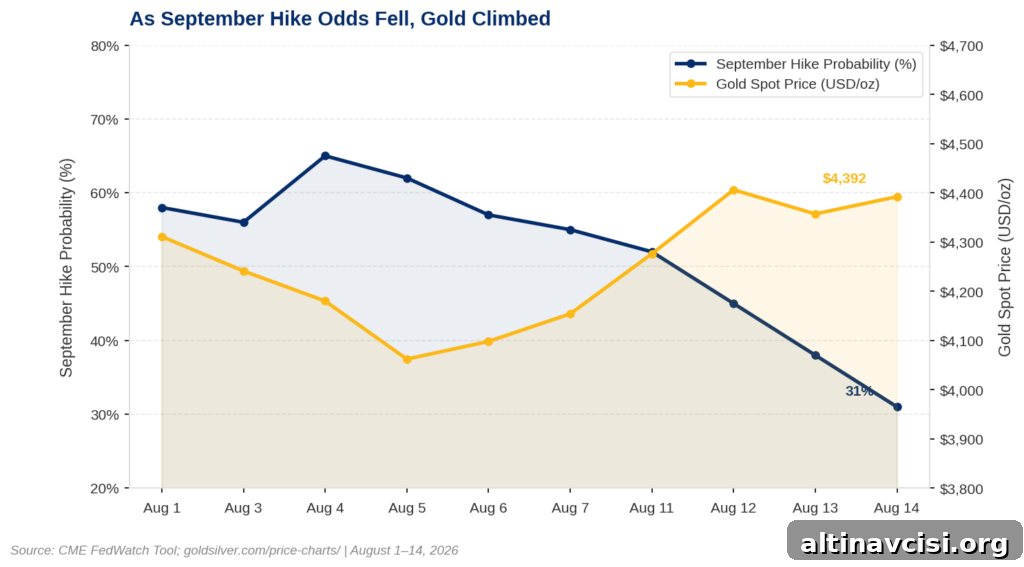
Reflecting that shift, the market-implied probability of a September Federal Reserve rate hike fell sharply this week. One week earlier, roughly half of market participants priced in a 25-basis-point increase; by Friday morning the odds had dropped substantially, with a majority expecting the Fed to hold instead of raise in September. Those changing probabilities directly influence real yields and, in turn, support for precious metals.
What Sound-Money Investors Are Watching Now
For investors who hold physical gold and silver with a multi-year horizon, short-term price moves matter for timing but do not usually alter the underlying thesis. What matters is understanding which mechanics are driving a particular move: whether the dominant force is real-yield compression, rising inflation expectations, renewed safe-haven demand, or some combination.
The purchasing-power case for gold does not require a collapse in the economy. It requires that prices repeatedly rise faster than incomes, gradually eroding purchasing power — a condition the Michigan survey has signaled intermittently over the past two years. When official data align with what households feel in their wallets, the practical argument for holding sound money becomes more immediate for many investors.
Silver shares much of gold’s structural support but adds industrial demand sensitivity: silver often outperforms when the broader economy stabilizes because of its industrial uses. The current gold-silver ratio remains elevated relative to long-term averages, a level that historically has tended to resolve with periods of silver strength.
Looking ahead, the market will focus on the FOMC minutes from the July 28–29 meeting. Those minutes will reveal how much actual appetite for a September hike exists within the committee, beyond the probabilities currently priced by markets. For now, the data are clear: two months of improving consumer sentiment ended with a notable reversal, and that reversal arrived paired with rising inflation expectations — a combination the Fed is unlikely to ignore.
Stay On Top of Gold & Silver Prices
Get important market alerts sent straight to your inbox.
SOURCES
1. University of Michigan, Surveys of Consumers — Preliminary August 2026 Consumer Sentiment Release.
2. US Census Bureau — Advance Monthly Retail and Food Services Sales, July 2026, released August 14, 2026.
3. CME Group — FedWatch Tool, September 2026 rate probabilities, August 14, 2026.
4. Bureau of Labor Statistics — Consumer Price Index Summary, July 2026, released August 12, 2026.
5. Bureau of Labor Statistics — Producer Price Index Summary, July 2026, released August 13, 2026.
6. Federal Reserve — FOMC Statement, July 29, 2026.
7. GoldSilver — Live Gold and Silver Spot Prices, August 14, 2026.
Disclaimer: This article is for informational purposes only and does not constitute investment advice. Past performance is not indicative of future results. Always consult a qualified financial advisor before making investment decisions.
You May Also Like:
- Gold Price and the September Fed Pivot: Five Data Prints Rewrote the Odds This Week
- The Fed’s September Math Just Changed. Here’s What It Means for Gold.
- Jackson Hole Is 14 Days Away. What Warsh Says Could Move Gold More Than Any Inflation Print.
- Gold Hit a Two-Month High. Then It Pulled Back. The PPI Data That Caused Both Moves Is What Matters.
- Two Soft Inflation Prints. Gold Is Still Below $4,500. One Number Is Keeping It There.
- China Bought the Most Gold Since 2023 in July. Here’s Why.
Popular Topics
Picked from the archive
-
01
 Topics
Gold Prices Stabilize Amid Saudi-Iran Tensions
-
02
Topics
Why Gold Held Steady After Trump’s Economic Pressure on Iran
-
03
Topics
Oil Drops 11% as Gold Rises: What Investors Need to Know
-
04
Topics
3 Questions Investors Must Ask Before Buying Any Asset in 2026
-
05
Topics
Silver Surges Past $70 Amid Conflicting GDP Data
-
06
Topics
What’s Moving Gold and Silver Prices This Week
-
07
Topics
How FOMC Minutes and Jackson Hole Could Move Gold
-
08
Topics
Two Investors Ran Debt Math Separately and Chose 15 Percent Gold