How the Federal Reserve Shrunk the Dollar’s Value 97% Since 1913
Key Takeaways
- The Federal Reserve (the Fed) is the United States central bank, created by Congress in 1913 to stabilize the banking system and prevent financial panics.
- The Fed operates under a dual mandate from Congress: maintain price stability (a 2% inflation target) and pursue maximum sustainable employment.
- The Fed’s most influential tool is the federal funds rate — the overnight borrowing rate that affects mortgages, loans, and savings across the economy.
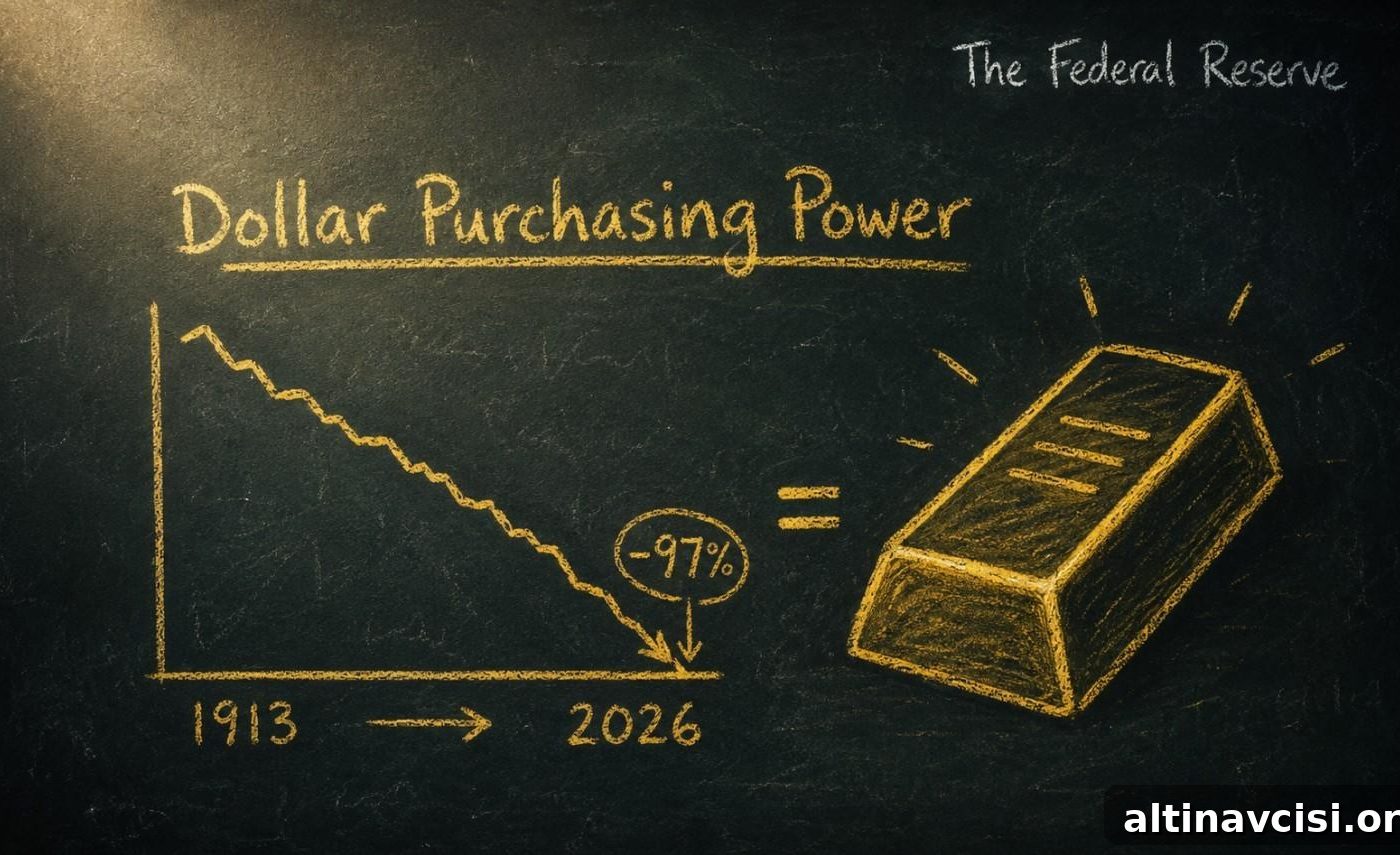
- Since 1913, the dollar has lost roughly 97% of its purchasing power, a long-term consequence of fiat monetary expansion; gold has tended to move in the opposite direction.
- As of July 29, 2026, the Fed held the policy rate at 3.50%–3.75% for the fifth straight meeting, with three dissenting votes favoring a hike.
The Federal Reserve is one of the most powerful financial institutions in the world, and yet its workings are unfamiliar to many. The Fed sets the price of money in the world’s largest economy. Its decisions touch mortgage rates, credit cards, savings yields, retirement portfolios and the price of precious metals like gold and silver. Understanding the Fed explains why markets move when officials speak, and why cash savings can lose buying power when inflation runs above interest rates.
What Is the Federal Reserve?
The Federal Reserve is the United States central bank, created when President Woodrow Wilson signed the Federal Reserve Act on December 23, 1913. The Fed was established to provide a stable, flexible monetary and financial system after a history of recurring banking panics, including the Panic of 1907.
The Fed is a decentralized institution made up of several components:
- 12 regional Reserve Banks, spread across major cities including Boston, New York, and San Francisco.
- The Board of Governors in Washington, D.C. — seven presidential appointees serving staggered 14-year terms, with shorter terms for the Chair and Vice Chairs.
- The Federal Open Market Committee (FOMC) — a 12-member committee that sets interest rate policy and meets regularly throughout the year.
The system’s regional design reflects political compromises from 1913 intended to distribute authority beyond the financial centers on the East Coast. Regional Reserve Bank presidents rotate as voting members of the FOMC, and their dissenting votes are part of the public record. For example, on July 29, 2026, three regional presidents dissented from the FOMC majority, preferring a rate increase.
The Knowledge That Changes Everything
Two concise guides — free. Learn why gold plays a vital role as a monetary hedge and why fiat currencies trend toward depreciation over time.
What Is the Fed’s Job? The Dual Mandate Explained
Congress gives the Federal Reserve two simultaneous objectives, often called the dual mandate:
- Maximum employment — the Fed aims to sustain low unemployment consistent with stable inflation.
- Price stability — the Fed targets an average of 2% annual inflation, typically measured by the Personal Consumption Expenditures (PCE) index.
Those goals can conflict. Low unemployment can boost wages and push prices higher. To cool inflation the Fed may raise interest rates, which can slow hiring and economic activity. Conversely, cutting rates to stimulate employment can risk higher inflation. The Fed constantly manages this trade-off, guided by data and its policy framework.
Debate about the mandate continues. For example, in 2026 the U.S. House Financial Services Committee considered legislation to alter the Fed’s remit to focus solely on price stability. That discussion highlights enduring questions about the balance between inflation control and labor-market support.
How Does the Fed Control the Economy?
The Fed’s primary policy instrument is the federal funds rate, the overnight rate banks use to lend reserve balances to one another. Changes in that rate quickly influence borrowing costs throughout the economy: mortgages, auto loans, business borrowing and the rates paid on savings accounts. When the Fed raises the federal funds rate, borrowing becomes more expensive, which tends to slow spending and reduce inflation. When it lowers the rate, borrowing is cheaper and economic activity often accelerates.
Beyond the policy rate, the Fed uses several other tools:
- Open market operations — buying or selling Treasury securities to adjust the supply of reserves in the banking system.
- Quantitative easing (QE) — purchasing longer-term securities when short-term rates are at or near zero to push down long-term rates and support credit markets. QE expands the Fed’s balance sheet; quantitative tightening reverses that process.
- Reserve requirements — rules for how much cash banks must hold. These requirements are rarely actively used today.
Markets pay particular attention to the federal funds target because it cascades through the entire financial system. As of July 29, 2026, the FOMC maintained a target range of 3.50%–3.75% with a 9–3 vote; three members preferred a higher rate.
Is the Federal Reserve Independent?
The Fed occupies a unique position: it was created by Congress and its governors are appointed by the President and confirmed by the Senate, yet it was designed to operate without direct political interference in day-to-day decisions. The Fed does not rely on congressional appropriations for its funding, which reinforces operational independence.
That independence matters because elected officials face reelection incentives that can favor looser policy. An independent central bank can, in theory, make difficult decisions to stabilize prices and financial markets. In practice, tensions between the Fed and elected leaders arise periodically, and those public disagreements can increase uncertainty about monetary policy.
How Does the Fed Affect Gold Prices?
Gold’s price is closely linked to real interest rates — nominal yields adjusted for expected inflation. Gold yields no interest, so when real yields on government bonds rise, holding gold becomes costlier compared with interest-bearing assets. Conversely, when real yields fall, gold becomes more attractive. Historically, movements in real yields have correlated strongly with changes in the gold price: a modest move in real yields can translate into a significant dollar change per ounce.
Over the long term, the expansion of fiat money has eroded the dollar’s purchasing power. Measured from 1913 to the mid-2020s, the dollar has lost most of its value relative to goods and services. Since the dollar decoupled from gold in 1971, gold moved from a fixed $35 per ounce to multi-thousand-dollar levels by 2026. That long-term relationship explains why some investors hold physical gold and other non-dollar-denominated assets as a hedge against currency depreciation.
Dollar purchasing power
−97%
since 1913 · BLS CPI-U
Gold indexed to 1913
+19,800%
$20.67 → $4,109 · gold price history
Dollar purchasing power (indexed, 1913 = 100)
Both series indexed to 1913 = 100. Dollar purchasing power is based on historical CPI-U data. Gold price reflects long-term spot price movement (referenced through mid-2026). Not a forecast, but a historical comparison showing how fiat money’s purchasing power has changed relative to gold.
What Has the Fed Actually Delivered? A 112-Year Track Record
The Fed was created to reduce the frequency and severity of banking panics. Over the last century-plus the institution has been central to America’s responses to major economic events: the Great Depression, World War II, the 1970s inflationary period, the 2008 financial crisis, and the pandemic shock of 2020. In each episode, policymakers deployed rate cuts, liquidity support and balance-sheet expansion to stabilize markets.
Those interventions have a cost: repeated monetary expansion contributes to the gradual erosion of purchasing power. That erosion accumulates slowly year to year but becomes consequential over decades, which is why savers, retirees and long-term investors pay attention to both monetary policy and non-dollar assets.
Stay On Top of Gold & Silver Prices
Receive timely market alerts and price updates delivered to your inbox.
People Also Ask
The Federal Reserve is the U.S. central bank, established in 1913 to provide a safer and more stable monetary and financial system. It supervises and regulates banks, acts as a lender of last resort, manages the payments system and conducts monetary policy to promote stable prices and employment.
The Fed’s dual mandate requires it to seek maximum sustainable employment and stable prices. In practice, this means balancing the trade-off between supporting job growth and keeping inflation near the 2% target. Policy choices often reflect current economic conditions and the Fed’s outlook for growth and inflation.
The FOMC — comprised of the Board of Governors and rotating regional presidents — meets regularly to set a target range for the federal funds rate. That target guides short-term interest rates and influences borrowing costs throughout the economy, from mortgages to business loans.
Quantitative easing is used when short-term rates are already low but additional stimulus is needed. The Fed buys longer-term securities to lower long-term interest rates and support financial conditions. QE directly increases the Fed’s balance sheet, whereas normal policy adjusts short-term interest rates.
Gold is sensitive to real interest rates. When real yields rise, gold becomes less attractive relative to yielding assets. When real yields fall or inflation expectations climb faster than yields, gold tends to gain. Over decades, expansion of the money supply has been a key factor in gold’s long-term appreciation relative to the dollar.
The Fed was created by Congress and its leaders are presidentially appointed and Senate-confirmed, but it operates with a degree of independence from daily political influence. This structure is intended to insulate monetary policy decisions from short-term political pressures.
The federal funds rate influences bank deposit rates and lending rates. When inflation exceeds what savings accounts yield in real terms, savers lose purchasing power. That dynamic motivates many to diversify holdings beyond cash, including into assets such as precious metals.
SOURCES
Federal Reserve historical and structural materials; Congressional Research Service analyses of the Fed’s mandate; St. Louis Fed commentary on the dual mandate; Federal Reserve H.6 money stock releases; contemporary reporting on Fed policy decisions; historical gold price series for long-term comparisons.
Disclaimer: This article is for informational purposes only and does not constitute financial or investment advice. Consult a qualified financial adviser before making investment decisions.
You May Also Like:
- Class 3 Vault: The Two-Hour Attack Standard That Protects Your Gold
- American Gold Eagle Coin: The Complete Investor Guide
- The Petrodollar System Explained: What It Is, How It Worked, and What’s Replacing It
- What Is a Self-Directed IRA? The Complete Guide for Precious Metals Investors
- Kiyosaki Gold Prediction: Buy the Dip or Wait?
- Gold Risk-Reward Calculator: Is Your Portfolio Actually Safe?
- What Are the Best Physical Precious Metals Products to Buy During a Correction?
Popular Topics
Picked from the archive
-
01
 Topics
Silver Drops 1.4% as Gold Holds; Ratio Reaches 70:1
-
02
Topics
BEA Removed Silver From GDP: What It Means
-
03
Topics
Gold and Silver Prices Jump Amid Strait of Hormuz Tensions
-
04
Topics
Gold Price Falls Before US Market Opens
-
05
Topics
Which Countries Hold the Most Gold Reserves?
-
06
Topics
Gold Price Falls Today: Why $4,500 Holds as Support
-
07
Topics
Markets Eye Friday CPI as Credit Card Debt Reaches Record High
-
08
Topics
Gold Drops as China Buys Most in 17 Months