Warsh Says PCE Drop Was Not Much of a Factor, Gold Agrees

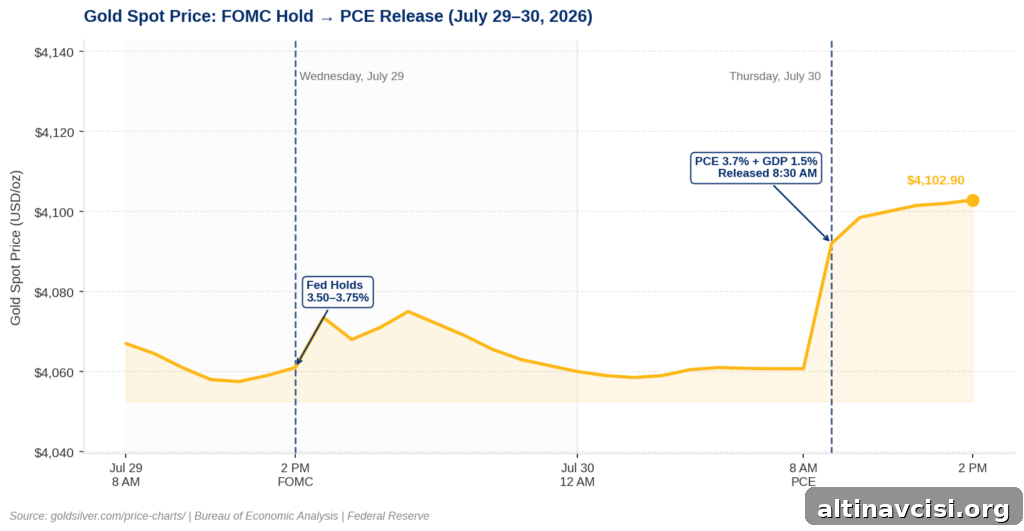
June’s inflation report was released Thursday morning. The Federal Reserve’s preferred measure, the Personal Consumption Expenditures (PCE) price index, eased to 3.7% year‑over‑year from 4.1% in May and fell 0.1% on the month, according to the Bureau of Economic Analysis.
Gold opened higher by about $34. By Thursday afternoon, spot gold traded near $4,102.90, an intraday gain of roughly 0.86% on the day. Silver rose about 1.43%, trading near $58.77. If you expected cooler headline inflation to knock gold lower, the full picture helps explain why that simple expectation missed key dynamics.
Why the PCE Drop Did Not Push Gold Lower
The BEA release contained data that pointed in different directions, so the headline PCE number told only part of the story.
The headline PCE decline was real but narrow in scope: much of it reflected lower energy prices tied to a temporary lull in Iran‑related tensions during June. Core PCE, which excludes food and energy, rose 0.1% for the month and remained at 3.3% year‑over‑year. That persistence in core inflation—four straight months at or above 3.3%—suggests underlying price pressure remains.
At the same time, the BEA reported the GDP Price Index for Q2 at 6.3%, well above consensus expectations near 3.6%. The GDP Price Index measures price changes for domestically produced goods and services—manufacturing output, business investment, government production and exports—excluding imports. In short, inflation was cooling on the consumer surface while accelerating inside the productive side of the economy. Those mixed signals help explain why gold rose despite the softer headline PCE.
The Edge Every Investor Needs
Smarter precious metals investing starts here. The Nuggets Newsletter highlights market insights, Fed developments, global trends, educational videos, and more.
Subscribe to get key market alerts and concise analysis delivered to your inbox.
What Warsh Said — and Why It Matters for Gold
Fed Chair Kevin Warsh made it clear after the July 29 FOMC decision that a single month of softer headline inflation is not enough to shift policy direction. In his opening remarks, Warsh emphasized that more than five years of inflation above the Fed’s target cannot be undone by a brief period of modest price decreases. In other words, a one‑month improvement in headline PCE does not automatically change the Fed’s policy calculus.
Following the statement, the FOMC voted 9‑to‑3 to keep the target federal funds rate at 3.50% to 3.75%, with three regional presidents dissenting in favor of an immediate hike. Market odds for a September rate move moved as investors digested both the PCE and the hotter GDP Price Index. Those competing signals—some data cooling, some showing stronger underlying price pressure—keep economic outlooks and rate expectations unsettled.
What the GDP Price Index Means for Precious Metals Investors
The GDP Price Index tracks price changes for goods and services produced within the domestic economy, including manufacturing, business investment, government output and exports, while excluding imports. When that index prints significantly above expectations—6.3% versus a consensus near 3.6% in the recent release—it signals inflation pressure embedded in the production side of the economy that the consumer‑facing PCE may not fully capture.
For precious metals, that combination—slowing consumer inflation on the surface but rising economy‑wide price pressures—has historically supported demand for stores of value. Investors who focused only on the headline PCE saw a promising number; those who read the full BEA release observed slowing growth with increasing internal price pressure, a mix that often favors gold and silver as hedges against persistent or resurging inflation.
What This Means for Your Holdings Going Forward
The next major calendar milestones include Fed Chair Warsh’s Jackson Hole remarks and the September FOMC meeting. Thursday’s data shifted market pricing for September, but did not resolve the narrative: the softer headline numbers eased some near‑term hike odds, while the strong GDP Price Index kept longer‑term inflation risks on the table.
For holders of physical gold and silver, that unresolved tension can be constructive. The structural investment case does not rest on one monthly inflation print; it rests on a constrained Fed, an economy showing internal inflationary pressures and the gradual erosion of real purchasing power. Silver’s stronger intraday move compared with gold reflected a tightening in the gold‑silver ratio; it illustrates how market mechanics—positioning, relative value and inflation expectations—often drive precious metals more than any single headline metric.
Stay On Top of Gold & Silver Prices
Get important market alerts sent straight to your inbox.
Subscribe to the newsletter from the website to receive alerts and concise market commentary.
SOURCES
1. Bureau of Economic Analysis — GDP (Advance Estimate), 2nd Quarter 2026
2. Bureau of Economic Analysis — Personal Income and Outlays, June 2026
3. Federal Reserve — Chairman Warsh’s Press Conference Opening Statement, July 29, 2026
4. CNBC — Analysis and reporting on the July 29, 2026 FOMC press conference
5. CNN — Coverage of June PCE and related developments
6. Fox Business — Reporting on the July FOMC decision and market reaction
7. GoldSilver — Live gold spot price reporting
8. GoldSilver — Live silver spot price reporting
Disclaimer: This article is for informational purposes only and does not constitute financial or investment advice. Always consult a qualified financial adviser before making investment decisions.
You May Also Like:
- Gold at $4,100. Silver Still Stuck Below $60. Five Signals Define the Next Six Weeks.
- Oil Spiked 8%. Gold Went Up Anyway. Here Is Why This Time Is Different.
- Gold Is Up $40. Here Is What the 9‑3 Fed Vote Actually Means.
- Iran Fired Missiles. Oil Spiked 6%. Gold Fell. The Three‑Step Chain Behind the Move.
- Everyone Is Watching the Fed. Gold Is Watching Tomorrow at 8:30 a.m.
- Gold Is Down $48. Here Are the Five Reasons Why.
Popular Topics
Picked from the archive
-
01
 Topics
Gold vs Silver: Why Gold Stabilizes Markets, Silver Amplifies
-
02
Topics
Gold Prices Surge: The Unexpected Reason
-
03
Topics
How Gold Is Changing Wall Street’s 60/40 Portfolio
-
04
Topics
Gold ETFs Lost 45 Tonnes as Central Banks Net 289: Why It Matters
-
05
Topics
Fed Split on Rate Hike as 45% of Central Banks Buy Gold
-
06
Topics
Why Gold and Oil Move Opposite and What It Means for Investors
-
07
Topics
Gold Near $4,700: Market Chaos May Be a New Floor
-
08
Topics
Gold Radar: 5 Hidden Signals Your Price Chart Misses