Why China’s Silver Imports Soared to a Record in 2026

Gold and silver market update — April 22, 2026
Key takeaways:
- China’s silver imports in March 2026 were 173% above the 10-year seasonal average — the highest on record per Chinese Customs Authority data.
- Two unrelated forces drove the surge simultaneously: retail investors substituting silver for gold after gold neared $5,500/oz, and solar manufacturers accelerating shipments ahead of China’s April 1 removal of export tax rebates.
- Strong physical demand and lower spot prices can coexist — heavy Chinese buying helps establish a physical demand floor, but it does not directly set global spot prices.
China’s silver imports in March 2026 reached a record level, arriving 173% above the 10-year seasonal average, according to Chinese Customs Authority data reported by major news outlets. Year-to-date imports for 2026 are also at record highs. The spike is notable not just for its magnitude but because it was driven by two distinct and unrelated buyer groups acting at the same time.
Examining both buyer groups—retail savers and industrial users—reveals the mixed demand profile that makes silver different from other precious metals. Those separate motivations converged in March and produced an unusually large, clear signal in import statistics.
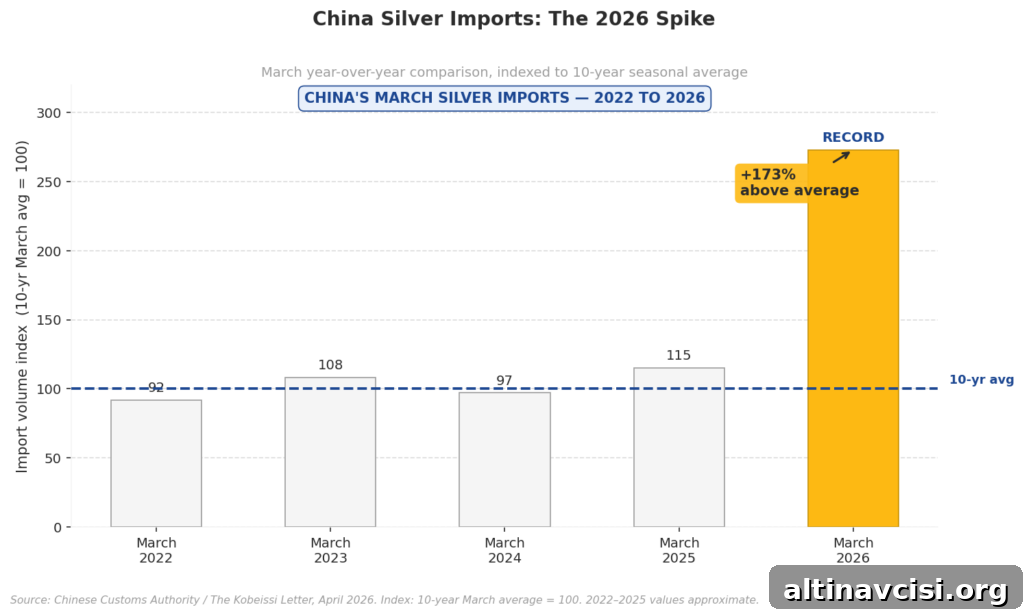
Why Chinese Silver Imports Hit a Record in March 2026
Two independent forces converged in March 2026. First, retail savers who typically buy physical metals shifted from gold to silver after gold rallied near $5,500 per ounce in January 2026. When the primary monetary metal becomes unaffordable to many individual savers, they often substitute into silver as a lower-cost store of physical value.
Second, solar panel manufacturers accelerated production and shipments ahead of a regulatory change: on April 1, 2026 China removed certain export tax rebates for finished solar panels. That policy change made imminent exports more costly, so manufacturers rushed to complete and ship panels before the rebate ended. Producing and shipping more panels in a compressed timeframe increased silver consumption within March because silver paste and other silver inputs are integral to panel manufacturing.
These two buyers were not reacting to the same signal. One was driven by monetary and saving behavior; the other by a calendar-driven industrial decision. Together, they pushed import volumes far outside typical seasonal ranges.
Why Are Chinese Retail Investors Buying Silver Bars?
Physical metal ownership is a common savings practice across China. When gold became significantly more expensive in early 2026, many individual savers moved into silver as the practical alternative. This substitution behavior is familiar from past cycles: when gold climbs beyond the budgets of retail buyers, they often increase silver purchases. The result is a durable, price-sensitive component of silver demand driven by monetary motives and personal savings habits.
That shift does not require any change in long-term belief about precious metals. Instead, it reflects a pragmatic decision: maintain exposure to a physical store of value while staying within affordability constraints.
Why Did Solar Manufacturers Front-Load Silver Purchases?
China’s policy change on April 1, 2026 removed export tax rebates for finished solar panels, increasing the cost of exporting those panels after the deadline. To avoid higher export costs, manufacturers worked to finish and ship panels before April 1. That front-loading raised silver use in March because the solar industry is a major consumer of silver—accounting for a significant share of annual industrial demand.
This behavior is a timing shift rather than a structural acceleration: some of the demand that would normally have occurred in April and May was pulled into March. That makes March’s import spike partially a temporary distortion driven by timing, even though it still represents real, immediate physical consumption.
How Is Silver’s Demand Profile Different From Gold’s?
Silver occupies a middle ground between the major monetary metal, gold, and heavily industrial metals like platinum and palladium. Silver’s demand splits between monetary investors and industrial users, and those two drivers are often uncorrelated. Monetary demand increases with inflationary pressures, negative real yields, or loss of confidence in fiat currencies. Industrial demand increases with technological deployment—most notably with solar panel manufacturing and electronics.
In March 2026 both demand channels were active: retail monetary buyers shifting from gold and industrial manufacturers accelerating production. When these drivers amplify one another, the combined effect on physical flows is amplified, especially in a market already running a structural supply deficit.
Does Strong Demand Explain Why Silver’s Price Still Fell?
A common question is why spot silver fell roughly 15% from its January 2026 high by mid-April even though Chinese physical demand surged. The explanation lies in how prices are formed: global spot prices are set in futures and exchange markets (COMEX, LBMA) and reflect broad positioning, currency moves, interest-rate expectations, and profit-taking. In Q1 2026, a stronger U.S. dollar, hawkish Federal Reserve signals, and post-rally profit-taking pressured prices.
Physical demand shown in import data does not directly move the spot market, but it influences the market’s underlying supply and demand balance. Large and sustained physical buying establishes a floor for how low inventories can fall before scarcity begins to influence price formation. In short, strong physical demand and temporary spot weakness can coexist.
What Should Silver Investors Watch Next?
Investors should monitor China’s monthly import releases, which typically arrive with a 4–6 week lag, to see whether the elevated retail demand persists after the industrial front-loading fades. Expect a partial pullback in April and May as solar producers normalize shipments, but watch whether a higher baseline of retail buying remains in place.
Supply context matters: the World Silver Survey 2026 (published in April 2026) confirmed a multi-year structural deficit in the silver market. A temporary timing distortion does not erase that deficit. Two important questions to follow are whether China’s retail silver demand holds once the solar timing effect diminishes, and whether industrial demand outside the solar front-loading continues above prior-year levels. Those developments will determine whether the March spike was a one-time blowout or the start of a sustained tightening of physical balances.
Stay On Top of Gold & Silver Prices
Receive timely market alerts and analysis delivered to your inbox.
Newsletter signup removed from this version.
SOURCES
1. Chinese Customs Authority silver import data reported in March 2026.
2. World Silver Survey 2026, Silver Institute.
3. Gold price data reported by major market data providers in Q1 2026.
4. Historical precious metal price references from major exchanges and market data services.
By the GoldSilver Editorial Team — helping investors understand sound money since 2005. This article is for informational purposes only and does not constitute financial, investment, or tax advice. Always consult a qualified financial advisor before making investment decisions.
You May Also Like:
- What Drives Gold Prices? 5 Forces Investors Are Watching Now
- The Gold-Silver Ratio Signal: What Silver’s Lead Means
- Gold Drops to $4,681 — Iran Ceasefire Expires Today
- The Real Reason Gold Is Down During an Oil War
- What the Warsh Hearing Means for Gold Prices
- IMF Says Treasuries Aren’t Safe Anymore. Gold Noticed First.
- Gold Price After Ceasefire Violation: The Floor Has Moved
- Oil Crashed 11%. Gold Went Up. That Tells You Everything.
Popular Topics
Picked from the archive
-
01
 Topics
Gold Coins vs Gold Bars: Compare Value, Liquidity and Costs
-
02
Topics
Silver Price Hits $50 as Morgan Stanley Allocates 20% to Gold
-
03
Topics
HSBC Survey: Investors Double Gold Allocations as Markets Falter
-
04
Topics
Wall Street Whiplash: Stocks Rally on CPI, Plunge on PPI Shock
-
05
Topics
Gold Price Support Shifts After Ceasefire Violation
-
06
Topics
Gold Prices Jump Past $4,000 as Fed Signals Rate Cut
-
07
Topics
Why Gold Is Outperforming Nvidia in 2025
-
08
Topics
High Earners Falling Behind on Credit Cards and Auto Loans