Official US Data Show Government Is Insolvent
Key Takeaways:
— The U.S. Treasury’s FY2025 consolidated financial statements show a negative net position of $41.72 trillion.
— When 75-year unfunded Social Security and Medicare obligations are included, total federal promises exceed $136.2 trillion.
— The Government Accountability Office (GAO) has declined to certify the U.S. government’s consolidated financial statements for 29 consecutive years.
The U.S. government’s own consolidated accounts for fiscal year 2025 make a stark admission: on a formal accounting basis, the nation is insolvent. Rather than a press conference or hearing, this conclusion is visible in the Treasury Department’s published financial statements, released in March 2026 and largely overlooked by mainstream coverage.
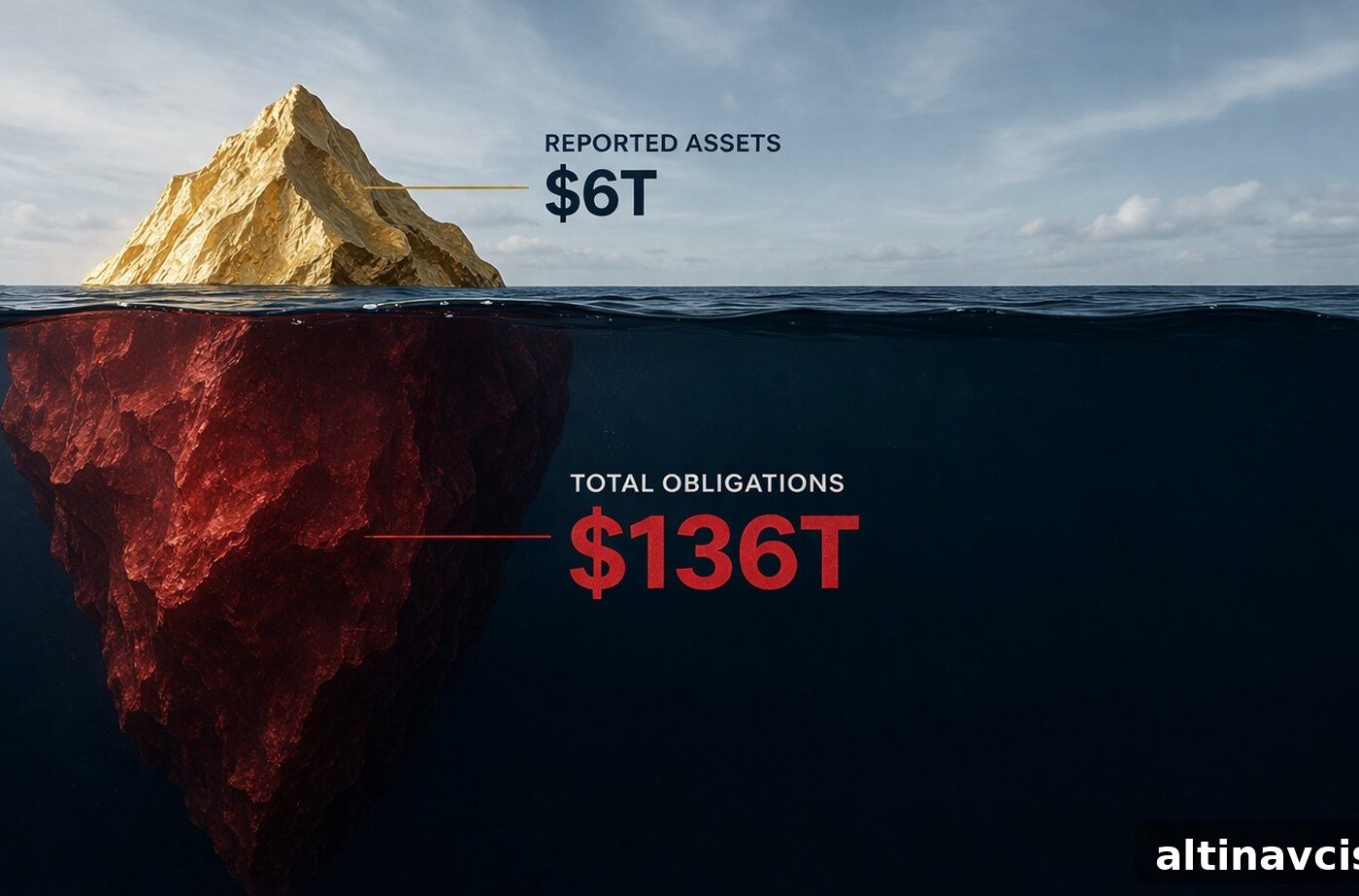
Economists Steve Hanke (Johns Hopkins University) and David Walker (former U.S. Comptroller General) analyzed those numbers and summarized the central result: the Treasury reports $6.06 trillion in assets versus $47.78 trillion in liabilities. That produces a negative net position of $41.72 trillion.
What Do the Treasury’s Numbers Actually Show?
The consolidated balance sheet is sobering: official liabilities are now nearly eight times reported assets. The largest contributors to that imbalance include a nearly $2 trillion increase in federal debt and interest payable, which now totals about $30.33 trillion, and a $438.8 billion rise in obligations for federal employees and veterans.
Those balance-sheet figures, however, do not capture the full fiscal picture. The Treasury also publishes a Statement of Social Insurance that records projected future obligations for Social Security and Medicare. On that basis, the 75-year unfunded liability jumped by $10.1 trillion in a single year, rising from $78.3 trillion to $88.4 trillion. The year-over-year increase was driven largely by a $6.9 trillion expansion in projected Medicare Part B shortfalls.
Combine those off-balance-sheet social insurance obligations with the official liabilities on the balance sheet, and total federal promises exceed $136.2 trillion—roughly five times annual U.S. GDP.
One additional detail: the Government Accountability Office issued a disclaimer of opinion on the FY2025 consolidated statements. This marks the 29th consecutive year the GAO could not confirm whether the government’s financial statements were fairly presented, largely because of persistent reporting issues at the Department of Defense.
What Does $136 Trillion Actually Look Like?
Trillion-dollar figures are hard to visualize. Hanke and Walker suggest dividing every number by 100 million to create a relatable household example. The result reads like this: a household with annual income of $52,446 and spending of $73,378 runs a $20,932 deficit each year. Its total liabilities and unfunded promises equal $1,361,788 while assets amount to only $60,554. The household is not merely overspending; it is structurally insolvent.
That is the precise term the authors use: insolvent. Not “stressed” or “at risk,” but insolvent.
U.S. Treasury · FY2025 Financial Statements
The U.S. Balance Sheet: What the Numbers Actually Show
Scale adjusted to show relative size — all figures in trillions of U.S. dollars.
What the government owns
Reported on balance sheet
Including Social Security & Medicare
Official liabilities are now nearly 8× reported assets. When off-balance-sheet Social Security and Medicare obligations are included, total federal promises exceed $136 trillion — roughly 5× U.S. annual GDP.
Assets ($6.06T)
Official liabilities ($47.78T)
Total obligations incl. unfunded ($136.2T)
Source: U.S. Treasury FY2025 Consolidated Financial Statements; Statement of Social Insurance; analysis by Hanke & Walker (March 2026)
Does “insolvent” Mean the U.S. Is About to Default?
Not necessarily. The United States issues the world’s primary reserve currency and has access to deep, liquid capital markets. It can borrow on a large scale and, if required, expand the money supply to meet obligations. A classic sudden default—where payments stop entirely—is not the most likely immediate result.
That said, using borrowing and monetary expansion to bridge structural shortfalls carries consequences. When obligations persistently outpace an economy’s ability to fund them through growth and productivity, the adjustment usually takes the form of currency debasement: a gradual reduction in the real purchasing power of money. Governments expand the money supply faster than output grows, and over time that erodes the value of savings and income.
That process can be slow and largely invisible in nominal portfolio returns. Even as account balances appear steady or rising, their real purchasing power can be quietly squeezed.
Why Is the Debt Problem Getting Harder to Solve?
Historically, higher interest rates are the conventional tool for fighting inflation. But higher rates also increase the cost of servicing outstanding debt. As borrowing costs rise, deficits grow, prompting more bond issuance; greater supply of bonds can push rates even higher. That feedback loop is now self-reinforcing, narrowing feasible policy options.
Decades of ultra-low rates encouraged unprecedented borrowing across governments, corporations, and households. The structure that formed under those conditions is now adjusting to a permanently higher-rate world. At the same time, geopolitical fragmentation and shifting trade relationships are reshaping global monetary trust—forces that accumulate beyond short-term headlines.
Why Are Central Banks Buying Gold at a Record Pace?
Many central banks—especially in emerging market economies—have been increasing gold reserves aggressively. This is a strategic shift rather than a speculative trade. Gold has no counterparty risk: it does not depend on any government’s promise to pay and exists outside the credit-based financial system. As confidence in fiat currencies and traditional reserve assets is tested, gold’s role as a non-credit reserve asset gains importance.
Historically, gold tends to reassert itself during periods of currency debasement, monetary stress, and geopolitical uncertainty.
What Should Investors Do With This Information?
The headline is not that an immediate crisis is unavoidable. Dramatic outcomes are not guaranteed. The essential point is that the government’s own accounts indicate a structural shift: obligations now outstrip the government’s capacity to fund them on conventional terms.
When a fiscal system is structurally imbalanced, likely outcomes narrow to a predictable set: higher inflation, gradual currency debasement, and forms of financial repression that favor public balance-sheet repair over private purchasing power. These outcomes generally unfold over time, not overnight.
For investors, the question is whether portfolios are positioned for a world in which these forces slowly intensify. Assets outside the credit system—held as a form of insurance rather than speculation—may play a different role in preserving real purchasing power.
People Also Ask
Not by an official proclamation, but the Treasury Department’s FY2025 consolidated financial statements show $6.06 trillion in assets versus $47.78 trillion in liabilities, yielding a negative net position of $41.72 trillion. Independent analysis of those statements concludes the U.S. is, by standard accounting measures, insolvent.
It does not necessarily mean an immediate collapse or stopped payments. The U.S. can still borrow and expand the money supply. The more likely long-term adjustment is a gradual reduction in the dollar’s purchasing power—currency debasement—which erodes real savings and returns. Assets outside the credit system have historically preserved purchasing power better during such episodes.
The FY2025 Statement of Social Insurance records $88.4 trillion in 75-year unfunded social insurance obligations—an increase of $10.1 trillion in one year. Added to the $47.78 trillion in official balance-sheet liabilities, total federal promises exceed $136.2 trillion, roughly five times annual U.S. GDP.
Many central banks, particularly in emerging markets, have been net buyers of gold for years. The motivation is strategic reserve diversification: gold carries no counterparty risk, cannot be defaulted on, and is not a liability on any balance sheet. As trust in fiat systems is tested, gold is increasingly treated as a core reserve asset.
Currency debasement is the gradual loss of a currency’s purchasing power, typically caused by expanding the money supply faster than real economic output. For investors, the risk is that nominal portfolio values can remain steady while real value—that is, buying power—falls. History shows this dynamic can unfold slowly, eroding wealth over time.
Disclaimer: This article is for informational purposes only and does not constitute financial or investment advice. Past performance is not indicative of future results. Consult a qualified financial advisor before making any investment decisions.
You May Also Like:
- UBS Forecasts Gold Above $6,000 — Should You Buy Now?
- Gold and Silver Mining Stocks: What Most Investors Miss
- Is There a Silver Shortage in 2026? The Data Is Alarming
- The Seven Stages of Empire: Why Every Great Currency Eventually Collapses
- When Should You Sell Gold and Silver? (And What to Buy Next)
- Could the US Revalue Its Gold Reserves to Pay Down Debt?
Popular Topics
Picked from the archive
-
01
 Topics
Gold Price Drops Below $5K After Jobs Revisions Roil Markets
-
02
Topics
Fed Governor Resignation Strengthens Trump in Powell Rate Fight
-
03
Topics
Gold Falls to One-Week Low as Trade Talks Enter Final Days
-
04
Topics
Silver Surges Past $70 Amid Conflicting GDP Data
-
05
Topics
Harvard 51B Endowment Sells Tech, Buys Gold and Crypto
-
06
Topics
Gold Price Falls Below $3,340 Ahead of Fed Comments
-
07
Topics
Gold Trading Volume: Why $227B Daily Trades Matter to Investors
-
08
Topics
US Q2 GDP Rises as Falling Imports Mask Weak Domestic Demand