
Key Takeaways
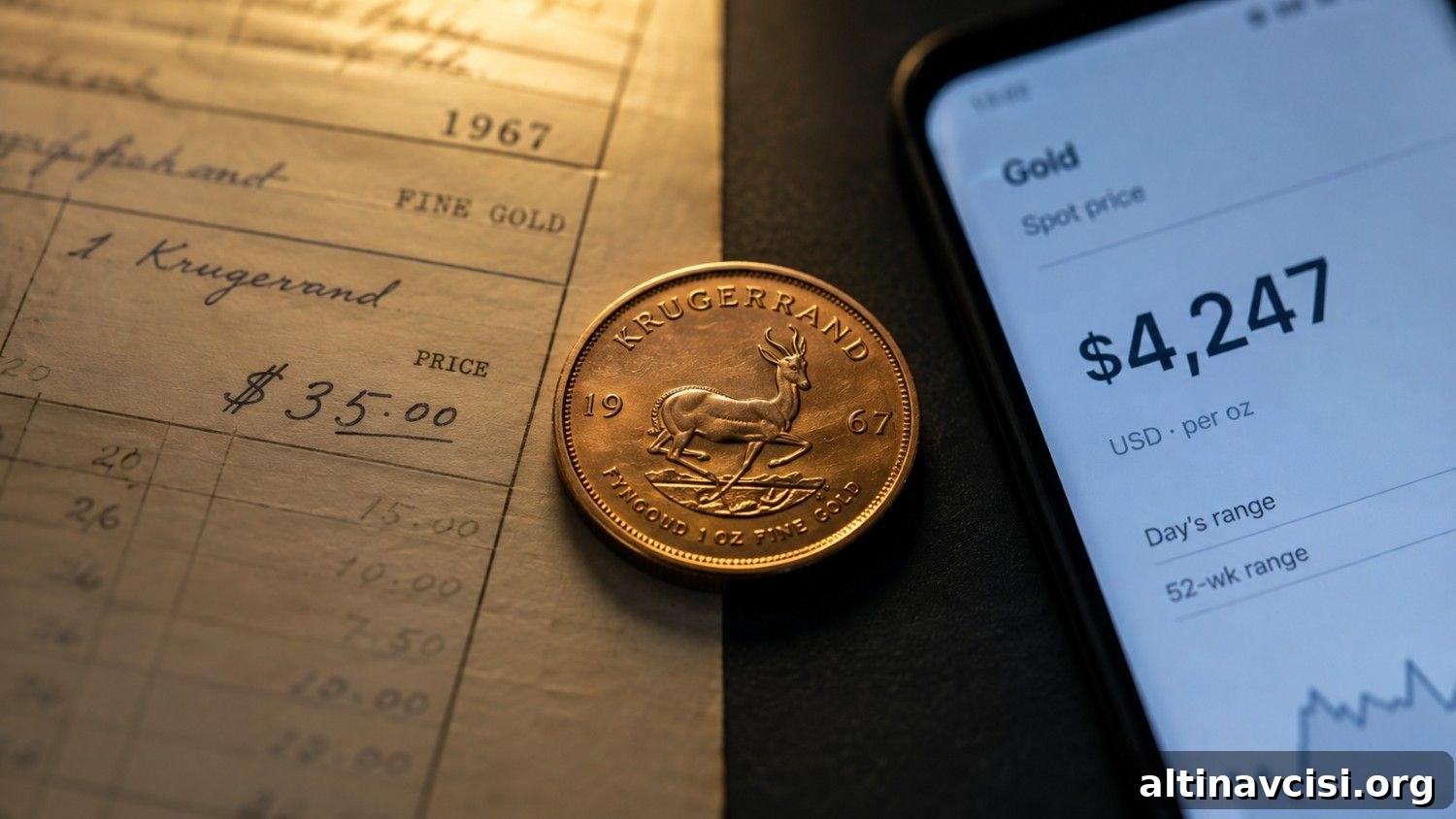
- The South African Krugerrand, launched July 3, 1967, was the world’s first gold bullion coin created specifically for private investors.
- Each 1 oz Krugerrand contains exactly one troy ounce of pure gold within a 22‑karat alloy — 91.67% gold and 8.33% copper — giving the coin both a warm color and increased durability.
- Unlike many coins, the Krugerrand carries no fixed face value. Its legal tender value reflects the current gold price, insulating it from currency debasement.
- By 1980 the Krugerrand accounted for roughly 90% of the global gold coin market. U.S. import restrictions in the 1980s helped spur competing coins such as the American Gold Eagle and Canadian Maple Leaf.
- Owning a Krugerrand today means holding the same type of asset that made gold ownership accessible to everyday investors. More than 60 million coins have been sold over nearly six decades.
Before 1967, individual investors faced significant obstacles to owning physical gold: restricted markets, dealers who catered to institutions, and bars sized for central banks. The South African Mint changed that with a compact gold coin featuring Paul Kruger on the obverse and a springbok on the reverse, and the gold market was transformed.
The Krugerrand was created to move gold from government reserves into private hands. It was designed as an investment vehicle rather than a collector’s item, built to be standardized, widely traded, and affordable for ordinary buyers. Its long production run, international distribution, and resilience through political disruptions helped establish the modern bullion coin market.
What Is the South African Krugerrand?
The Krugerrand is a gold bullion coin minted by the South African Mint and produced with Rand Refinery cooperation, first issued on July 3, 1967. Its name combines Paul Kruger, the South African Republic president whose portrait appears on the coin, and the rand, South Africa’s currency. The coin’s purpose was explicit: provide a practical, marketable form of gold for private investors.
Rather than serving as legal tender with a low nominal denomination, the Krugerrand was intended to trade according to the value of its gold content. This approach made it a straightforward way to own physical gold without tying the coin’s value to a fiat currency that could be inflated away.
What Is the Krugerrand Made Of?
A 1 oz Krugerrand contains exactly one troy ounce (31.1035 grams) of fine gold, but the coin’s total weight is heavier because it is struck in 22‑karat gold (91.67% gold, 8.33% copper). A full‑weight 1 oz Krugerrand therefore weighs 1.0909 troy ounces, about 33.93 grams. Copper is added to improve the coin’s hardness and wear resistance and to give it a distinctive warm, reddish tone.
The South African Mint also produces Krugerrands in silver (.999 fine) and platinum (.9995 fine), though the 22‑karat gold version remains the original and most widely held.
Why Does the Krugerrand Have No Face Value?
Although legal tender in South Africa, the Krugerrand has no stamped denomination. This choice ensures the coin’s legal tender value equals the market price of the gold it contains, rather than an arbitrary fiat figure. A fixed face value can become meaningless when metal prices rise sharply; by avoiding a nominal denomination, the Krugerrand remains a pure expression of gold value and is therefore protected from currency debasement.
How Did the Krugerrand Dominate the Gold Coin Market?
South Africa was the world’s largest gold producer when the Krugerrand launched. The government and industry promoted the coin internationally, and rising gold prices in the 1970s made it an attractive investment. Early mintage was modest, but as demand grew the Krugerrand became widely available and highly liquid. Between 1970 and 1980, tens of millions of coins were produced, and by 1980 the coin accounted for roughly 90% of the global bullion coin market.
Its combination of recognizable design, low premiums, and wide distribution made the Krugerrand the standard vehicle for private gold ownership, effectively creating the modern retail bullion market.
Why Was the Krugerrand Banned in the United States?
In 1985 the United States prohibited imports of Krugerrands as part of economic sanctions against apartheid South Africa. The ban sharply reduced mintage and sales because the U.S. had been a major market. The restriction also prompted the U.S. to create its own bullion program, resulting in the American Gold Eagle. The import ban remained until the early 1990s and is now a historical episode in the coin’s story, showing both the political risks bullion can face and the resilience of the market once restrictions are lifted.
What Sizes Does the Krugerrand Come In?
Originally available only as a 1 oz coin, fractional sizes were introduced in 1980 to broaden access. Available sizes include:
- 1/2 oz — contains 0.5 troy oz of fine gold
- 1/4 oz — contains 0.25 troy oz of fine gold
- 1/10 oz — contains 0.1 troy oz of fine gold
All sizes share the same 22‑karat composition and design. Fractional coins usually carry slightly higher premiums relative to their gold content because of manufacturing costs, while proof issues are produced in limited runs for collectors and trade at higher premiums.
How Does the Krugerrand Compare to Other Gold Bullion Coins?
The Krugerrand established the basic model for modern bullion coins. Competing coins have differentiated by purity, face value, and domestic marketing. For example, the Canadian Gold Maple Leaf uses .9999 fine gold and carries a small face value; the American Gold Eagle uses a 22‑karat alloy similar to the Krugerrand and carries a nominal face value in U.S. dollars. Practical differences matter less than premiums and liquidity: Krugerrands typically trade at low premiums over spot and have deep global recognition, making them highly liquid in secondary markets.
Is a Krugerrand a Good Investment?
Whether a Krugerrand is a good investment depends on your goals. If you want efficient exposure to physical gold with low premiums and strong liquidity, the Krugerrand is a compelling option. It contains one troy ounce of gold and trades based on that content, not on numismatic rarity for most bullion issues. Its long history, worldwide recognition, and narrow dealer spreads make it easy to buy and sell at fair prices.
Like any gold holding, it protects purchasing power relative to fiat currencies over long periods, but it is not a speculative instrument that generates yield. If that aligns with your objectives—preservation of wealth and liquidity—the Krugerrand is a practical choice.
What Is the Design of the Krugerrand?
The coin’s design has stayed largely unchanged since 1967. The obverse features a portrait of Paul Kruger, originally engraved by Otto Schultz, flanked by the inscriptions “SUID‑AFRICA” and “SOUTH AFRICA.” The reverse shows a springbok antelope in full stride, designed by Coert Steynberg, with the year of issue, gold weight, and the name “KRUGERRAND.” Bullion coins have 160 reeds on the edge; proofs have 220. The consistent design supports instant recognition and market trust.
The Knowledge That Changes Everything
Two essential guides — yours free. Understand why gold matters and why fiat currencies tend to fail over time.
Stay On Top of Gold & Silver Prices
Get important market alerts sent straight to your inbox.
People Also Ask
Can You Hold a Krugerrand in a Gold IRA?
No. U.S. Individual Retirement Account rules require a minimum fineness of .995 (99.5% pure) for gold held in an IRA. The Krugerrand, at 91.67% gold, does not meet that standard. Other eligible coins include the American Gold Buffalo (.9999), Canadian Gold Maple Leaf (.9999), and the American Gold Eagle, which has a specific tax-code designation.
How Are Gains from Selling a Krugerrand Taxed in the US?
The IRS classifies precious metals as collectibles. Long-term capital gains on collectibles are subject to a maximum federal rate of 28%, which differs from the lower long-term rates applied to many securities. Short-term gains on holdings under one year are taxed as ordinary income. Tax outcomes depend on individual circumstances, so consult a tax professional.
How Do You Verify That a Krugerrand Is Genuine?
Common verification steps include checking weight (1 oz Krugerrand = 33.93 g), dimensions (32.77 mm diameter, 2.84 mm thickness), and edge reeds (160 on bullion pieces). A precision scale and calipers will detect most counterfeits. The “ping test” can help, and for older or high‑value purchases, third‑party grading and certification provide definitive authentication.
What Is the Difference Between a Bullion Krugerrand and a Proof Krugerrand?
Bullion Krugerrands are mass‑produced for investors with matte finishes, 160 edge reeds, and low premiums over spot. Proof Krugerrands are struck for collectors with polished dies and planchets, mirror fields, frosted designs, 220 edge reeds, and limited mintage; they carry substantial numismatic premiums above melt value.
Does the Krugerrand Come in Silver or Platinum?
Yes. The South African Mint issues silver Krugerrands in .999 fine silver and platinum Krugerrands in .9995 fine platinum, primarily in 1 oz sizes. They share the Krugerrand’s recognizable obverse and reverse designs and offer more affordable entry points for investors who prefer silver or platinum exposure.
The Longer View
Before July 3, 1967, private gold ownership at scale was limited by access and product design. The Krugerrand proved that gold could be standardized, portable, liquid, and available to ordinary investors without sacrificing its intrinsic properties. Decades later, the coin still provides one troy ounce of gold and remains a durable, globally recognized form of bullion.
History shows the currency that once priced the coin has lost purchasing power while the gold content retained value. That contrast is central to why many investors include physical gold in their portfolios.
SOURCES
1. South African Mint — official coin specifications and history
2. Office of the Federal Register — Executive Order 12535, 1985
3. Wikipedia — “Krugerrand” and cited numismatic sources
4. CoinWeek — coverage of Krugerrand history and embargoes
5. Jardines Galleries — numismatic research on the Krugerrand
6. FindBullionPrices — market comparisons and premium data
7. GoldSilver.com — live spot price references and price charts
8. IRS publications — IRA fineness requirements and collectibles tax rules
Disclaimer: This article is for informational purposes only and is not financial or investment advice. Consult a qualified financial adviser before making investment decisions.
You May Also Like:
- The London Fix Prices Unallocated Gold: What It Means for Where Yours Lives
- How Changes in Measuring Inflation Affect the Reported Numbers
- M2 Money Supply: Why It Matters for Long‑Term Portfolios
- The Pitfalls of Gold IRA Rollovers
- The Canadian Gold Maple Leaf: High Purity and IRA Eligibility
- How the Federal Reserve Has Influenced Dollar Purchasing Power Since 1913
- Class 3 Vault Standards: Physical Security for Your Bullion