Why Investors Keep Falling Into the Gold IRA Rollover Trap
Key Takeaways
- A gold IRA rollover moves retirement assets into a self-directed IRA that holds physical precious metals. If you follow IRS rules, the transfer is tax-free.
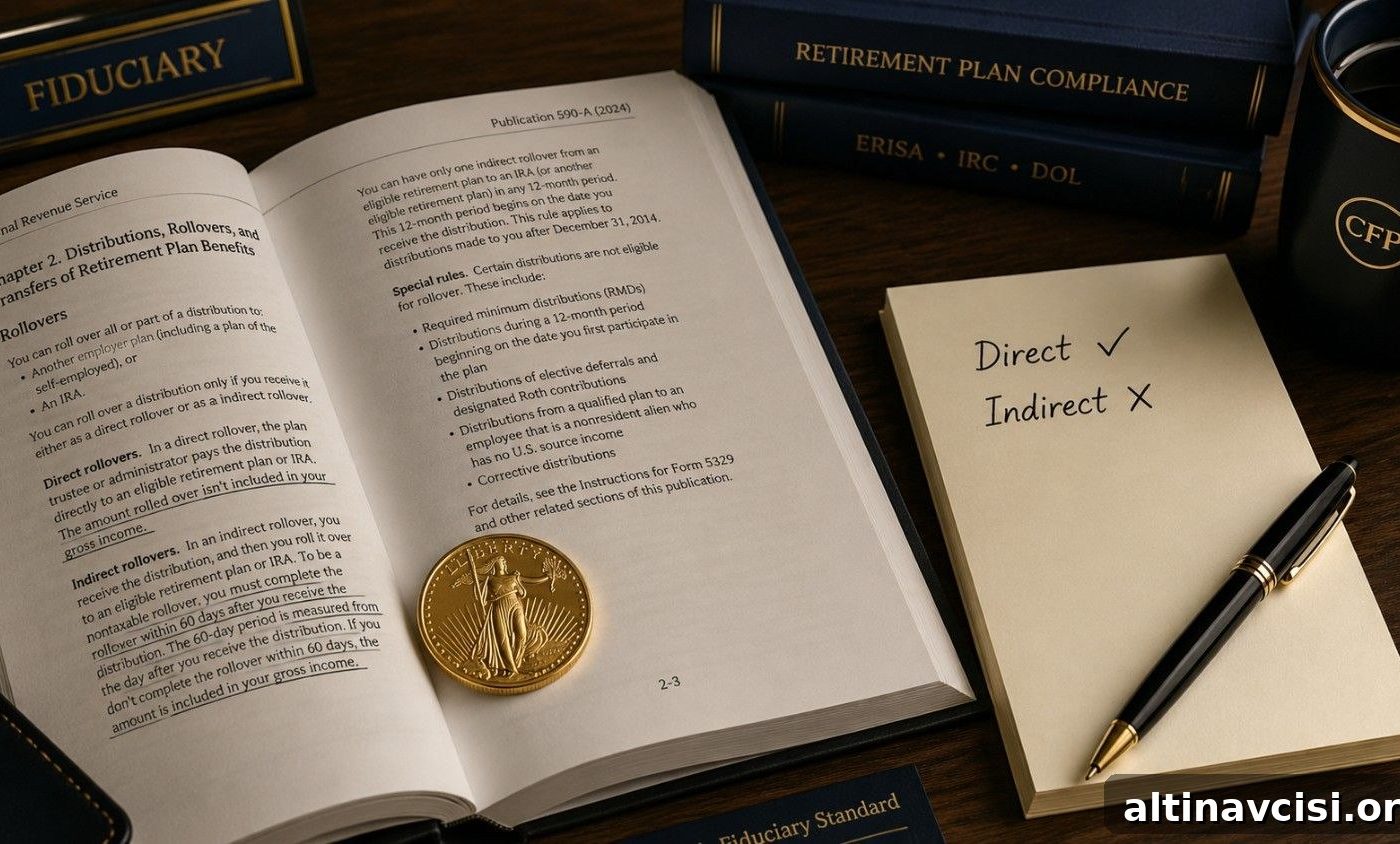
- A direct trustee-to-trustee transfer is the safest option: funds never reach you, no withholding applies, no 60-day deadline is triggered, and the once-per-year restriction does not apply.
- An indirect 60-day rollover gives you the distribution first. Employer plans (401(k), 403(b), TSP) must withhold 20% automatically. IRA distributions default to 10% withholding but you can elect zero withholding on Form W-4R. You must redeposit the full original amount within 60 calendar days or the IRS treats the payment as taxable.
- Gold held in an IRA must meet IRS fineness standards: minimum 0.995 (99.5%) for gold, with a statutory exemption for American Gold Eagle coins.
- IRAs that hold physical metals must store them at an IRS-approved depository overseen by a qualified custodian; home storage is not permitted.
- Rollover transfers do not count against annual IRA contribution limits. Rollover amounts are separate from the yearly contribution caps.
A gold IRA rollover moves retirement savings from a 401(k), traditional IRA, 403(b), TSP, or similar account into a self-directed IRA that holds physical precious metals. Since the Taxpayer Relief Act of 1997, the IRS allows certain gold, silver, platinum, and palladium in IRAs. You can accomplish this by a direct trustee-to-trustee transfer or by an indirect 60-day rollover. In nearly all cases, a direct transfer is the recommended route because it avoids withholding, deadlines, and rollover-frequency limits. Below is a clear explanation of both methods, eligibility rules for metals, custodian and storage requirements, and tax consequences when you take distributions.
What Is a Gold IRA Rollover?
A gold IRA is a self-directed individual retirement account that holds physical precious metals instead of—or in addition to—traditional paper investments. Unlike standard brokerage IRAs, a gold IRA requires a qualified custodian and mandates storage at an IRS-approved depository. While assets remain in the IRA, you do not take personal possession of the metals.
A rollover is the mechanism used to fund a gold IRA. You may move balances from traditional IRAs, Roth IRAs, 401(k)s, 403(b)s, TSP accounts, 457(b)s, SEP IRAs, or SIMPLE IRAs (subject to SIMPLE rules) into a self-directed precious-metals IRA if you follow applicable IRS procedures. The rollover preserves the tax status: traditional IRAs stay tax-deferred, Roth IRAs remain tax-free under qualified rules.
The Knowledge That Changes Everything

Two essential guides — free. Learn why gold matters and how fiat currency loses purchasing power over time.
What Is the Difference Between a Direct and Indirect Gold IRA Rollover?
Choosing between a direct transfer and an indirect rollover is the most important decision when moving retirement funds into a gold IRA. Both routes end with physical metals in a tax-advantaged account, but they expose you to different risks and procedural requirements.
Direct rollover (trustee-to-trustee transfer) — The account administrator sends funds directly to the new gold IRA custodian. You never receive the money. Because the funds do not pass through your hands, there is no federal withholding, no 60-day deadline, and no annual limit on transfers. Trustee-to-trustee transfers are explicitly excluded from the one-per-year rollover restriction.
Indirect rollover (60-day rollover) — The plan or custodian distributes the funds to you. You then have 60 calendar days to redeposit the full original amount into the new gold IRA. Employer plans (401(k), 403(b), TSP) must withhold 20% for federal taxes; that withholding cannot be waived. IRA custodians typically withhold 10% by default but you can elect zero withholding on Form W-4R to receive the full balance. Regardless of withholding, you must restore the entire original distribution within 60 days to avoid taxation on the amount.
Because mandatory withholding from employer plans can create a large cash shortfall, the indirect route often becomes costly or impractical for many investors.
Direct vs. indirect gold IRA rollover
One choice separates a clean transfer from a potential 20% withholding hit
| Direct rolloverTrustee-to-trustee | Indirect rollover60-day | |
|---|---|---|
| Funds touch your hands? | No | Yes |
| Withholding | None | 20% mandatory from employer plans; 10% default from IRAs (waivable) |
| 60-day deadline? | No | Yes — missing it triggers taxation |
| Once-per-year limit? | None | Limited to one indirect rollover per rolling 12 months across all IRAs |
| Risk of taxable event? | Minimal | High if mishandled |
| IRS authority | IRS Publication 590-A · IRC §408(d)(3)(B) | IRC §408(d)(3) · IRC §402(c) |
| Verdict | Preferred for virtually all investors | Use only with professional tax guidance |
Sources: IRS guidance and tax code provisions on rollovers and IRA transfers
What Is the 20% Withholding Trap, and How Do You Avoid It?
The biggest practical risk of an indirect rollover is mandatory withholding from employer-sponsored plans. For example, a $200,000 401(k) rolled indirectly would trigger $40,000 withheld and a $160,000 check to you. To complete a tax-free rollover you must restore the full $200,000 within 60 days, meaning you would need to supply the $40,000 shortfall from other funds and later reclaim the withheld amount when you file taxes.
If the source is an IRA, custodians typically withhold 10% by default but you can elect no withholding by completing the appropriate IRS form. Even with zero withholding elected, the 60-day clock still applies.
Missing the 60-day deadline even by one day converts the distribution into taxable income for that year. If you are under age 59½, an additional 10% early withdrawal penalty may apply. There are limited hardship exceptions, but relying on a waiver is risky; the direct transfer avoids this entire problem.
There is also a rollover-frequency restriction: indirect, IRA-to-IRA rollovers are limited to one per 12-month period for all your IRAs combined. Exceeding that limit results in a taxable distribution.
What Are the IRS Purity Requirements for Gold IRA Metals?
Not every coin or bar qualifies for IRA ownership. For gold, the IRS requires a minimum fineness of 0.995 (99.5%) for IRA eligibility. Bars and rounds must come from accredited refiners on accepted lists, such as LBMA or COMEX-approved sources, or from a national government mint.
The purity thresholds extend to other approved metals: silver generally must be 0.999 (99.9%) and platinum and palladium often require 0.9995 (99.95%). Collectible or numismatic coins are disallowed regardless of metal content.
A notable statutory exception allows the U.S. Mint’s American Gold Eagle (22-karat, 0.9167 fine) to be IRA-eligible despite falling short of the 0.995 standard. That exemption is specific to the American Gold Eagle and does not apply to other 22-karat coins such as the Krugerrand.
Common IRA-eligible gold products include:
- American Gold Eagle (statutory exception)
- American Gold Buffalo (0.9999 fine)
- Canadian Gold Maple Leaf (0.9999 fine)
- Austrian Gold Philharmonic (0.9999 fine)
- Australian Gold Kangaroo (0.9999 fine)
- Gold bars and rounds meeting 0.995 fineness from accredited refiners
Why Does a Gold IRA Require a Special Custodian?
Standard brokerage custodians are not permitted to hold physical metals in an IRA. The IRS requires a qualified trustee or custodian to administer accounts that hold alternative assets. The custodian purchases metals on your direction through approved dealers and arranges delivery to an IRS-compliant depository.
You cannot take personal possession of metals while they remain IRA assets. Holding IRA metals at home or in a private safe is a prohibited transaction and results in the IRS treating the fair market value as a taxable distribution plus potential penalties.
What Does the Gold IRA Rollover Process Look Like in Practice?
A typical direct rollover process takes two to six weeks. The usual steps are: open a self-directed IRA with a qualified precious-metals custodian; instruct the custodian to request a trustee-to-trustee transfer from your current plan or IRA; once funds arrive, direct the custodian to purchase eligible metals; the custodian then directs delivery from the dealer to an approved depository in your IRA’s name.
Rollover amounts do not count as IRA contributions. Annual contribution limits are separate — for reference, the IRS set 2026 IRA contribution limits at $7,500 for those under 50 and $8,600 for those 50 and older. Moving a large balance into a gold IRA does not affect your ability to make the annual contribution.
What Are the Tax Rules When You Eventually Withdraw?
Distributions from a gold IRA follow the same tax rules as distributions from other IRAs of the same type. Traditional gold IRA distributions are taxed as ordinary income when received. Qualified Roth distributions — taken after age 59½ and after satisfying the five-year rule — are tax-free, including any gain on the metals.
Required minimum distributions apply to traditional IRAs beginning at the ages specified by current law. RMDs may be satisfied with cash or physical metal distributions, both of which are taxed as ordinary income. Early distributions (before age 59½) generally incur a 10% penalty in addition to income taxes, subject to standard exceptions.
If you distribute physical metals and then sell them, the gain on the sale is taxed at collectible rates under current IRS rules: a maximum long-term capital gain rate of 28% for collectibles, rather than the lower rate that applies to many other investments. This collectible tax treatment applies when the metal is sold after distribution; it does not apply while the asset remains inside the IRA.
Stay On Top of Gold & Silver Prices
Get important market alerts sent straight to your inbox.
People Also Ask
A transfer is a direct trustee-to-trustee movement between IRA custodians and is not a distribution to you; it does not trigger the 60-day deadline or the one-per-year limit. A rollover generally refers to a distribution you receive and then redeposit within 60 days. For most investors, transfers are the safer option.
Yes—if you use a direct rollover where the plan transfers funds directly to the gold IRA custodian. No taxes are withheld and no taxable event occurs. An indirect distribution typically triggers 20% withholding and requires you to restore the full pre-withholding amount within 60 days to avoid taxes.
A direct rollover commonly completes in two to six weeks, depending on custodial processing, paperwork completeness, and depository delivery times. Coordinating transfer paperwork through your new custodian reduces delays.
If you miss the deadline, the distribution is treated as taxable income for the year, and an early withdrawal penalty may apply if you are under age 59½. The IRS may grant relief in exceptional circumstances, but relying on relief is risky; a direct transfer avoids the deadline entirely.
Gold must generally meet a 0.995 fineness requirement. The American Gold Eagle is permitted by statute despite lower purity. Common eligible coins include American Gold Eagle, American Gold Buffalo, Canadian Maple Leaf, Austrian Philharmonic, and Australian Kangaroo; acceptable bars and rounds must come from accredited refiners.
There is no dollar limit on rollover amounts. Rollover transfers do not count against annual IRA contribution limits.
SOURCES
1. IRS Publication 590-A — Contributions to Individual Retirement Arrangements (IRAs)
2. IRS Publication 590-B — Distributions from Individual Retirement Arrangements (IRAs)
3. IRS guidance on rollovers of retirement plan and IRA distributions
4. IRS information on IRA contribution limits
5. IRS announcements and tax code provisions related to one-per-year rollover rules and withholding requirements
6. International depository and industry standards for IRA-eligible precious metals
Disclaimer: This article is for informational purposes only and does not constitute financial or investment advice. Consult a qualified financial adviser before making investment decisions.
You May Also Like:
- The Canadian Gold Maple Leaf: Purer Than the Eagle, Lower Premium, and IRA-Eligible
- The Federal Reserve Has Eroded Significant Purchasing Power Since 1913 — Explanation of the Mechanism
- Class 3 Vault: The Two-Hour Attack Standard That Protects Physical Holdings
- American Gold Eagle Coin: A Complete Investor Guide
- The Petrodollar System Explained: Its Role and Emerging Alternatives
- What Is a Self-Directed IRA? A Complete Guide for Precious Metals Investors
- Kiyosaki Gold Predictions: Timing Strategies and Considerations
Popular Topics
Picked from the archive
-
01
 Topics
Why Gold Is So Expensive: 5 Factors Driving Its Price
-
02
Topics
Gold vs Bitcoin: Which Is the Smarter Investment Today?
-
03
Topics
Why Investors Are Buying Gold After Today’s Price Drop
-
04
Topics
Gold Drops 1.2%, Silver 2.8% as Support Holds
-
05
Topics
How to Dollar-Cost Average into Gold and Silver
-
06
Topics
Gold Surges to $4,480 as Physical Demand Hits 50-Year High
-
07
Topics
Gold Prices Near $4,000 as Job Cuts Reach 20-Year High
-
08
Topics
Hong Kong Completes First Gold Settlement; Banks Also Run London