Key Takeaways
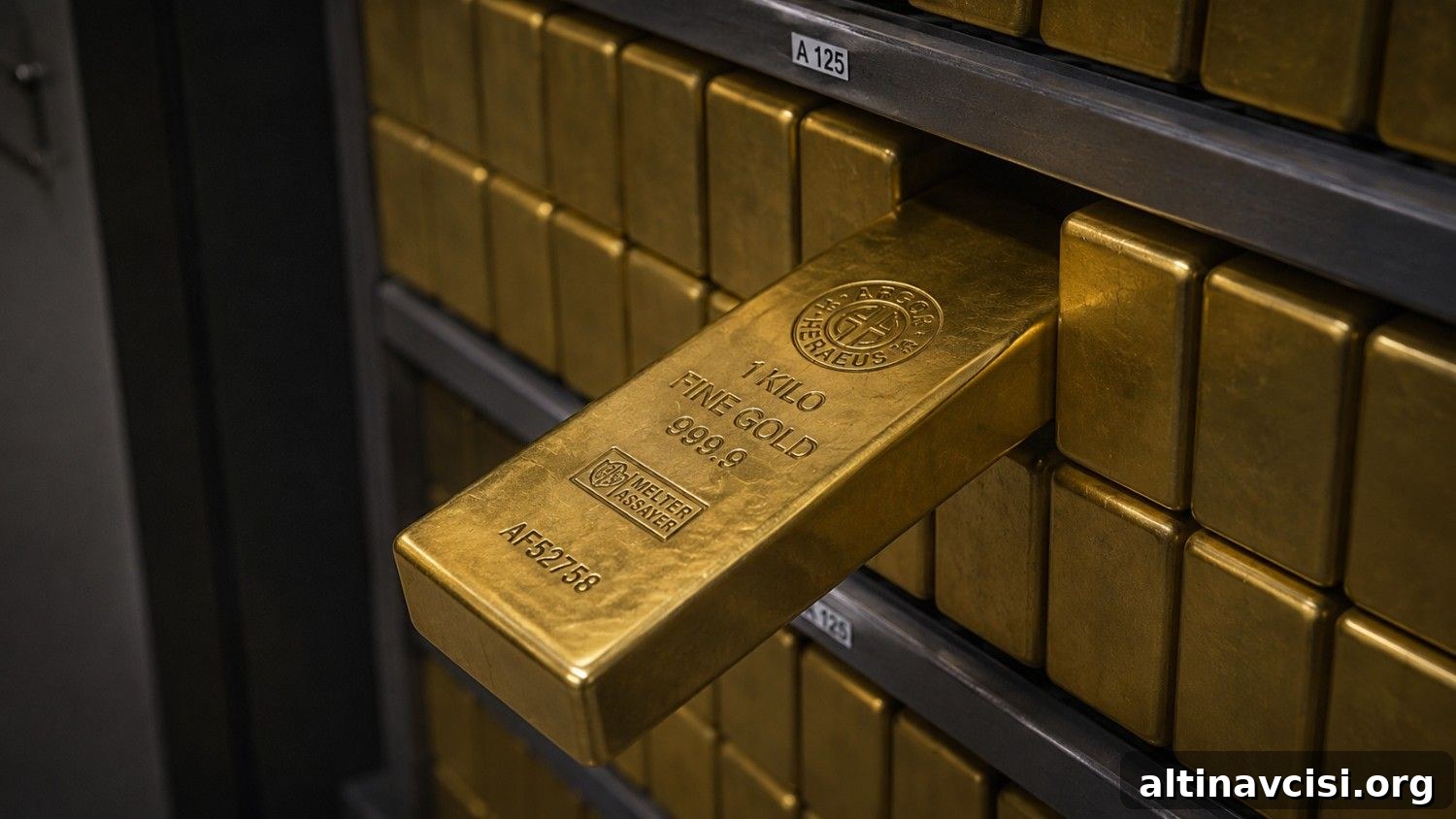
- All the gold ever mined — about 220,000 tonnes — would fit in a cube roughly 22 meters on each side [World Gold Council, 2025]. Annual mined supply grows only about 1.8% per year and cannot be meaningfully accelerated.
- Gold’s zero nominal yield becomes attractive when real interest rates compress toward zero. Historical analysis shows a 100-basis-point rise in real yields has corresponded to an average ~18% decline in the inflation-adjusted gold price [PIMCO].
- Central banks bought more than 1,000 tonnes per year from 2022–2024 — roughly double the prior decade’s pace — and 863 tonnes in 2025, keeping structural demand elevated and supporting a higher price floor [World Gold Council, Full Year 2025].
- A weaker US dollar raises demand from all non-US buyers simultaneously. Analysis indicates each 50 basis points of Fed easing can add substantial price support for gold by weakening the dollar and compressing real yields [Goldman Sachs].
- Major banks’ year-end forecasts in mid-2026 projected materially higher gold prices, reflecting the combined impact of scarcity, central-bank demand, dollar dynamics, and monetary debasement.
Five forces power gold’s high price today: physical scarcity, competition with real interest rates, sustained central bank buying, US dollar mechanics, and long-term monetary debasement. Each reinforces the others and together help explain gold’s record high of $5,589 per ounce on January 28, 2026.
Gold’s supply is exceptionally constrained relative to potential demand. With total above-ground stocks measured in only a few hundred thousand tonnes and annual mine growth under 2%, the market cannot quickly increase supply in response to rising demand. That basic imbalance is a central reason gold commands a premium compared with most other metals and asset classes.
How Much Gold Actually Exists in the World?
Every ounce of mined gold totals about 220,000 tonnes according to end-2025 estimates. Melted into a single block, that volume would form a cube roughly 22 meters on a side — about the height of a six-story building. That total represents millennia of mining and is slowly augmented each year by new production.
Global mine production reached a record level in 2025, adding roughly 3,600–3,700 tonnes, equivalent to about a 1.8% increase in the total stock. Geological constraints make this growth rate essentially fixed over human timescales: technology and capital cannot meaningfully speed the natural processes that create gold.
When demand rises for an asset with near-zero supply elasticity, prices must adjust. The decisive question becomes which factors are driving that demand today.
The Knowledge That Changes Everything
Two essential guides — free. Learn why gold matters and why fiat currencies face persistent risks.
Why Does Gold Have No Yield — and Why Does That Help?
Gold does not pay interest, dividends, or coupons. That lack of nominal yield is often seen as a drawback when compared to a nominally paying bond. The correct comparison is with real yields — the return after inflation. When real yields approach zero or turn negative, bonds stop preserving purchasing power, and gold’s zero yield becomes competitive as a store of value.
Long-term data show a clear inverse relationship between real yields and inflation-adjusted gold prices. For example, analyses covering 2004–2025 indicate that rising real yields have historically pressured gold, while falling real yields have been supportive. The Fed’s policies after the 2008 crisis pushed real yields negative and coincided with a large gold rally in the following decade.
Since 2022, however, real yields rose and would normally have weighed on gold. The metal still reached record highs because other structural forces — especially large-scale central-bank buying — overrode the traditional model.
Why Are Central Banks Buying Gold at Record Rates?
Central banks dramatically increased gold purchases starting in 2022, absorbing more newly mined gold than in previous years. At peak buying, central banks accounted for roughly 30% of annual mine production, leaving less material available for investors, jewelry, and industrial users.
This is a structural shift: central banks buy for long-term reserve diversification and geopolitical insurance, not short-term trading profits. Policy events in 2022 highlighted the risk that foreign-currency reserves can be frozen, prompting some central banks to increase domestic holdings of physical gold. That strategic behavior creates a persistent bid that supports higher prices and raises the market’s structural floor.
How Does the US Dollar Affect Gold’s Price?
Gold is quoted in US dollars, so dollar strength or weakness has immediate global effects. A weaker dollar lowers the local-currency cost of gold for buyers outside the US, boosting demand across many markets simultaneously. A stronger dollar makes gold more expensive for international buyers and can restrain demand.
Fiscal and monetary trends that erode the dollar’s purchasing power provide a long-term tailwind for gold. Policy-driven rate cuts compress real yields and can amplify gold demand, while dollar devaluation directly increases purchasing power for non-US buyers.
What Does “Debasement” Mean and Why It Matters
Debasement refers to the loss of a currency’s purchasing power as its supply expands. Persistent deficits financed by debt, together with a central bank that keeps real rates low, effectively dilute the currency. The US dollar has lost a large portion of its purchasing power since the early 1970s, which helps explain why gold priced in dollars has risen dramatically over decades.
Gold’s nominal price therefore reflects both its own scarcity and the changing value of the currency used to price it. Over very long periods, one ounce of gold tends to buy a similar bundle of goods and services in real terms, even though the dollar cost can rise substantially.
Is Gold Fairly Priced Today, or Is It a Bubble?
Gold near $4,000 per ounce in mid-2026 sits below its January 2026 record but remains high in historical and inflation-adjusted terms. Major financial institutions have year-end targets notably above mid-2026 levels, reflecting continued structural demand and macro drivers.
Labeling gold a bubble requires speculation disconnected from verifiable fundamentals. Current high prices rest on measurable pillars: constrained supply, central-bank accumulation, and broader monetary trends. While none guarantee continued appreciation, they indicate the market’s current valuation is tied to structural changes rather than pure speculation.
What This Means for Investors
Gold’s high price reflects more buyers than available supply, a condition reinforced by central-bank reserve accumulation and monetary pressures that weaken fiat currencies. Annual production growth is limited by geology, so demand-side shifts matter most. Central-bank buying, which is largely price-insensitive and strategic, has raised the market’s floor and altered the balance between supply and demand.
For individual investors, the relevant question is not whether gold is expensive in absolute terms, but whether it is expensive relative to alternatives that will preserve purchasing power over time. Gold remains a long-term option for portfolio diversification and an insurance asset against currency debasement and geopolitical risk.
Stay On Top of Gold & Silver Prices
Get important market alerts sent to your inbox.
People Also Ask
Why is gold so expensive compared to other metals?
Gold is pricier because its supply is limited and it serves monetary and reserve functions that most other metals do not. All mined gold totals roughly 220,000 tonnes, increasing slowly each year. Central banks hold a substantial portion as official reserves, a role unique to gold and a key driver of its valuation relative to industrial metals.
Does gold go up when inflation rises?
Gold can be an inflation hedge over the long term, but it does not automatically rise with every inflation report. Real interest rates — what bonds yield after inflation — are a more reliable short- and medium-term indicator. When real yields fall, gold tends to strengthen; when real yields rise, gold can underperform.
What would make gold prices fall significantly?
A significant, sustained gold price decline would likely require several conditions to converge: materially higher real interest rates, a strong and sustained dollar rally, a reversal of central-bank buying, and large ETF outflows. Any single factor can pressure prices, but a major correction would probably need multiple forces acting together.
How is gold’s price set?
Gold’s price is the result of a decentralized global market. Major venues include the London OTC market and COMEX futures in New York. Benchmark prices published by market organizations serve as references, but the market price is the aggregate outcome of buy and sell orders from central banks, investors, ETF managers, jewelry buyers, and private individuals around the world.
Is gold expensive right now compared to history?
Nominally, gold in mid-2026 is near historic highs and remains elevated in inflation-adjusted terms. Comparisons across different valuation models — real yields, money supply measures, and asset-price ratios — can produce different conclusions about fair value. Analysts often point out that relative to the expansion of financial assets and monetary measures since the 1970s, gold’s price still has arguments on both sides.
SOURCES
1. World Gold Council — Gold Demand Trends Full Year 2025; Central Banks Full Year 2025; Are We Running Out of Gold? (March 2026); Gold Market Primer: Market Size and Structure
2. PIMCO — Understanding Gold Prices
3. JPMorgan Global Research — Gold Price Predictions 2026 and Beyond
4. Goldman Sachs — Research on gold price drivers (June 2026)
5. GoldSilver — Gold Price Forecast 2026 and commentary on central bank demand
6. Bureau of Labor Statistics — CPI and inflation data
Disclaimer: This article is for informational purposes only and does not constitute financial or investment advice. Consult a qualified financial adviser before making investment decisions.
You May Also Like:
- Gold vs. Savings Account: Which One Is Actually Beating Inflation Right Now?
- Seigniorage: The Hidden Tax on Every Dollar You Hold
- Gold Has a 0% Risk Weight and an 85% Funding Penalty. Banks Are Finally Asking Why.
- Deutsche Bank Found Gold’s Price Floor. It’s Not the Buyers You Think.
- 23 Questions to Ask Before Choosing a Gold Storage Provider
- Goldman Just Changed Its Model. Should You Change Yours?
- Gold Is Down 25%. Morgan Stanley Says One Number Unlocks $5,200.