Why Invest in Gold Now? Market Reasons and Timing

Written by: The MacroButler
Harry Browne’s Permanent Portfolio is a simple, resilient allocation: stocks for inflationary expansion, long-term bonds for deflationary contractions, gold for extreme currency stress, and cash for liquidity when markets freeze. The strength of the approach is balance—no matter which economic regime prevails, at least one asset class typically performs. Layer Schumpeter’s business cycle on top, and you get a practical framework for deciding which quadrant to emphasize. The hard part is identifying the current phase of the cycle in real time.
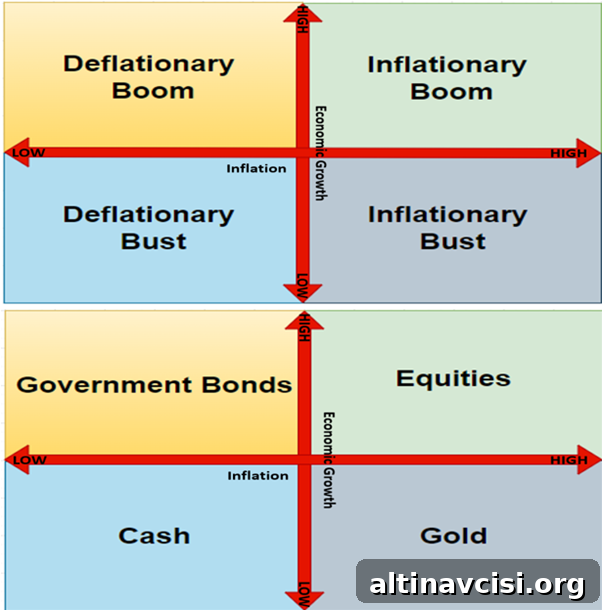
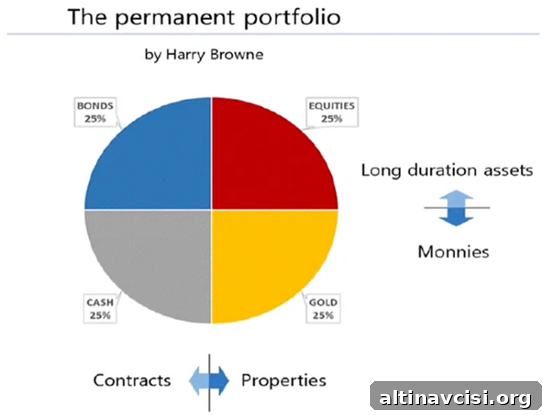
Think of Browne’s Permanent Portfolio as a low-maintenance strategy: equal weights of stocks, bonds, cash, and gold that are intended to weather booms, busts, bubbles, and panics without frequent trading. It’s a four-square design where each corner responds differently to economic shocks, reducing the chance of catastrophic portfolio loss.
Financial assets can be classified across two axes: contracts (IOUs like bonds) versus properties (ownership claims like stocks), and long-term versus short-term instruments (e.g., long government bonds versus cash or gold). Plotted this way, the Permanent Portfolio neatly occupies four quadrants, each designed to provide protection in different macro environments.
In this allocation, gold acts as the emergency asset. Historically used as money and ornament for thousands of years, gold cannot be printed, making it inherently scarce and durable. Central banks hold it, private investors buy it in crises, and it often emerges as a haven when currency systems or political stability are under stress.
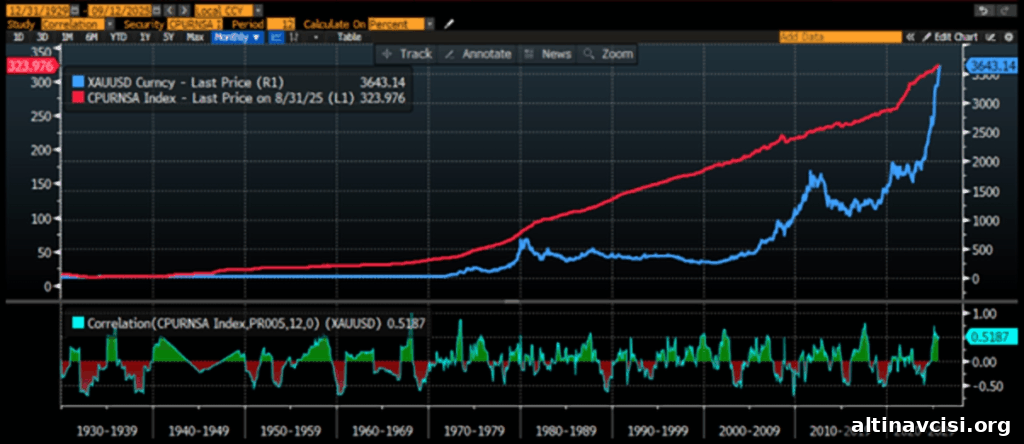
Gold’s long-term role is as a store of value that preserves purchasing power when paper money weakens. It has outlasted empires and monetary regimes, maintaining trust across centuries. But its performance versus inflation is subtle: gold does not reliably track short-term CPI readings, which means its value as an inflation hedge should be understood over extended periods rather than month-to-month.
Empirical data shows that the short-term correlation between gold and U.S. CPI is often low. That does not invalidate gold’s value; rather, it clarifies that gold’s primary utility lies in long-term preservation of wealth and as a crisis hedge when trust in fiat currency erodes.
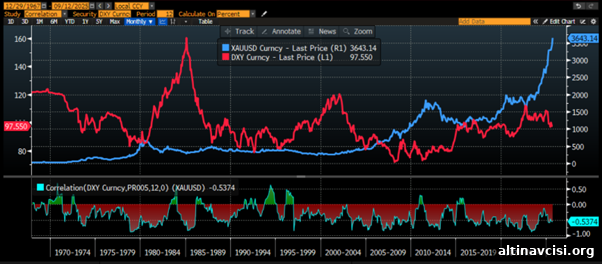
If gold is not a perfect short-term proxy for inflation expectations, what drives it? One consistent relationship has been with the U.S. dollar: gold is priced in dollars, and a stronger dollar often coincides with weaker gold prices. Over many decades, gold and the dollar index have frequently shown a negative correlation, reflecting the currency’s influence on dollar-denominated gold valuations.
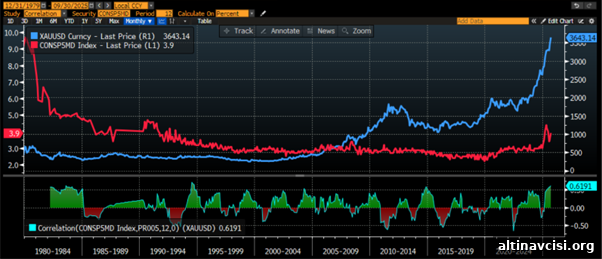
Gold also behaves like an asset that resists counterparty risk. It requires no issuer or middleman; ownership of physical metal is direct. That quality makes gold unappealing to highly indebted governments—hence historical episodes of confiscation or restrictions—because gold cannot be inflated away like paper liabilities.
In recent cycles, gold’s price has also shown meaningful co-movement with indicators of sovereign risk, such as credit default swap (CDS) spreads, signaling that perceived government credit risk can drive demand for the metal as a hedge against policy or fiscal instability.
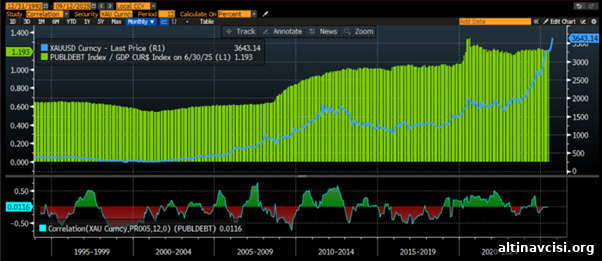
Caution is warranted: it’s easy to confuse correlation with causation or to overfit a model that breaks when conditions change. For example, relationships between gold and real yields have shifted at times, meaning no single driver explains gold’s movements in every environment.
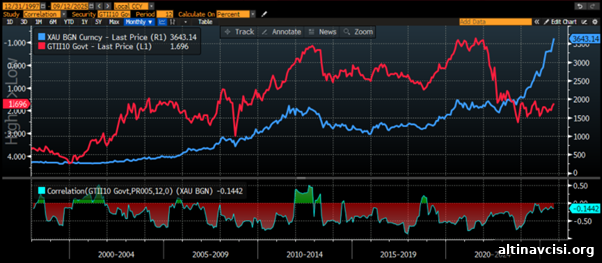
Still, in recent years gold outperformed many accessible asset classes, fueled by macro uncertainty, structural shifts, and geopolitical tensions. ETF inflows, central bank purchases, and retail demand all contributed to larger positions in the metal, underscoring its renewed role in diversified portfolios.
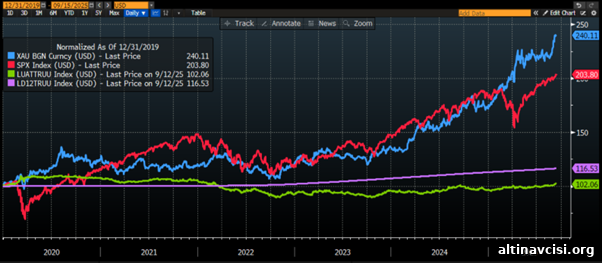
The concept of antifragility—introduced by Nassim Nicholas Taleb—captures why some investors prize gold. Antifragile assets don’t merely survive volatility; they can benefit from it through asymmetric payoffs or optionality. Gold’s lack of counterparty risk and historical role in crises gives it qualities that can make it a valuable portfolio ballast when uncertainty rises.
Markets generally tell a clearer story than headline economic statistics. Comparing gold and government bonds, or tracking ratios like gold-to-bond or S&P 500-to-gold, can provide early signals of currency debasement or shifting investor preferences that official CPI numbers might obscure.
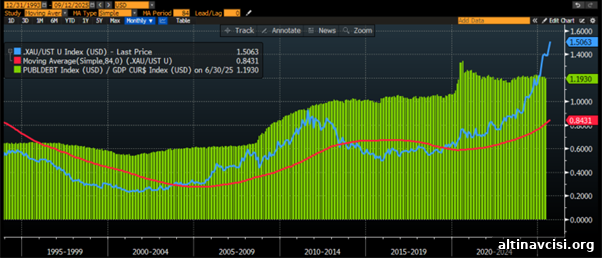
Geopolitically, recent gatherings such as the SCO Summit in Tianjin highlighted efforts by major emerging economies to deepen regional cooperation and reduce reliance on Western financial systems. Initiatives to settle trade in local currencies, develop regional banks, and diversify reserves can support demand for gold as part of reserve-building strategies.
Regional development banks and alternative payment systems aim to reduce dollar dependence and strengthen trade invoicing in yuan, rubles, rupees, and other currencies. Over time, these shifts may encourage central banks and sovereigns to increase gold holdings as a diversification tool.
China’s rising gold reserves alongside adjustments in U.S. Treasury holdings illustrate how reserve management can shift as geopolitical and economic priorities evolve. That trend reinforces gold’s role in portfolios seeking protection from policy or currency risks.
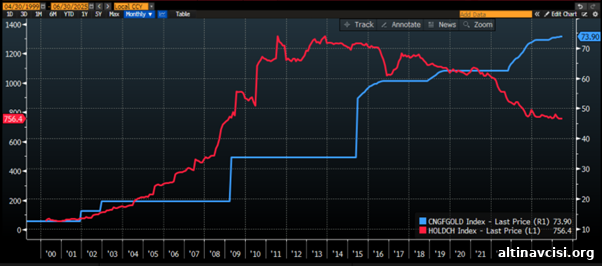
Gold’s historical relationship with war and geopolitical stress is well documented: nations and private actors have turned to bullion in times of conflict, currency collapse, and political upheaval. For investors, these episodes underscore the metal’s role as a non-sovereign asset that can preserve value when paper claims fail.
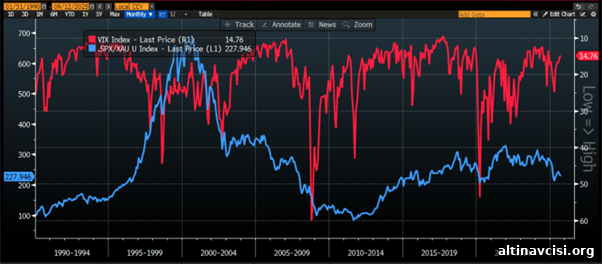
Empirically, gold tends to outperform risky assets during spikes in volatility. The S&P 500-to-gold ratio often falls as volatility and geopolitical risk rise, giving gold relative strength against equities in turbulent periods. Such patterns can help inform tactical allocation decisions.
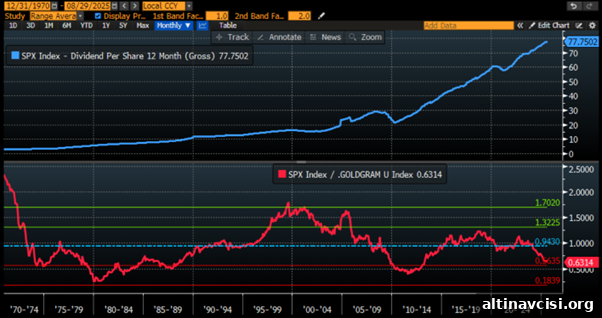
A useful tactical rule: when S&P 500 dividends expressed in grams of gold are cheap relative to history, equities may offer attractive upside versus gold; when dividends are expensive in gold terms, caution may be warranted. Such valuation metrics provide a different lens on equity risk than nominal price moves alone.
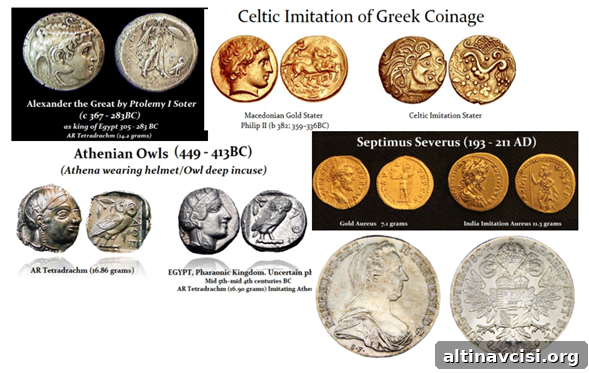
At the same time, beware of absolutist positions: neither gold nor fiat is a universal panacea. Historically, money has been based on trust, convention, and institutional backing as much as on intrinsic substance. The prudent investor recognizes the trade-offs between different monetary regimes and diversifies accordingly.
Markets teach through mistakes. Investors who learn from historical episodes and current signals can position defensively without being paralyzed by fear. That means allocating to assets that protect capital and optionality—physical gold and silver among them—while maintaining flexibility with short-term cash and high-quality, short-duration credit.
Below are the key takeaways and a practical approach to trading and positioning in this environment.
KEY TAKEAWAYS
As investors reassess risk and policy uncertainty, the main points to remember are:
- Harry Browne’s Permanent Portfolio combines stocks, bonds, gold, and cash to provide broad protection across economic regimes.
- Gold functions as a long-term store of trust and a crisis hedge rather than a precise short-term inflation tracker.
- Gold’s lack of counterparty risk and historical role in crises give it antifragile characteristics valuable in turbulent times.
- Currency dynamics and sovereign risk often influence gold prices more than short-term CPI movements.
- Geopolitical shifts and the rise of regional financial institutions may support increased demand for gold as reserves diversify away from a single-dominant currency.
- Tactical signals—such as the S&P 500-to-gold ratio and dividends expressed in gold—can help inform buying and selling decisions between equities and gold.
- Maintain physical exposure to gold and silver for true counterparty-free protection while using short-duration, investment-grade cash instruments for liquidity.
- Expect higher volatility and muted real returns in the near term; position for the preservation of capital rather than speculative returns.
HOW TO TRADE IT?
As of September 12, 2025, market signals suggest an elevated probability of a transition from an inflationary boom to an inflationary bust as the S&P 500-to-gold ratio trades below its long-term moving average. In this context, remain disciplined:
- Use market-based indicators and moving averages to identify regime changes rather than relying solely on headline economic reports.
- Keep liquidity available in short-dated USD investment-grade instruments and T-bills for flexibility.
- Favor physical gold and silver held securely across trusted jurisdictions for protection against seizure, freezing, or counterparty failure.
- Seek equity exposure to lean, low-debt, high-cash-flow companies that can weather supply-chain friction, reshoring, and higher defense spending.
- Avoid long-duration sovereign bonds as a primary risk allocation; instead focus on short-duration, high-quality corporate credit for cash management.
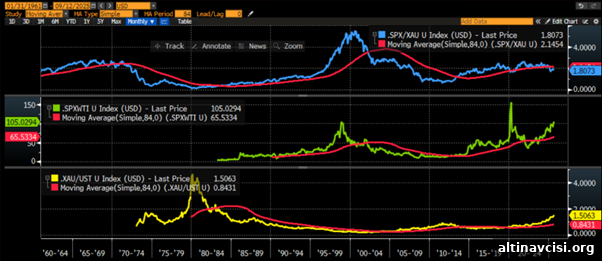
In times of geopolitical stress and financial upheaval, the priorities are clear: protect capital, preserve optionality, and reduce exposure to instruments with concentrated counterparty or sovereign risk. Physical precious metals, diversified jurisdictions, and liquidity management are essential building blocks for resilient portfolios.

To summarize: tangible assets endure where paper promises can fail. The Permanent Portfolio’s allocation—especially its allocation to physical gold—provides a durable, practical way to survive and navigate cycles where trust in institutions and currencies may be tested. Preserve freedom, maintain liquidity, and remember that in uncertain times, holding assets that cannot be printed or erased offers distinct advantages.
For readers wishing to explore the topic further, the author’s original long-form piece provides additional charts and historical context.
Popular Topics
Picked from the archive
-
01
 Topics
Dollar Steadies After Jobs Data Shock Sends 90% Odds of Fed Cut
-
02
Topics
Consumer Confidence Hits 4-Month High as Inflation Eases
-
03
Topics
Gold Price Falls Below $3,340 Ahead of Fed Comments
-
04
Topics
Global Oil Prices Steady as Travel Demand Rises, Sanctions Loom
-
05
Topics
Silver Prices Eye Record Highs as Fed Signals Rate Cuts
-
06
Topics
AI Bubble Fears Surge as Gold Price Falls Below 4,000 USD
-
07
Topics
Tariff-Driven Inflation Clouds Fed’s September Rate Decision
-
08
Topics
10-Year Treasury Yield Rises After Tariff News, Services Data