Every trading desk in the world is waiting for one sentence from Wyoming this week. At the same time, the Federal Reserve has published an agenda focused on something else entirely.
The Federal Reserve Bank of Kansas City hosts its annual economic policy symposium at Jackson Hole, running from Thursday, August 27 to Saturday, August 29, 2026. New Fed Chair Kevin Warsh will deliver his first keynote address on Friday morning, and markets are eager to learn whether the hiking cycle is paused or over. That question is understandable, but it is not the central topic on the official programme.
Key takeaways
- Jackson Hole’s 2026 theme is payments and financial innovation, not the level of interest rates.
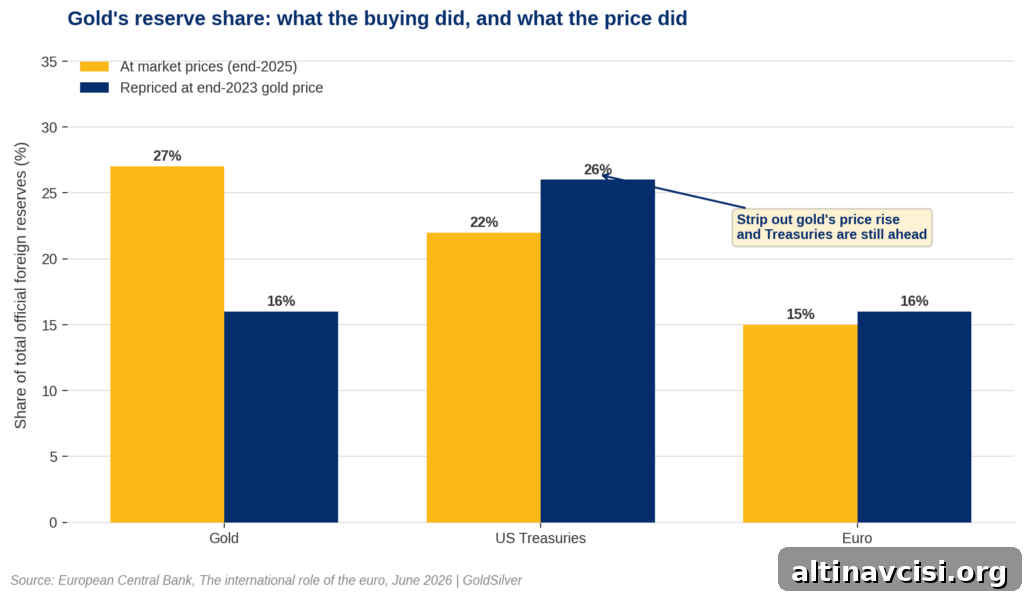
- The European Central Bank’s June 2, 2026 report shows gold at 27% of total official foreign reserves at end-2025, versus US Treasuries at 22%.
- That crossover is driven mainly by price. Repricing holdings at end-2023 gold prices reduces gold’s share to 16% and moves Treasuries to 26%.
- Tether purchased more than 100 tonnes of gold in 2025—more than any central bank that year.
What is the Fed actually discussing at Jackson Hole?
This year’s theme, “Financial Innovation: Implications for Payments and Policy,” is deliberate. Roughly 120 central bankers, policymakers and economists from more than 70 countries attend, and the Kansas City Fed selects participants with the theme in mind. The topic therefore signals what the institution views as important now.
Although the full programme is not yet public, the broad subject is clear: who may issue dollars, which settlement rails those dollars use, and whether privately issued digital money changes how a policy rate reaches households and businesses. In short, the conference is about the plumbing of money—how money is created, moved and controlled in an increasingly digital environment—and the policy implications that follow.
Why are central banks buying gold?
Central banks buy gold because it carries no issuer risk; its appeal is structural rather than a short-term inflation bet. The European Central Bank’s June 2, 2026 report quantified this, noting gold accounted for 27% of total official foreign reserves at the end of 2025, ahead of US Treasuries at 22% and the euro at 15%.
However, the ECB is candid that this shift largely reflects valuation effects. Gold’s price rose sharply—about 60% in 2025 and roughly 30% in 2024—so rising market prices increased gold’s share of reserves. If those same holdings were valued at end-2023 gold prices, gold’s share would fall to around 16%, putting it level with the euro and behind Treasuries at roughly 26%. In other words, the change is a mix of accumulation and revaluation, not a wholesale move away from the dollar.
The ECB also highlights gold’s limitations as a reserve asset: its price is volatile, it yields no interest, physical storage incurs costs, and the supply cannot be expanded quickly to meet sudden liquidity needs. These practical constraints explain why gold complements rather than replaces conventional reserve assets.
One illustrative detail in the report: Poland was cited as the largest official-sector buyer of gold in 2025, at about 100 tonnes. Notably, the largest stablecoin issuer, Tether, purchased more than that in 2025—underscoring how private-sector actors are increasingly active in markets traditionally dominated by official institutions.
Do faster dollars mean fewer dollars?
No. Faster payments and new settlement rails extend the reach and usability of the dollar but do not change the aggregate supply of dollars. The ECB’s June 2026 analysis noted stablecoin capitalisation exceeded $300 billion at the end of 2025—about 50% larger than a year earlier—and most of that capital is backed by dollar-denominated assets. New payment technologies therefore amplify dollar usage globally, rather than shrink the dollar stock.
ECB researchers also warn that wider stablecoin adoption can complicate monetary policy transmission, weakening policy effectiveness and increasing unpredictability. That is why a conference about payments is also a conference about monetary policy: innovations in how money moves affect how policy decisions propagate through the economy.
Scale matters. The ECB estimates roughly $400 billion of stablecoin-based retail payments settle annually, while global cross-border retail transactions are on the order of $44 trillion. The new rails are real and important, but they remain early-stage relative to the global payments system.
Can a Fed chair change gold’s case?
Some market participants expect Chair Warsh might say something that pressures gold prices. No one knows the contents of an unpublished speech; predictions are speculation. What a chair can influence is the opportunity cost of holding gold. Holders of physical gold forgo yield: on August 20, 2026 the ten-year inflation-indexed Treasury yielded about 2.35% in real terms, which represents the annual real return foregone by owning non-yielding bullion.
Large speculators have been willing to pay that carry: data from mid-August 2026 showed net long positions in gold futures rising significantly. Choosing to pay a positive real carry for an asset that yields nothing is not primarily a bet on near-term inflation; it reflects a belief about the durability and trustworthiness of the monetary unit.
For context, gold traded in the mid-$4,600s as of August 25, 2026, about 17% below its January 28, 2026 record. That places recent moves in the category of recovery within a broader drawdown, rather than a fresh peak. Importantly, an ounce of physical gold settles without a counterparty and cannot be reissued, frozen, upgraded, or redeemed at another party’s discretion. That attribute—private, bearer-settlement—lies outside any central bank’s remit to grant, and it remains a core part of gold’s appeal regardless of speeches about payment rails.
SOURCES
1. European Central Bank — The International Role of the Euro, June 2, 2026
2. Federal Reserve Bank of Kansas City — 2026 Economic Policy Symposium: Financial Innovation, Implications for Payments and Policy, August 27–29, 2026
3. Federal Reserve Board — H.15 Selected Interest Rates, August 20, 2026
4. Commodity Futures Trading Commission — Commitments of Traders, COMEX Gold, August 18, 2026
5. GoldSilver — Gold and Silver Price Charts, August 25, 2026
Disclaimer: This article is for informational purposes only and does not constitute investment advice. Past performance is not indicative of future results. Always consult a qualified financial advisor before making investment decisions.
You May Also Like:
- Two Investors Ran the Debt Math Separately. Both Landed on 15% Gold.
- Gold Nears $4,700, Silver Holds Above $69. Why Is Everyone Waiting on One Friday Speech?
- Gold Hits 3-Month High as Oil Falls Ahead of Sanctions Announcement
- Gold’s Speculative Crowd Hit a 60-Week High. Almost Nobody Bought.
- Gold Hit a Three-Month High. Silver Hit a Two-Month High. One Story Connects Them.
- The National Debt Hit $40 Trillion. Jefferies Just Turned Bullish on Gold.
- Gold Fell and Silver Rose on the Same Report. Here Is the Mechanism.