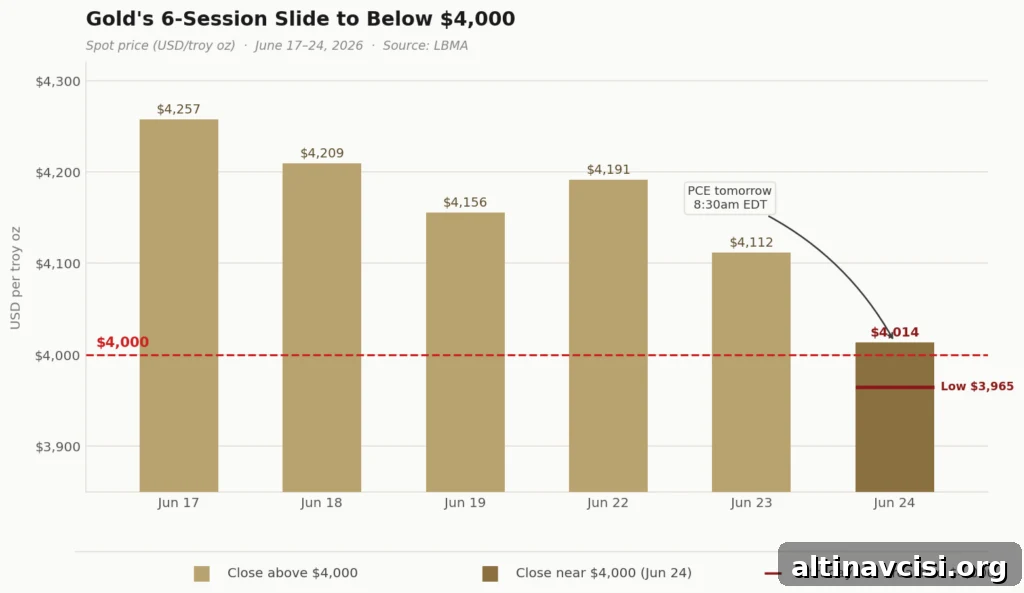
Gold fell below $4,000 per ounce today for the first time since November, prompting many headlines declaring the end of the so‑called “debasement trade.” The argument driving those headlines is straightforward: the Federal Reserve signaled more tightening, real yields turned positive, the dollar strengthened, and bullion has dropped roughly 28% from its January high. That reads like a tidy conclusion — but the full story is more nuanced.
The recent selloff is real and driven by familiar market mechanics. Yet the broader structural forces that pushed gold from roughly $2,600 to nearly $5,600 in just over a year remain largely unchanged. Below are the main points to understand ahead of tomorrow’s inflation release.
Why is gold falling today?
The immediate drivers are straightforward. At the Federal Reserve’s June 17 meeting — Chair Kevin Warsh’s first — a plurality of FOMC participants indicated at least one rate increase could be appropriate before year‑end. The median projection shifted higher, and markets re‑priced the outlook quickly. Futures pricing now assigns a materially higher chance of a 25 basis point hike by December, and the US Dollar Index rallied above 100 for the first time since May 2025.
That matters because real yields on 10‑year Treasury Inflation‑Protected Securities (TIPS) have risen to levels near 2.2%. When real, risk‑free yields climb, non‑yielding assets like gold face pressure as investors can earn a positive real return in fixed income. The paper gold market reacted accordingly, selling into the shift in yields.
In addition, broader market turbulence contributed. A sharp drop in technology and other risk assets prompted algorithmic and cross‑asset selling; some investors liquidated positions in bullion to meet margin requirements or cover losses elsewhere. This type of mechanical selling amplifies moves in the short term but does not negate gold’s long‑term role as a store of value.
Did the structural case for gold change today?
No. That distinction is crucial. Short‑term price action and changing dot plots do not automatically dismantle the broader structural thesis that supported gold’s dramatic rally.
Today’s developments did not erase large fiscal deficits, restore real wage gains, or eliminate persistent inflation pressures. The Fed’s potential 25 basis point move would lift the funds rate into the mid‑3% range, but that still sits below the inflation rate measured by the Fed’s preferred PCE gauge, which has been running well above the 2% target. A central bank that signals hikes but faces limits in how far it can raise rates without disrupting housing and Treasury markets has not resolved the underlying monetary pressures.
Historically, environments where policymakers are constrained between slowing growth and persistent inflation tend to favor real assets and precious metals over time. That structural backdrop remains intact even after a sharp correction in paper prices.
What does tomorrow’s PCE inflation data mean for gold?
May’s Personal Consumption Expenditures (PCE) inflation report is scheduled for release at 8:30am EDT. Consensus forecasts expect a year‑over‑year headline reading near 4.1%. If the print comes in hotter than expected, it will likely extend rate‑hike expectations and could keep near‑term pressure on gold.
However, the nuance is important: May’s PCE reflects a period when oil and energy prices were elevated due to geopolitical tensions. Those pressures have eased since mid‑June after diplomatic developments that improved the outlook for energy markets. Many economists anticipate a notable slowdown in inflation measures in June, which will be reflected in the next PCE release. In other words, tomorrow’s figure is partly backward‑looking and influenced by temporary supply shocks.
Traders may interpret the number as signaling future Fed action. Long‑term holders of physical gold should consider the context: temporary commodity spikes can inflate near‑term inflation readings while the medium‑term trend may be moving in a different direction.
Is the debasement trade really over?
Paper losses are real: gold is down roughly 28% from the January peak, and silver has fallen over 50% from its highs. Those moves are painful for holders. But the fundamental drivers that led central banks and institutional buyers to accumulate gold — concerns about currency dilution, large fiscal deficits, and sustained inflation above target — have not been resolved by a single central‑bank projection.
Mainstream sentiment often exits after significant corrections; that is a typical pattern. A steep drawdown can create opportunity for investors who remain focused on the longer horizon and on the structural reasons investors allocate to precious metals. From that perspective, the “debasement trade” may be paused or repriced, but it is not necessarily finished — the market has simply repriced short‑term risks and volatility.
SOURCES
1. CME Group — FedWatch Tool: FOMC Rate Change Probabilities
2. Federal Reserve Bank of St. Louis (FRED) — 10‑Year Treasury Inflation‑Indexed Security
3. Federal Reserve — H.15 Selected Interest Rates, June 2026
4. Federal Reserve — FOMC Summary of Economic Projections, June 17, 2026
5. Morningstar — May PCE expected to show rising inflation
6. LBMA — Precious metal prices
Disclaimer: This article is for informational purposes only and does not constitute financial or investment advice. Always consult a qualified financial adviser before making investment decisions.
You May Also Like:
- Two Things Are Hitting Gold Simultaneously. Only One Is About Gold.
- Why Is Silver Down 5%? The Gold‑Silver Ratio Explains.
- BofA Says Three Rate Hikes. Silver Just Priced In the First One.
- Iran Deal. Oil Falling. A PM Out. Gold Still Above $4,100.
- PCE Drops Thursday. Here’s What It Means for Gold.
- Goldman Sachs Gold Target Cut: What the $1,400 Gap Means
- Gold Price Today, June 19: What Juneteenth Trading Tells You
- Half the Fed Wants a Hike. 45% of Central Banks Are Buying More Gold.