
In today’s update: Institutional gold repricing is no longer hypothetical — this week Russia sold gold at its fastest rate since 2002, Perth Mint posted a record $40 billion in bullion exports, and the US Senate introduced a bipartisan bill to modernize precious metals storage for the first time since the 1970s.
Five separate developments from around the world point to the same conclusion: institutional gold repricing is under way and driven by major market participants rather than retail trends. The World Gold Council is building shared digital infrastructure for gold. Russia is reducing reserves at the quickest pace in more than two decades. The US Senate has proposed legislation to expand approved precious metals vaults. Perth Mint reported its largest export year in 126 years. And a Bloomberg analysis published May 21, 2026, shows the US conflict with Iran is reshaping bond-market expectations across more than $50 trillion in G7 government debt. Each of these items matters on its own; together they form a coherent picture. Below is what each development means.
What Is the World Gold Council’s “Gold as a Service” Initiative?
On March 19, 2026, the World Gold Council (WGC) and Boston Consulting Group (BCG) released a white paper titled Digital Gold: The Case for a Shared Infrastructure. The paper outlines a “Gold as a Service” model — a shared technical layer with rules for issuing, transferring, and settling gold-backed digital products. WGC CEO David Tait emphasized that “gold must evolve to maintain its role in the global financial system.”
This is not a short-term pilot; it represents a permanent commitment to a standardized digital claims infrastructure for institutional participants.
Importantly for investors: digital gold represents claims on physical metal, not a substitute for physical bullion. The infrastructure being developed standardizes and simplifies the claim side — custody, transfer and settlement — making it easier for institutions to own gold. That broadened access increases demand for physical ounces and is another driver of institutional repricing from the demand side.
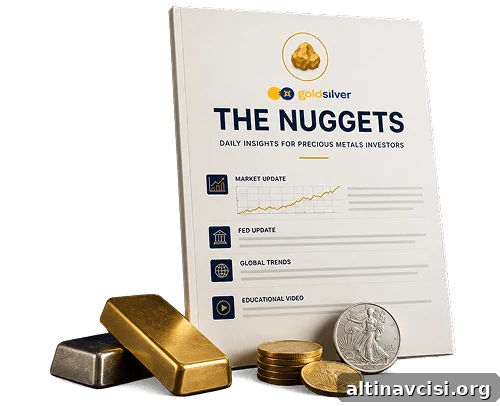
The Edge Every Investor Needs
Smarter precious metals investing starts here. The Nuggets Newsletter brings essential market insights, Fed updates, global trends, educational videos, and more.
Why Is Russia Selling Gold at the Fastest Pace in Over Two Decades?
On May 20, 2026, the Bank of Russia reported that gold reserves declined for the fourth consecutive month in April. Sales since January totaled 27.9 tonnes — the steepest four-month reduction since 2002, according to World Gold Council data. Reserves now stand at about 73.9 million troy ounces, the lowest level since February 2022.
The primary driver is fiscal pressure rather than a change in strategic reserve policy. Russia reported a federal budget deficit of 4.6 trillion rubles ($51.1 billion) by the end of March 2026, with military spending now exceeding social welfare costs. Sanctions froze a large portion of Russia’s foreign exchange reserves in 2022, and gold has been used to help cover fiscal needs.
This development is a reminder that central bank gold holdings are not static: they can be reduced when governments face financial strain. But unlike currency, gold cannot be created by policymakers. When stressed governments sell, other market participants buy — a classic supply-side driver of institutional repricing.
What Does the SILVER Act Mean for Precious Metals Investors?
On May 21, 2026, Senators Jim Risch (R-ID) and Catherine Cortez Masto (D-NV) introduced the SILVER Act (System Integrity through Licensed Vault Expansion and Resilience Act). The bill would amend the Commodity Exchange Act to expand the list of approved precious metals storage facilities, which have long been concentrated in the Greater New York City area.
The proposal requires at least two approved storage facilities in each of the four continental US time zones — Eastern, Central, Mountain, and Pacific — opening eligibility to additional states and regions. Practical benefits include reduced storage costs, lower single-region risk, and improved access for investors outside the Northeast.
Beyond immediate effects, the bill signals that US policymakers recognize precious metals custody as a form of national financial infrastructure needing modernization after decades of concentration in a single region.
Perth Mint Just Broke Its Own Export Record — By $8.7 Billion
Australia’s Perth Mint, a government-owned refinery operated by Gold Corporation and the country’s only LBMA-accredited refiner, announced on May 22, 2026 that it had exported $40 billion in bullion and minted products for the financial year, with a month still to go. The previous record was $31.3 billion. Perth Mint refines roughly 70% of Australia’s mined gold.
These export figures are a clear, hard-data signal of physical demand. They measure refined, hallmarked metal leaving vaults — not survey responses or derivatives positioning. A $40 billion export tally is concrete evidence that substantial physical buying is taking place and supports the case for institutional-driven repricing of gold.
Are Government Bonds Still a Safe Haven When Inflation Strikes Twice?
A Bloomberg report published May 21, 2026 quantified how the US war on Iran, which began in late February 2026, has shifted market expectations across more than $50 trillion in G7 government bonds. Long-term yields in major economies have moved higher, reaching levels not seen since the mid-2000s. The 30-year US Treasury closed near 5.12% — its highest closing level since June 2007 — and some strategists warn yields could climb further.
The mechanism is straightforward: disruptions to fuel and fertilizer flows through the Strait of Hormuz pushed US CPI to 3.8% in April 2026, the highest in three years. Market participants at leading asset managers now treat this as a renewed inflation wave rather than a brief shock. A single inflation spike can look transitory; repeated shocks reshape expectations and increase demand for assets that are inflation-resistant and have no duration risk — like gold.
This macro backdrop — higher yields, renewed inflation, and geopolitical uncertainty — reinforces institutional interest in precious metals and helps explain the coordinated movement toward revaluing gold across asset classes.
When Five Separate Headlines Tell the Same Story — That’s Institutional Gold Repricing
In a single news cycle, the World Gold Council set out shared rails for digital gold; Russia sold physical metal at the fastest pace in two decades; US lawmakers proposed modernizing precious metals storage; Perth Mint moved a record amount of refined gold; and major bond investors repriced risk amid rising yields and inflation concerns.
These events come from different actors — central banks, legislators, mint officials, and bond strategists — acting under distinct pressures yet arriving at a similar conclusion: physical precious metals are being repositioned by serious institutions, not just retail traders. Holding gold or silver is no longer a fringe view for some investors; it is increasingly a mainstream institutional response to modern macro and geopolitical risks.
The central question for investors is not whether institutional repricing is happening, but whether they are positioned before the market’s broader shift becomes fully priced in.
Stay On Top of Gold & Silver Prices
Get important market alerts sent straight to your inbox.
SOURCES
1. World Gold Council — Gold as a Service — press release & white paper
2. World Gold Council — Monthly central bank statistics
3. Bank of Russia — International reserves data
4. TASS — Russia gold reserves lowest since February 2022
5. Bloomberg — Russia sold over $4 billion of gold from reserves
6. AccessNewswire — SILVER Act — official press release
7. Congress.gov — H.R. 8007 — SILVER Act text
8. Perth Mint — Record $40 billion export announcement
9. Bloomberg — Iran war upends $50 trillion G7 bond market
10. US Bureau of Labor Statistics — Consumer Price Index — April 2026
11. Federal Reserve (FRED) — 30-year Treasury constant maturity yield
Disclaimer: This article is for informational purposes only and does not constitute financial or investment advice. Consult a qualified financial adviser before making investment decisions.
You May Also Like:
- Silver Dropped 12%. Gold Dropped 3%. That Gap Is the Story.
- Gold Price Holds Firm After Hawkish Fed Minutes — Here’s Why
- Why London Still Sets the Gold Price — and Asia Doesn’t
- Gold Price at ~$4,502: Is the Dip a Buy? BofA Says $6,000
- Gold Didn’t Fall on Iran Peace News. That’s the Point.
- Trump Called Off the Strike. Gold’s Real Risk Is Still $39 Trillion.
- The Gold Market Is Mostly Paper. Dubai Disagrees.
- The Institutions Are Buying. Yields Are Rising. What Does That Tell You?