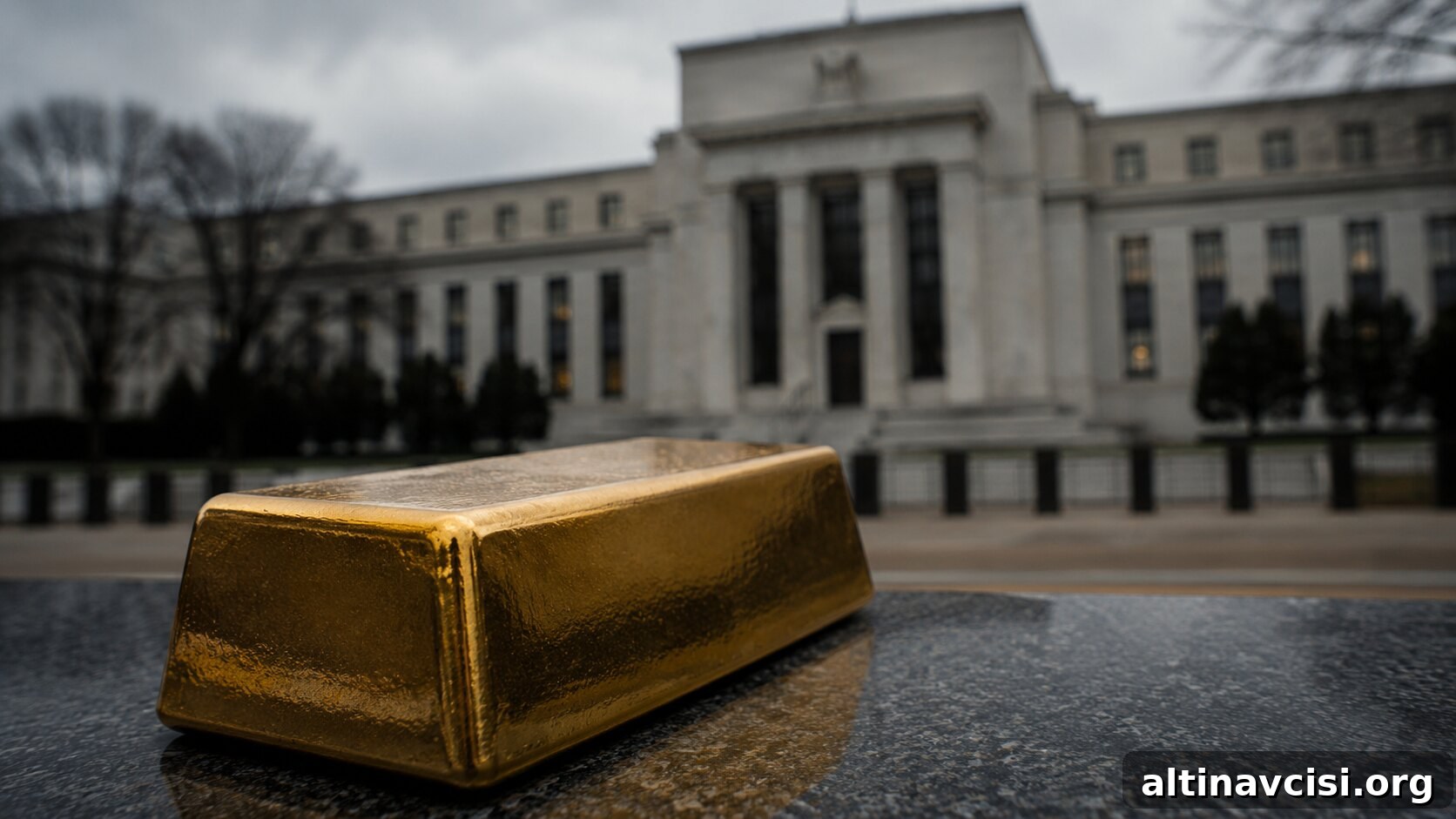
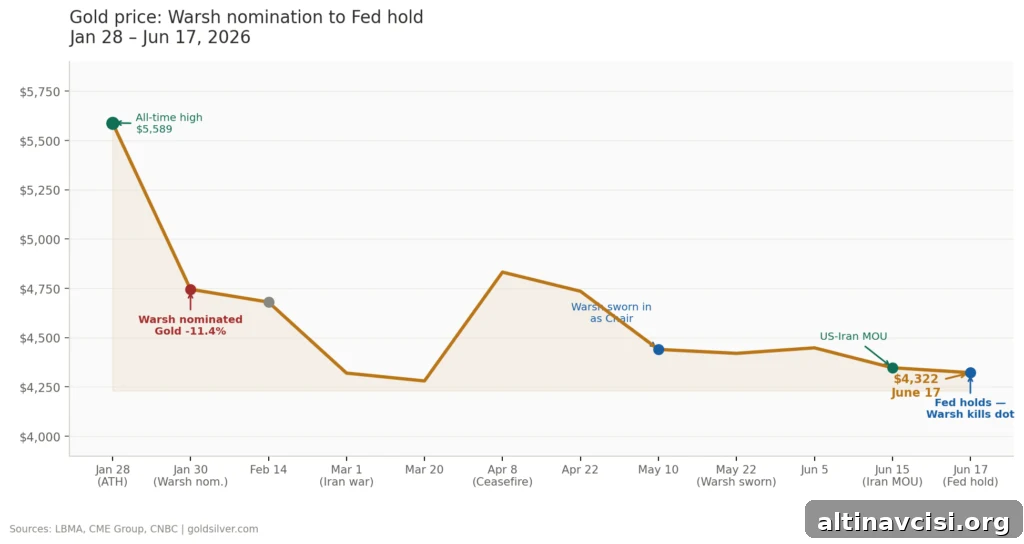
Gold is trading at $4,322 per ounce today and barely moved on the Federal Reserve’s announcement. That calm is the main takeaway.
On Wednesday the Fed left its policy rate unchanged at 3.50%–3.75%. Markets were virtually certain of that outcome: futures priced the hold at about 97% going into the meeting. What mattered more for holders of physical gold was what Chair Kevin Warsh did alongside the decision.
Warsh declined to publish his personal rate projection on the Fed’s quarterly “dot plot.” By sitting out the familiar forecasting chart he became the first Fed chair in 14 years not to include a personal dot on the map that has guided markets since 2012. That omission was more than symbolic; it signals how this Fed intends to operate going forward.
Who is Kevin Warsh, and why does his first meeting matter?
Kevin Warsh was sworn in as the 17th Federal Reserve Chair on May 22, 2026. His confirmation vote in the Senate was 54–45, the most partisan confirmation for a Fed chair on record. Wednesday marked his first Fed meeting as chair.
He inherited a divided Federal Open Market Committee. The April 2026 meeting under Jerome Powell resulted in an 8–4 vote, the most contested FOMC decision since 1992. Warsh began his tenure managing that same split and with a clear public stance: during his Senate confirmation he stated he does not support forward guidance on interest rates tied to economic data. That stance foreshadowed his decision this week to forgo the dot plot.
The Edge Every Investor Needs
Smarter precious metals investing starts here. The Nuggets Newsletter delivers market insight, Fed updates, global trends, and educational content.
What is the dot plot, and why does it matter for gold investors?
The dot plot is a quarterly chart the Fed has published since January 2012. Each voting and non-voting Fed official submits an individual projection for where the policy rate should be at year-end; those projections appear as dots that collectively show the committee’s expectations. The tool became a primary form of forward guidance after the 2008 financial crisis when the Fed needed to reassure markets about the future path of policy.
That forward guidance worked for a time, but it can also create problems. In 2021 the Fed signaled rates would remain near zero “for an extended period,” and markets treated that guidance as a commitment. When inflation accelerated, the Fed had to pivot quickly, producing a large bond-market disruption. Warsh has repeatedly pointed to that episode as evidence that explicit rate projections can turn into promises that reduce policy flexibility and magnify mistakes.
By opting out of the dot plot, Warsh effectively removed one predictable element from the Fed’s communications toolkit.
Does a less predictable Fed help or hurt gold?
This question matters most to long-term holders of physical gold. To answer it, we must look at what actually drives gold prices. Gold does not pay interest, so commentators often say it suffers when rates rise. The more precise driver is real yields—the yield on Treasury securities after adjusting for inflation.
When real yields fall into negative territory—when inflation outpaces returns on safe assets—gold tends to become more attractive as a store of purchasing power. Forward guidance that clearly outlines future rate paths reduces one source of uncertainty for savers: they can estimate what cash or short-term bonds will earn. That transparency can suppress demand for a non-yielding asset like gold.
A Fed that refuses to forecast, by contrast, forces markets to focus on incoming data—jobs, inflation, growth—and increases the chance of policy surprises. Greater uncertainty is typically priced into assets that have historically benefited from monetary ambiguity, and physical gold is one of those assets.
What did the dot plot itself show on Wednesday?
Although Warsh withheld his dot, the other committee members still submitted their projections. Reports indicate at least three members expect a rate hike in 2026, and markets now price roughly a two-thirds chance of at least one hike by December—a dramatic shift from earlier in the year when markets priced in multiple cuts.
Mechanically, higher nominal rates can push real yields higher, which raises the opportunity cost of holding non-yielding gold and can weigh on prices. That tension between nominal rates, inflation, and real yields is the core dynamic for gold moving forward.
Is the hawkish Warsh discount already priced into gold?
Markets began pricing a hawkish Warsh months ago. The day Warsh was nominated, gold fell sharply from intraday highs and settled materially lower that session. Today’s price of $4,322 sits about 23% below the January peak, reflecting a significant repricing that already incorporated much of the expected hawkishness.
The question now is whether the Warsh who leads the committee, weighs incoming data, and avoids binding commitments will prove as hawkish in practice as markets feared. His decision to skip the dot suggests he may be a pragmatic chair who prefers flexibility over promises—an approach that could be less aggressively hawkish than anticipated.
What does this mean for people holding physical gold?
The structural communication backdrop has shifted: Fed forecasts may no longer provide the same level of predictable guidance they once did. That change increases policy uncertainty, and uncertainty is typically supportive for gold.
When the Fed explicitly forecasts future rates, savers can estimate future cash returns and may favor interest-bearing assets. Remove that clarity and savers will look for alternative anchors. Physical gold has long served that role—not because it yields interest, but because it preserves purchasing power and provides stability when monetary signals are unclear.
What are central banks signaling about gold right now?
Central banks continued to buy net tonnes of gold in early 2026, maintaining purchases even as prices fell from their January highs. These are sovereign reserve decisions with multi-decade horizons, not short-term momentum trades. Their buying through a price correction is a clear signal of preference for physical gold amid an uncertain monetary transition.
Put together: a Fed chair who refuses to make specific forecasts, central banks accumulating reserves, and real yields that will now be driven by unpredictable data. Those forces align toward greater interest in gold as a hedge against a less legible monetary system.
Owning physical gold is not strictly a bet on rates falling. It is a position that anticipates what happens when monetary policy becomes harder to read. With the Fed making its communications less precise, that illiquidity of information has increased—and for many investors in physical gold, that matters.
SOURCES
1. LBMA — Precious Metal Prices
2. CME Group — FedWatch Tool, June 2026 FOMC Probabilities
3. Federal Reserve Board — FOMC Meeting Calendars and Statements
4. Federal Reserve Bank of San Francisco — Ben Bernanke: Solving a Crisis, Changing the Fed
5. U.S. Senate — Kevin Warsh Confirmation Vote, May 13, 2026
6. CNBC — Coverage of Fed Chair Warsh and dot plot decision (June 2026)
7. Federal Reserve Bank of St. Louis (FRED) — 10-Year Real Interest Rate
8. CNBC — Market reaction to Warsh nomination, January 30, 2026
9. World Gold Council — Gold Demand Trends Q1 2026
Disclaimer: This article is for informational purposes only and does not constitute financial or investment advice. Consult a qualified financial adviser before making investment decisions.
You May Also Like:
- Gold Holds at $4,347 While Stocks Hit All-Time Highs. Here’s Why.
- Why Is Silver Up Today? The Iran Deal Changed the Fed Math
- Gold Up 3%, Silver Up 4.7%: Five Forces Driving Metals Higher Today
- Iran Peace Deal Sends Oil Down 5%, Gold Up 3%
- Gold & Silver Surge on Iran Peace Deal — Then Pull Back
- Silver Fell 22% in 30 Days. Gold-Silver Ratio Hits 63.
- Every Bearish Catalyst Landed at Once. Gold and Silver Went Up Anyway.
- Gold at Seven-Month Lows: Why Geopolitical Fear Is Not Enough
- Gold Slides to $4,130 as Iran War Turns Inflation Against It
- May CPI Printed 4.2%. Core Inflation Beat. So Why Did the Gold Price Drop?