
Daily News Nuggets | Today’s top stories for gold and silver investors
October 7, 2025
Gold Rush Nears $4,000, Silver Approaching $50
Gold surged toward the $4,000 mark Tuesday, while silver climbed within striking distance of $50 as investors poured into precious metals amid growing global uncertainty. Analysts point to a combination of political volatility, weak U.S. economic data, and record central bank demand as the primary drivers behind the rally.
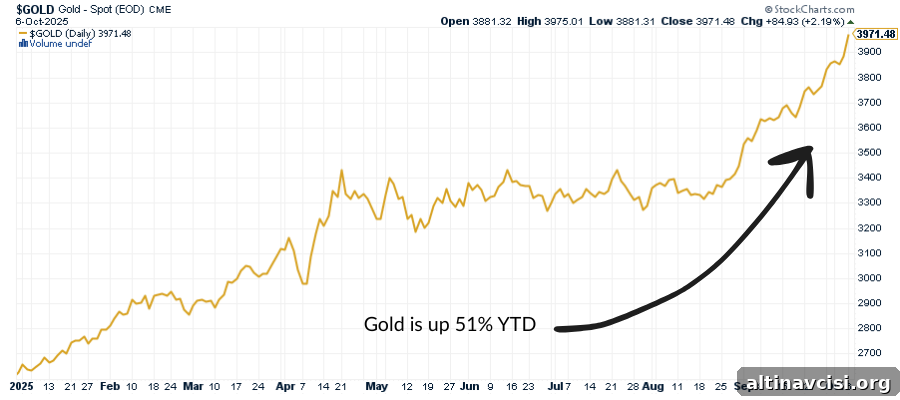
Gold is now up more than 50% year-to-date, on pace for its best annual performance since the 1970s. Silver has advanced roughly 67%, supported by strong industrial demand and speculative inflows. With monetary policy expected to ease and inflation remaining persistent in many regions, investors appear to be rotating from paper assets into tangible stores of value.
As bullion hits new highs, major institutional investors who were previously skeptical are increasingly participating in the rally, reinforcing price momentum.
Goldman Hikes December 2026 Gold Price Forecast to $4,900
Goldman Sachs raised its December 2026 gold target to $4,900 per ounce, citing persistent central bank buying, a softer U.S. dollar, and slowing economic growth. The bank argues that structural support for gold is strengthening as investors diversify away from richly valued equities and long-duration bonds.
The upgrade follows other bullish forecasts, including Fidelity’s $4,000 projection. These calls share a common premise: real interest rates are likely to remain low while confidence in fiat currencies erodes, making precious metals an attractive hedge.
For months the market treated gold’s rise as an anomaly. The scale of the current move and the growing institutional participation suggest investors are preparing for an extended period of uncertainty. If private-sector indicators continue to show economic fragility, demand for gold could remain elevated.
Private Sector Steps In: Carlyle Tracks Weak U.S. Jobs Growth
Concerns about the reliability of official U.S. jobs data have intensified this year. With disruptions to government reporting and questions about methodology, private firms are providing alternative labor-market measures.
The Carlyle Group’s proprietary model estimates only 17,000 jobs were created in September, far weaker than many historical trends. ADP reported a 32,000-job decline, while other private trackers show modest gains, highlighting the divergence in available readings and the uncertainty surrounding the true state of the labor market.
These independent measures add to worries that the U.S. labor market may be softer than headline government figures indicate. A weakening jobs backdrop could prompt the Federal Reserve to cut rates more aggressively, conditions that historically support higher gold prices as investors seek safety from policy missteps.
As confidence in official statistics wanes, both investors and policymakers are placing greater emphasis on tangible assets and independent data sources.
Trump Greenlights Alaska Mining Push
The administration approved a long-disputed access road to Alaska’s Ambler mining district, aiming to unlock domestic supplies of copper and other critical minerals. The move includes $35.6 million in U.S. funding tied to Canada’s Trilogy Metals, giving the U.S. a 10% stake and warrants for an additional 7.5%.
The Ambler project is positioned as a strategic element of efforts to secure mineral supply chains and reduce reliance on foreign sources. Environmental groups have raised concerns about risks to fragile Arctic ecosystems, but policymakers emphasize the project’s importance for national security and industrial resilience.
While increased domestic supply could temper some industrial metal prices in the near term, the broader trend is a global race to secure physical commodities as confidence in financial assets shifts. As Washington strengthens its mineral base, other nations are also accumulating reserves of strategic assets.
China’s Central Bank Extends Gold Buying Spree
China’s central bank continued its gold-buying streak for the 11th consecutive month in September, marking its longest run of accumulation in over a decade. The People’s Bank of China now holds more than 2,250 tonnes of gold, reinforcing its role as one of the world’s most consistent sovereign buyers.
This sustained purchasing reflects a broader strategic shift among central banks, particularly across Asia and the Global South, that are diversifying reserves away from dollar exposure and toward hard assets. The flow of gold is increasingly eastward, reversing the westward movement that characterized much of the 20th century.
What appears to be happening is more than tactical reserve management; it may be a structural realignment of monetary influence that could shape the next financial era. If 2025 has taught investors anything, it is that gold is transitioning from an alternative asset to a core anchor of reserve strategy.