
The unemployment rate fell to 4.2% in June, but the headline improvement masks an important detail: the labor force participation rate declined to 61.5%, its lowest level since March 2021. In other words, the drop in the unemployment rate was driven more by fewer people actively looking for work than by a surge in hiring. Markets effectively priced that distinction into precious metals pricing on July 2, 2026, before it became a widespread narrative in the headlines.
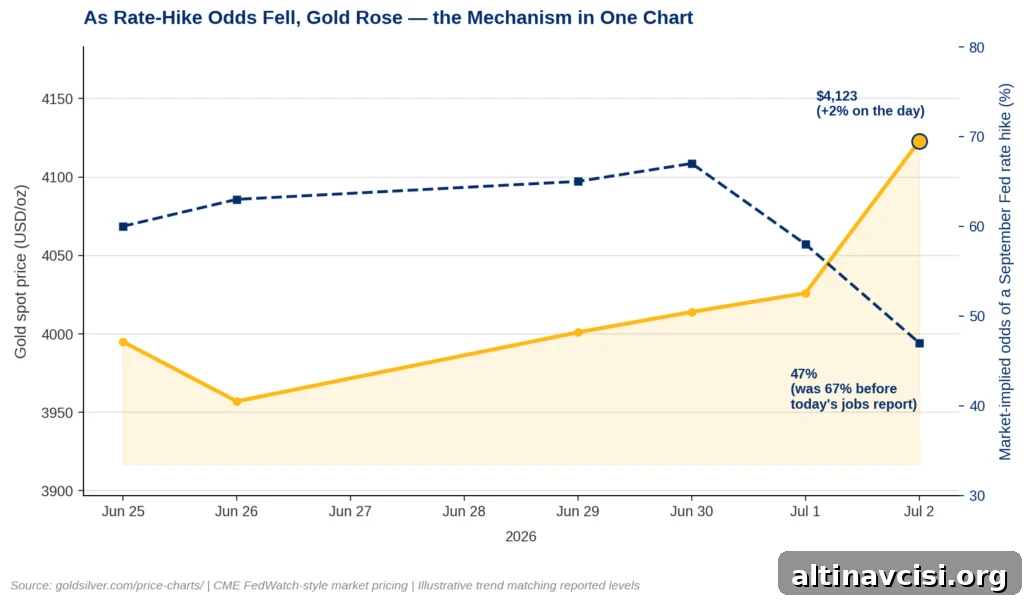
On July 2, 2026, gold climbed above $4,100 per ounce, trading into the $4,140s during the morning session—roughly a 2% gain on the day. Silver outperformed, rising above $61 per ounce, gaining more than 3%. These moves extended the reversal that analysts flagged earlier in the session. That earlier coverage highlighted how hawkish market pricing was unwinding following a weak ADP report and dovish comments from Federal Reserve officials. The June jobs report that arrived later in the day reinforced that shift.
What the Jobs Report Showed
The Bureau of Labor Statistics reported that U.S. employers added just 57,000 payroll jobs in June, well below consensus expectations. The print was the weakest in several months, and earlier months were revised lower: April and May payrolls were revised down by a combined 74,000 jobs. Leisure and hospitality, a sector many expected to benefit from seasonal and event-related hiring, lost 61,000 jobs in June. Average hourly earnings rose 3.5% year over year, which means wage growth remains elevated but broadly in line with recent readings. Taken together, the data point toward a cooling labor market—at least by some measures.
The Edge Every Investor Needs
Smarter precious metals investing starts here. The Nuggets Newsletter brings essential market insights, Fed updates, global trends, educational videos, and much more.
The Gold Price Unemployment Rate Link
The labor force participation rate is the crucial link between the unemployment figure and gold pricing this week. Participation fell from 61.8% in May to 61.5% in June. The household survey showed roughly 507,000 fewer employed people month over month, according to BLS data, which indicates that many people stopped being counted as job seekers rather than that a matching number of new jobs appeared. An unemployment rate that declines because the labor force shrinks is a weaker improvement packaged as strength. Headlines may describe the situation as stability, but the underlying data point more toward labor-market fatigue and disengagement.
Why Gold and Silver Moved
The movement in gold and silver reflected the mechanics of this data release rather than pure sentiment. CME FedWatch probabilities tell the broader story: the chance of a September rate hike fell sharply after the jobs report, dropping from roughly two-thirds to below 50%. The 2-year Treasury yield, which is particularly sensitive to Fed policy expectations, fell to the low 4% range. Lower expected policy rates reduce expected real yields, and real yields are the main opportunity cost of holding non-yielding assets like gold. When the market reduces the odds of additional tightening, the relative appeal of holding precious metals increases.
Several market strategists noted that the payroll slowdown weakens the narrative of a re-accelerating labor market and reduces the Fed’s immediate case for further tightening. That view is the core rationale gold traders are reacting to: it’s not an assertion that the economy is collapsing, but rather that the Federal Reserve has one less imperative to prefer short-term cash instruments over gold.
The Sound Money Angle
The Federal Reserve faces a difficult balance. Core inflation, measured by the Fed’s preferred gauge, remains clearly above the 2% target, arguing for tighter policy. At the same time, signs of a cooling labor market cut the urgency for additional rate hikes. A portion of that cooling is tied to lower participation rather than a direct collapse in hiring. Each month the Fed confronts this tension, real yields can stay compressed. Compressed real yields represent the primary structural tailwind for gold right now: gold does not require rate cuts to advance, only a persistent lack of upward pressure on real yields that would otherwise favor fixed-income instruments.
The Second Corner
The deeper story is not the single number of 57,000 jobs or the 4.2% headline. The important distinction is how that falling unemployment rate came about. Normally, a lower unemployment rate reads as reassuring; this instance was driven largely by a declining participation rate. Gold markets interpreted that nuance quickly and adjusted pricing accordingly. Many mainstream commentaries treated the headline at face value and missed the underlying mechanism. That discrepancy—the gap between the appearance of strength and the mechanics producing it—is where the sound-money argument gains traction. Savers who seek genuine stores of value pay attention to the mechanics beneath headline statistics.
What to Watch Next
Two upcoming data points deserve close attention. First, the Consumer Price Index (CPI) for June is scheduled for release on July 14, 2026; a hotter-than-expected core CPI print could reintroduce rate-hike betting and put downward pressure on precious metals. Second, the next Federal Open Market Committee meeting takes place July 28–29, 2026; the July jobs numbers increase the likelihood the Fed will pause, but the Fed’s statement and economic projections will be key. Also monitor the gold-silver ratio: when silver outperforms gold, the ratio compresses, and that pattern can reflect rotation or changing risk preferences among traders. Recent action showed silver gaining more than gold on July 2, illustrating that the story remains active and may evolve as fresh data arrive.
Stay On Top of Gold & Silver Prices
Get important market alerts sent straight to your inbox.
SOURCES
1. Bureau of Labor Statistics — The Employment Situation, June 2026
2. News coverage of the June 2026 jobs report and market reaction
3. Market data for gold and silver spot prices and Treasury yields
4. Core inflation reports and commentary on Fed policy
Disclaimer: This article is for informational purposes only and does not constitute financial or investment advice. Always consult a qualified financial adviser before making investment decisions.
You May Also Like:
- Gold Jumps 2.5%, Silver Surges 3.85% as Rate-Hike Bets Unwind Ahead of Jobs Report
- Fed Official Warns Inflation Is Too High; Market Notes Diminishing Rate-Risk
- ADP Missed Forecasts; Precious Metals Held Their Ground
- Bank Forecast Adjustments Reflect Evolving Economic Narrative for 2026
- Gold’s Quarterly Performance and Geopolitical Drivers
- Jobs Data That Could Move Markets Again
- Fed Projections and the Market’s Response