
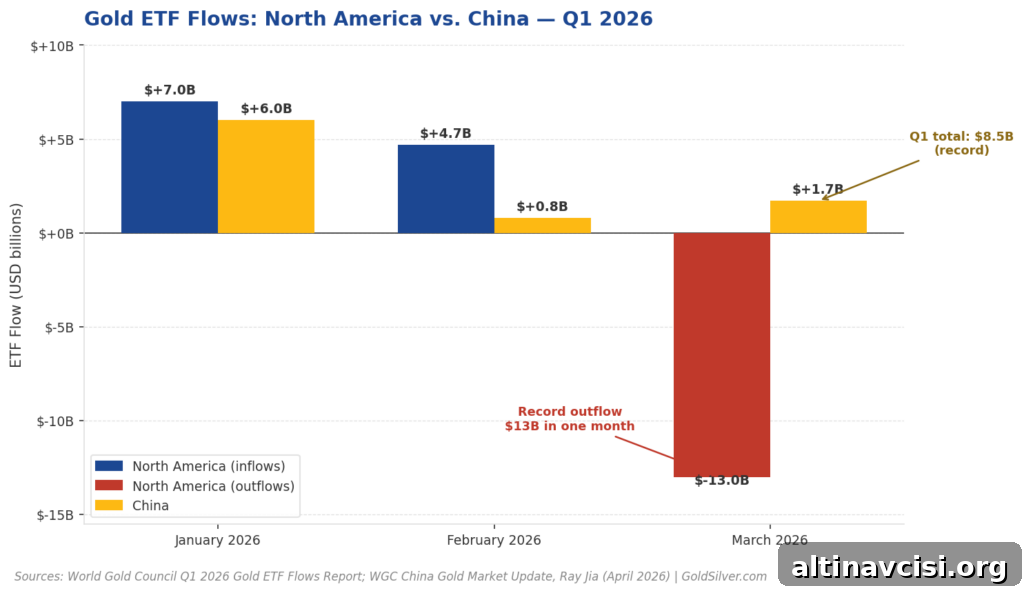
In Q1 2026, North American investors withdrew $13 billion from physically backed gold ETFs — the largest monthly outflow on record for the region, according to the World Gold Council. Over the same quarter, Chinese investors added a record $8.5 billion to their gold ETFs. It is the same metal, trading at the same price, but opposite flows.
This morning gold is trading around $4,879 per ounce, roughly 17% above its mid‑March lows.
Why Did North American Gold ETF Outflows Hit a Record in March 2026?
The $13 billion outflow was driven primarily by the Federal Reserve’s shift away from expected rate cuts. When strikes involving the US and Israel against Iran began on February 28, oil jumped and inflation expectations rose. Markets that had been pricing in multiple Fed rate cuts in 2026 quickly repriced toward a hold, and futures briefly even priced in a small chance of a hike.
That repricing matters for gold because the metal yields no interest. Gold competes with interest-bearing assets, and higher real interest rates (nominal rates minus inflation expectations) raise the opportunity cost of holding gold versus Treasuries. US institutional investors who used gold as a hedge against falling rates reacted mechanically: they sold.
This was not a panic-driven liquidation but a mechanical response to changing rate expectations, and it ended a nine-month North American inflow streak, per the World Gold Council. The historical precedent is instructive: several of the largest monthly outflows on record occurred during COVID‑19 and were followed by strong recoveries in flows within six to twelve months, once real rates eased and central banks pivoted again.
The Edge Every Investor Needs
Smarter precious metals investing starts here. The Nuggets Newsletter delivers concise market insights, Fed updates, global trends, and educational content.
Why Is China Buying Record Amounts of Gold?
Chinese gold ETF inflows reached $8.5 billion in Q1 2026, a quarterly record, according to World Gold Council research head Ray Jia. Holdings rose by 50 tonnes to 298 tonnes, and assets under management jumped 26% to $44 billion — the largest quarter-end total in the history of the Chinese gold ETF market.
China’s CSI 300 index fell in March as the Iran conflict disrupted supply chains. The dollar strengthened after the February 28 strikes, briefly boosting the appeal of hard assets, and safe-haven demand rose as concerns about the Strait of Hormuz and global energy supply increased.
The timing of Chinese buying is the most revealing detail. Investors in China increased purchases as prices dipped in March, not as they rose — the opposite behavior of rate-sensitive Western investors. That suggests a different thesis: many Chinese investors treat gold as a long-term monetary holding rather than a short-term hedge to trim when the Fed turns hawkish.
China’s Q1 2026 GDP, published by the National Bureau of Statistics, came in at 5.0%, beating the 4.8% consensus and accelerating from 4.5% in Q4 2025. A growing economy buying record amounts of gold at elevated prices points to conviction buying rather than distress selling.
What Does the East-West Divergence Actually Tell Us?
State Street Global Advisors corroborates the divergence. Their April 2026 Monthly Gold Monitor shows mainland China gold ETF inflows of $8.1 billion year‑to‑date versus more than $2 billion in outflows from the US gold ETF sector in the same period. Differences in totals reflect methodology and the set of funds each organization tracks.
One asset, two major markets, and mirror-image behavior. Are US investors mistaken or simply earlier in the cycle? The People’s Bank of China’s persistent buying makes the structural case stronger: the PBOC has added gold for 17 consecutive months, bringing official holdings to 2,313 tonnes — about 9% of China’s foreign exchange reserves, per the World Gold Council. Central banks typically accumulate for strategic reasons rather than short-term rate cycles. That sustained institutional demand creates a price floor less sensitive to brief rate moves.
Have US Gold ETF Outflow Streaks Reversed Before?
Yes. Major US gold ETF outflow streaks in recent decades have typically reversed within six to twelve months. The COVID‑era outflows — among the largest on record — unwound within roughly a year, and the same pattern occurred after the Global Financial Crisis. In those cases reversals followed declines in real rates and a more accommodative Fed stance.
Gold’s mid‑March 2026 low was about $4,100 per ounce. At roughly $4,879 today, the price has already recovered around 17%. Sellers exited near the trough, and buyers now hold the gains.
What Should Investors Watch Next?
The Federal Reserve’s FOMC meeting on April 28–29 is the next key event that could influence flows. Any renewed shift toward rate cuts would likely draw North American inflows back into gold. Watch $5,000 per ounce as the first meaningful resistance level — a sustained move above that mark would suggest the March low is a cycle floor. The World Gold Council’s April flow data, published in early May, will indicate whether re‑entry into US funds has begun.
Ultimately, gold is indifferent to which market holds it. The salient question is who holds it through the next cycle and at what prices they make that decision.
Stay On Top of Gold & Silver Prices
Get timely market alerts delivered to your inbox.
SOURCES
1. World Gold Council — ETF Flows: March 2026
2. World Gold Council — China Gold Market Update: A Seasonal Demand Rebound in March (Ray Jia, April 2026)
3. National Bureau of Statistics of China — National Economy Got off to a Good Start in the First Quarter (April 16, 2026)
4. World Gold Council — Gold Price Data
By the GoldSilver Editorial Team — helping investors understand sound money since 2005. This article is for informational purposes only and does not constitute financial, investment, or tax advice. Consult a qualified financial advisor before making investment decisions.
You May Also Like:
- Silver Market Deficit 2026: Six Years and Getting Worse
- Is the Petrodollar Ending? What the Iran War Means for Gold
- France’s Gold Repatriation Is Done. Germany Is Next
- Gold/Silver Ratio Hits 61.1 — Silver’s Turn to Run
- Silver Holds Near $80 as Iran Ceasefire Revives Rate‑Cut Bets
- The Fed Goes Silent in 3 Days – What Does That Mean For Gold?
- Gold Is Down 10% From Its War‑Peak — and Still Up 46% in a Year
- Gold Outranks the Dollar at Central Banks — What It Means for Your Savings