Gold and silver market update — May 8, 2026
Key Takeaways
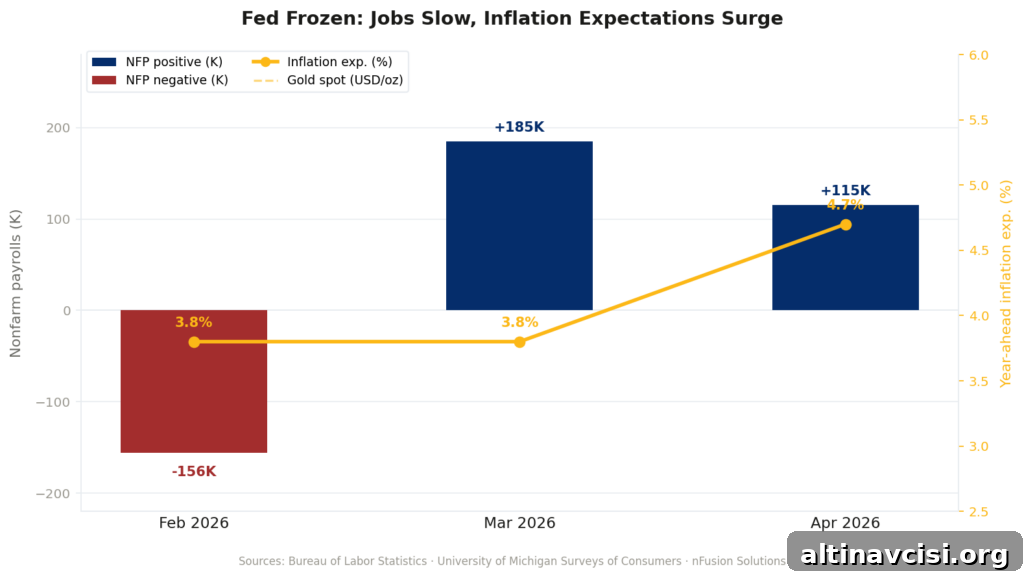
- April 2026 nonfarm payrolls printed 115,000 — more than double the 55,000 Dow Jones consensus — yet gold remained above $4,700 while the dollar weakened. Average hourly earnings missed at +0.2% vs. +0.3% forecast (BLS, May 8, 2026), leaving the Fed unable to justify either a hike or a cut.
- University of Michigan May 2026 preliminary: year-ahead inflation expectations 4.5%, a slight decline from April’s finalized 4.7% — both well above the Fed’s 3.50–3.75% policy rate, implying negative real returns on cash.
- CME FedWatch priced a June hold above 95%; central banks had purchased gold for 18 consecutive months as of April 2026. A Fed that cannot hike or cut is a structural tailwind for precious metals.
On May 8, 2026, April nonfarm payrolls surprised to the upside at 115,000. Rather than sending gold lower, traders saw the dollar fall and gold hold its gains — a sign that markets are pricing Fed paralysis rather than a simple payroll beat.
Gold was around $4,723 as of mid-afternoon ET, up roughly 0.8% on the day (source: nFusion Solutions).
Why gold held after a strong jobs report: The payrolls beat was notable, but wage growth disappointed. Average hourly earnings rose just 0.2% month-over-month, below the 0.3% consensus, and are tracking 3.6% year-over-year (BLS). That mix — strong headline jobs but cooling wages — reduces the Fed’s rationale to tighten while elevated inflation expectations reduce the case for easing. The University of Michigan’s preliminary May survey showed year-ahead consumer inflation expectations at 4.5%, down only slightly from April’s 4.7%. In that context, the Fed is boxed in, and that dynamic supports gold.
A labor market the BLS characterizes as showing “little net change over the prior 12 months” is unlikely to tolerate aggressive rate hikes. Before the report, CME FedWatch already priced a June hold above 95%. For precious-metals investors, a central bank effectively frozen in place is one of the clearest structural tailwinds available.
The Edge Every Investor Needs
Smarter precious metals investing starts here. The Nuggets Newsletter brings you essential market insights, Fed updates, global trends, educational videos, and timely analysis.
What Did the April 2026 Jobs Report Actually Show?
At 8:30 AM ET the Bureau of Labor Statistics reported 115,000 nonfarm payrolls added in April, well above the 55,000 Dow Jones consensus and the 62,000 Reuters median. March was revised up to 185,000. The unemployment rate held at 4.3%. Job gains were concentrated in healthcare (+37K), transportation and warehousing (+30K), and retail trade (+22K), while federal government employment declined by 9,000. The BLS emphasized the broader context, noting the series showed “little net change over the prior 12 months.”
Most important for policy, average hourly earnings rose only 0.2% month-over-month, missing the 0.3% forecast and signaling cooling wage pressures. That combination — healthy job creation without accelerating wages — weakens the case for rate hikes while persistent inflation expectations complicate any argument for cuts. The University of Michigan’s May preliminary sentiment reading, released 90 minutes later, showed year-ahead inflation expectations at 4.5%, a small decline from April’s 4.7% but still well above the Fed’s policy rate range.
Why Did the Dollar Fall on a Strong Jobs Report?
The dollar’s decline despite a strong payrolls print reflects the market’s focus on the Fed’s limited options. Elevated one-year inflation expectations (around 4.5%) make cuts risky because they could entrench higher inflation psychology. At the same time, a labor market described as showing little net change and lacking wage acceleration cannot comfortably absorb aggressive tightening. With CME FedWatch pricing a June hold probability above 95%, markets are pricing a credibility problem for the Fed rather than reacting purely to payrolls data. EUR/USD and GBP/USD both rallied intraday as a result, while gold held its gains.
What Are Markets Pricing for the Fed’s June 17 Meeting?
Before the jobs release, CME FedWatch showed a roughly 95.9% chance of a June hold; the stronger-than-expected payrolls print pushed that probability higher. Reuters’ analyst survey published before today’s data put the 2026 average gold price forecast at $4,916, up from $4,746 three months earlier. Gold is trading significantly higher year-over-year, driven by fiscal deficits, energy-driven inflation, and a central bank that struggles to demonstrate clear progress on either inflation or employment mandates.
What Does Fed Paralysis Mean for Physical Gold and Silver Investors?
When consumers expect inflation near 4.5% while the policy rate sits at 3.50–3.75%, real returns on cash are negative. That gap erodes confidence in fiat savings and tends to increase demand for stores of value outside the monetary system. Central-bank purchases of gold — 18 consecutive months as of April 2026 — and elevated consumer expectations together create a structural bid under precious metals. For physical gold and silver investors, that structural support is more consequential than single data prints or geopolitical headlines.
Is This a Temporary Spike or a Structural Shift in Gold’s Floor?
The recent Michigan readings and central-bank buying suggest more than a short-lived spike: they point to a change in expected behavior. Years of higher-than-projected inflation, a delayed policy response, and renewed energy disruptions have undermined confidence. Institutional and retail players moving in the same direction tend to create a durable floor for prices rather than a transient trade.
What to Watch Next
Key data to watch this week: CPI for April on Tuesday, May 12, and PPI for April on Wednesday, May 13. Elevated readings in either series would reinforce gold’s support above $4,700 and strengthen the narrative of Fed paralysis and negative real cash returns.
Stay On Top of Gold & Silver Prices
Get important market alerts sent straight to your inbox.
SOURCES
1. Bureau of Labor Statistics — The Employment Situation, April 2026
2. U.S. BLS — CPI Release Schedule 2026
3. U.S. BLS — PPI Release Schedule 2026
4. University of Michigan Surveys of Consumers — May 2026 Preliminary Results
5. CME Group — CME FedWatch Tool
6. Federal Reserve — FOMC Statement, April 28–29, 2026
7. Reuters — Gold Price Analyst Survey, 2026
8. World Gold Council — Gold Demand Trends, Q1 2026
9. nFusion Solutions — Metals Spot Price API, May 8, 2026
10. TradingEconomics — Gold Spot Price, May 8, 2026
Disclaimer: This article is for informational purposes only and does not constitute financial or investment advice. Always consult a qualified financial adviser before making investment decisions.
You May Also Like:
- Jobs Beat, Ceasefire, Deficit: What It Means for Gold
- Gold Price Outlook: Oil Futures Disagree With Stock Markets
- Why Silver Hit $82 Today: Iran, Oil, and the Fed
- Gold Hits $4,746 as Oil Crashes. Here’s Why That’s Bullish
- Gold Price and Nonfarm Payrolls: Why the Fed Is Trapped
- Gold Is Decoupling From Geopolitics. Here’s the Proof
- The Fed Is Frozen. The Debt Is Growing. Gold Is Watching.
- Gold Jumps on Iran Deal Hopes. The Real Driver Is the Fed