Daily News Nuggets | Today’s top stories for gold and silver investors
March 10th, 2026 | Brandon Sauerwein, Editor
Precious Metals Steady After the January Surge
Gold traded near $5,200 per ounce on Tuesday, while silver hovered around $89—keeping both metals well within rally territory.
So far this year, gold has gained about 18.6%, while silver has surged roughly 23.3%, outpacing its yellow-metal counterpart. Both metals posted sharp gains in mid-to-late January before a correction briefly interrupted the advance.
Gold and Silver Prices Year-to-Date
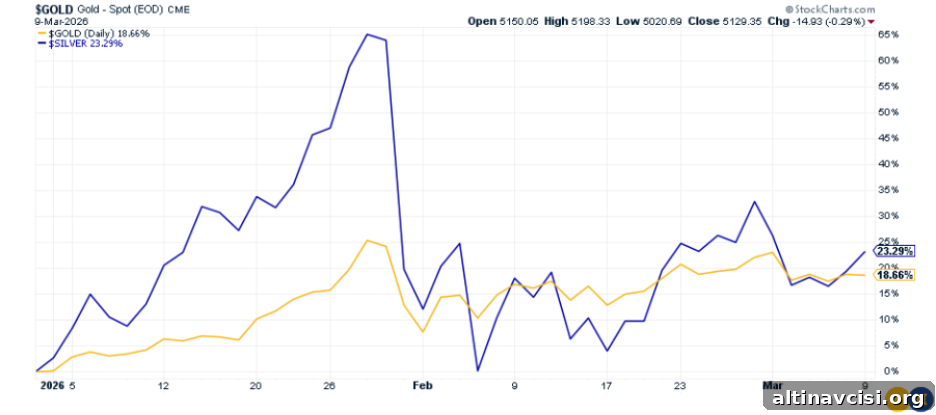
The pullback proved temporary; in recent weeks both metals have been steadily regaining ground. Silver’s stronger year-to-date performance is familiar to veterans of precious-metals bull markets. Silver benefits from both safe-haven demand and wide industrial use—solar panels, electronics, and electric vehicles all require silver—so investor interest tends to amplify price moves.
The underlying drivers remain intact: persistent inflation concerns, rising sovereign debt, and an unstable geopolitical backdrop continue to push capital toward hard assets. Until those fundamentals change, the upward trend has room to continue.
Trump: The Iran War Could Be “Very Close” to Over
President Trump suggested the campaign may be nearing its end, saying U.S. and Israeli forces are “far ahead of schedule”—a reference to a series of targeted strikes intended to degrade Iran’s military infrastructure and limit its nuclear capabilities.
Markets reacted. If the conflict winds down quickly, some of the geopolitical risk premium in oil and gold could unwind rapidly. That said, officials and analysts remain cautious as attacks in the region continue.
Iran Expands Attacks Across the Middle East
Hours after claims the campaign was “far ahead of schedule,” Tehran launched additional missile and drone strikes targeting Israel and Gulf states, including Saudi Arabia and Kuwait. Regional air defenses intercepted several drones, but the scale of the attacks made clear the conflict is expanding rather than winding down.
What began as a targeted operation has increasingly become a regional confrontation with no clear exit. Iran’s recent strikes appear designed to demonstrate its reach and deter pressure for a ceasefire. That uncertainty carries real costs: the Strait of Hormuz, a chokepoint for roughly 20% of global oil flows, remains under threat, keeping energy prices elevated and supply chains on edge. Until the trajectory of the conflict becomes clearer, volatility is likely to persist.
The Edge Every Investor Needs
Smarter precious metals investing starts here. The Nuggets Newsletter brings essential market insights, Fed updates, global trends, educational videos, and more.
Wednesday’s CPI Report: Hotter Than Expected Would Sting
February’s inflation data arrives Wednesday at a sensitive moment. War-driven energy costs and shipping disruptions are pushing prices higher, and the CPI report has a well-established relationship with gold: hotter inflation often lifts the metal.
The Federal Reserve will be watching closely. A hotter-than-expected CPI print could push out expectations for rate cuts and keep financial conditions tighter into the spring. Inflation surprises affect stocks, bonds, and commodities simultaneously; gold generally stands apart by attracting demand when inflation re-accelerates. A surprise print could be the catalyst that tests that pattern.
The World Gold Council’s Case for Gold
The World Gold Council’s February commentary argues the dollar’s decline is paused, not over. January’s brief DXY recovery—driven by positive U.S. economic surprises—appears temporary in the WGC’s view.
The structural case is clear: U.S. equities and the dollar look stretched by historical measures, and the “double reward” that attracted foreign capital—strong returns combined with a strong currency—is fading. Europe and Japan now present viable alternatives, and capital appears to be rotating. February’s flows support that view: global gold ETF inflows reached $5.3 billion, with particularly strong demand in Asia. Elevated Shanghai Futures Exchange activity and steady buying during Asian hours suggest Eastern investors aren’t waiting for Wall Street to lead.
A weaker dollar makes gold cheaper for buyers outside the U.S., increasing demand against a relatively fixed supply. The WGC sees this dynamic as still in its early stages.
Stay On Top of Gold & Silver Prices
Get important market alerts sent straight to your inbox.
You May Also Like
- Gold Price Today: Why This Week’s News May Be Bullish for Gold
- Gold Price Outlook: What Could Push Gold to $6,300
- Gold and Silver Prices Today: Iran, Oil, and a $1.3B Bet
- Gold and Silver Are Climbing While the World Watches Hormuz
- Hormuz, the Fed, and the Battle for Safe-Haven Status