Gold as an Emergency Fund: Pros, Cons, and Liquidity

Last verified November 2026.
Using gold as an emergency fund means holding physical gold (coins or bars) instead of cash to cover unexpected expenses like job loss, medical bills or urgent car repairs.
Gold functions differently from cash. It trades in deep global markets — roughly $361 billion a day in 2025 [World Gold Council, April 16, 2026] — yet its price can move sharply. For example, it dropped 8.9% in a single week in November 2026 [World Gold Council, November 23, 2026]. Because of these swings and retail selling costs, gold is generally a better secondary reserve than the primary dollars you’d rely on immediately.
Surveys and regulators highlight what an emergency fund must provide: safety, quick access and protection from casual spending. The Fed’s 2025 household survey found 63% of adults could cover a $400 unexpected bill with cash or an equivalent [Federal Reserve Board, May 2026]. The Consumer Financial Protection Bureau (CFPB) recommends an emergency fund be safe, accessible and out of reach of routine spending [CFPB, October 29, 2025]. Gold meets the “hard to spend” test but strains the safety and accessibility standards, and dealers commonly buy back at prices below spot [CFTC and FINRA, March 20, 2024].
Key Takeaways:
- Gold is actively traded but can be volatile; it fell 8.9% in the week ending November 20, 2026, its steepest weekly decline since March [World Gold Council, November 23, 2026; ING Think, November 20, 2026].
- Market liquidity differs from retail liquidity. Dealers typically buy below spot and set their own spreads, which affects what you actually receive when selling [CFTC and FINRA, March 20, 2024].
- Gains on gold coins are taxed as collectibles at up to 28% for long-term profits, and capital losses can be deducted only up to $3,000 per year against ordinary income [IRS, November 9, 2026].
- Cash held in an FDIC-insured bank account is protected up to $250,000 per depositor, per bank, per ownership category; that protection does not extend to physical gold [FDIC, April 1, 2024].
What Does an Emergency Fund Need to Do?
An emergency fund must convert to spendable money quickly and predictably. The CFPB describes it as cash set aside for unplanned expenses like car repairs, medical bills and income disruptions, and it should be safe, accessible and difficult to spend on everyday wants [CFPB, October 29, 2025].
Many households lack that protection. The Federal Reserve’s Survey of Household Economics and Decisionmaking (SHED) reported that 63% of adults could cover a $400 emergency with cash or its equivalent in 2025, down from a 2021 peak of 68% [Federal Reserve Board, May 2026]. Only 55% of adults had set aside three months of expenses [Federal Reserve Board, May 2026].
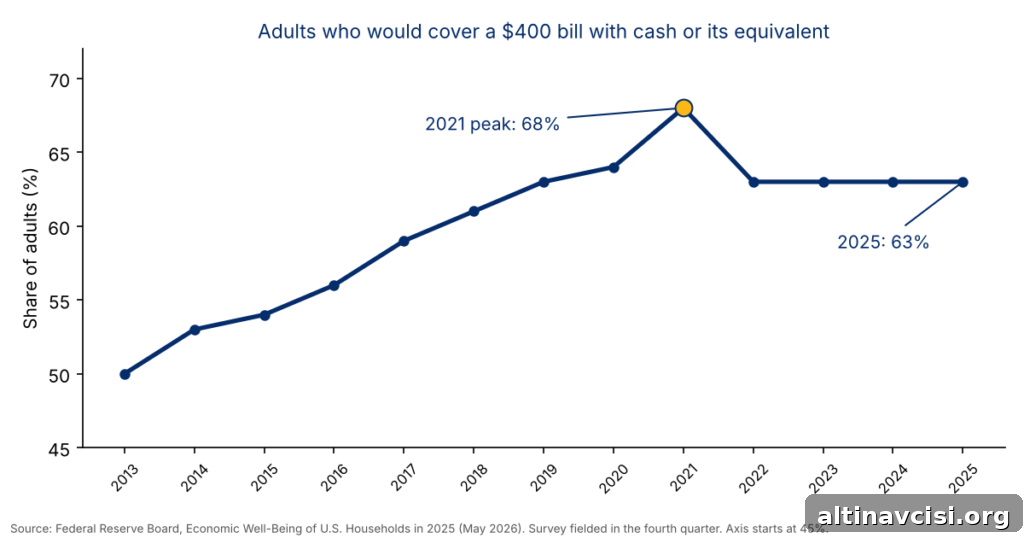
This context matters for gold because 7% of adults said they would sell an asset to meet a $400 bill [Federal Reserve Board, May 2026]. A properly funded cash emergency account removes the need to liquidate assets under pressure.

The Edge Every Investor Needs
Smarter precious metals investing starts here. The Nuggets Newsletter brings market insights, Fed updates, global trends, and educational content.
What Are the Pros of Using Gold as Emergency Fund Savings?
Gold carries several strengths that attract savers. First, the market is large and globally traded, which means you can usually find buyers when you choose to sell. The World Gold Council reports average daily trading of about $361 billion in 2025 and notes that investors have historically sold gold during crisis sell-offs to meet liquidity needs, with prices later recovering [World Gold Council, April 16, 2026].
Second, physical gold has no issuer risk. Unlike a bank deposit, which is a claim on a financial institution, a coin or bar in your possession is not another party’s liability.
Third, gold has delivered strong returns at times — the LBMA Gold Price rose roughly 63% during 2025 [LBMA, January 7, 2026]. For savers who want a store of value outside a single bank, gold can serve as a long-term hedge where FDIC coverage ends at $250,000 per depositor, per bank, per ownership category [FDIC, April 1, 2024].
What Are the Cons of Gold as Emergency Fund Savings?
The main drawback is price risk. An emergency fund must preserve value when you need it, and gold’s price can fall sharply. For example, the LBMA Gold Price PM dropped 9.6% in the week to March 20, 2026 — its steepest weekly decline in over a decade — and spot fell 8.9% in the week to November 20, 2026 [World Gold Council, March 23, 2026; World Gold Council, November 23, 2026].
That risk increases when market stress coincides with personal need. Analysts noted that broad risk reduction and equity sell-offs in November 2026 may have forced some investors to liquidate gold for cash [World Gold Council, November 23, 2026; ING Think, November 20, 2026]. If you face a job loss at the same time the gold market is slipping, you may get a much lower price than recent spot quotes would suggest.
Other downsides include zero yield, storage and theft risk if kept at home, and the practical problem that coins and bars come in set sizes, which can force you to sell more metal than required for a small expense. Dealers also typically buy below spot, adding an additional cost at sale [CFTC and FINRA, March 20, 2024].
Is Gold as Emergency Fund Money Liquid Enough?
Liquidity has two meanings: market liquidity and retail liquidity. Market liquidity refers to the global ability to trade gold — that side is deep. But retail liquidity measures what you actually net when selling coins or bars to a dealer. Retail spreads, buy-back policies and product type can materially reduce proceeds.
Wholesale bid-ask spreads widened briefly at times after 2024, according to market reports, and dealers’ retail practices mean you should ask for their buy-back price before you buy gold. Collectible or semi-numismatic coins are often harder to resell than plain bullion, and dealer buy-backs vary across firms [World Gold Council, April 16, 2026; CFTC and FINRA, March 20, 2024].
What Does Selling Gold in a Hurry Really Cost?
To illustrate, imagine a household holds $30,000 in gold at spot and uses $5,000 a month for essentials. If gold drops 9% in a week, the position’s spot value becomes $27,300. If the dealer’s bid is 3% below spot, the household nets about $26,481. That covers roughly 5.3 months of essentials versus six months if the reserve were held in cash — and that’s before taxes. This example shows how price moves and dealer spreads can shrink an emergency buffer when you need it most.
How Is Gold Taxed When You Sell It for Cash?
The IRS treats most physical gold and many physically backed gold ETFs as collectibles for tax purposes. Long-term capital gains from collectibles are taxed at a maximum rate of 28% [IRS, November 9, 2026]. Short-term gains are taxed at ordinary income rates, and other taxes, such as the net investment income tax, may apply to higher earners [IRS, November 9, 2026].
Capital losses on these assets are limited in how they offset other income: net capital losses may offset ordinary income up to $3,000 per year, with excess losses carried forward [IRS, November 9, 2026]. A forced sale during a rally can therefore trigger a tax bill, while a forced sale at a loss provides only a slow deduction.
Why Can a Liquid Asset Still Be a Poor Emergency Fund?
A deep market does not guarantee a predictable sale price for your particular holding at the moment you need cash. Because gold trades readily, investors may sell it when they need liquidity elsewhere. That synchronization of personal need and market stress can depress prices; recovery after a sell-off helps only if you can afford to wait.
This leads to a practical division: cash handles short-term certainty; gold provides long-term endurance. An emergency fund’s primary role is to supply predictable cash for the near term. Gold is better positioned as a long-term reserve, not the first line of defense.
Where Does Gold as Emergency Fund Money Fit in Your Planning?
Design your safety net in layers. Layer one is insured cash that covers essential costs for the period you choose; regulators and the Fed note that three months of expenses is a common benchmark, though the right amount depends on your circumstances [CFPB, October 29, 2025; Federal Reserve Board, May 2026].
Layer two is other liquid sources you could tap — lines of credit, insurance, or borrowing from retirement accounts, each with costs and consequences. Layer three is a long-term reserve where gold can belong if your objective is value preservation across years or decades rather than immediate spending.
Three questions help decide whether gold belongs in your emergency layer:
- Would you be willing and able to wait out a 10% price drop before selling?
- Do you have a dealer’s written buy-back price today?
- Have you planned for the tax consequences of a sale?
If you cannot answer yes to each, the holding likely belongs in the long-term reserve rather than your immediate emergency fund.
Stay On Top of Gold & Silver Prices
Get important market alerts sent straight to your inbox.
People Also Ask
An emergency fund is a cash reserve set aside for unplanned expenses such as car repairs, medical bills or a loss of income. The CFPB recommends the fund be safe, accessible and held separately from everyday spending [CFPB, October 29, 2025]. In 2025, 55% of U.S. adults reported having three months of expenses saved [Federal Reserve Board, May 2026].
Cash generally fits emergency needs better because it holds a predictable value and converts to spendable funds immediately. Gold offers deep markets and no issuer risk, but it can experience large short-term price swings and retailers often buy below spot [World Gold Council, November 23, 2026; CFTC and FINRA, March 20, 2024].
Ask for written quotes and the dealer’s buy-back price before you sell. Regulators advise getting all fees and costs in writing and confirming payment timing. Compare bids to current spot prices and avoid unsolicited offers [CFTC and FINRA, March 20, 2024].
Costs include the dealer’s spread (dealers typically buy below spot), taxes on gains (collectibles can be taxed up to 28% for long-term gains), and any price movement between your purchase and sale. Price drops can significantly reduce the proceeds available in an emergency [CFTC and FINRA, March 20, 2024; IRS, November 9, 2026].
There is no one-size-fits-all answer. The CFPB says the right amount depends on your circumstances, while the Federal Reserve uses three months of expenses as a common measure of financial resilience [CFPB, October 29, 2025; Federal Reserve Board, May 2026].
You lock in the lower price and then face any dealer discount. For example, a $30,000 gold reserve could net roughly $26,481 in a rapid 9% price drop plus a 3% dealer discount. If you also lack other cash, you may be forced to accept the lower proceeds; capital losses also offset ordinary income slowly under tax rules [IRS, November 9, 2026].
What Is the Bottom Line on Gold as Emergency Fund Savings?
Gold can be a useful part of household finances, but it should not replace the primary cash layer of your emergency fund. Cash delivers predictability and immediate access; gold can serve as a secondary reserve for long-term value preservation. Only consider gold in an emergency role after your cash buffer is sufficient and you accept the price, liquidity and tax risks involved.
SOURCES
1. Federal Reserve Board — Economic Well-Being of U.S. Households in 2025: Savings and Investments [Federal Reserve Board, May 2026]
2. Consumer Financial Protection Bureau — An Essential Guide to Building an Emergency Fund [CFPB, October 29, 2025]
3. FDIC — Understanding Deposit Insurance [FDIC, April 1, 2024]
4. Internal Revenue Service — Topic No. 409, Capital Gains and Losses [IRS, November 9, 2026]
5. CFTC and FINRA — 10 Things to Ask Before Buying Physical Gold, Silver, or Other Metals [CFTC and FINRA, March 20, 2024]
6. World Gold Council — You Asked, We Answered: Has Gold’s Performance Structurally Changed? [World Gold Council, April 16, 2026]
7. World Gold Council — Weekly Markets Monitor: Testing Gold’s Resolve [World Gold Council, March 23, 2026]
8. World Gold Council — Weekly Markets Monitor: A(I) Reckoning [World Gold Council, November 23, 2026]
9. ING Think — Metals Sell-Off Runs Ahead of Physical Markets [ING Think, November 20, 2026]
10. LBMA — Precious Metals Market Report: Q4 and Full Year 2025 [LBMA, January 7, 2026]
11. CNBC — Gold, Silver ETF Owners Face 28% Top Tax Rate on Profits [CNBC, March 14, 2022]
Disclaimer: This article is informational only and does not constitute investment advice. Past performance does not guarantee future results. Consult a qualified financial advisor before making investment decisions.
You May Also Like:
- Gold Price Outlook November 2026: Yields, Fed and Floors
- Gold to Copper Ratio: Does It Predict Gold or Yields?
- Gold in Retirement: Can It Reduce Sequence Risk?
- Gold and Silver Outlook 2027: Forecasts and Risks
- Gold Vault Storage: Inside a Brink’s Vault
- What Backs the US Dollar Today?
- Silver Price Outlook October 2026: Fed Hold Is Locked
Popular Topics
Picked from the archive
-
01
 Topics
Gold Prices Moved on Iran News — Iran Was Not the Driver
-
02
Topics
Why Silver Is Outperforming Gold Today: Dual Drivers Explained
-
03
Topics
China Moves Gold Reserves After 20-Month Buying Spree
-
04
Topics
Why 72% of Family Offices Don’t Hold Gold: What They’re Missing
-
05
Topics
Insurance vs Upside: How Gold and Silver Balance Your Portfolio
-
06
Topics
How the Recent Gold Correction Affected Investors’ Portfolios
-
07
Topics
Why Krugerrands Have No Face Value: What It Means for Investors
-
08
Topics
Why Gold Soared 40% This Year After Moody’s Downgrade