Tightening Treasury Yields: Impact on Gold Prices

The Federal Reserve may not need another rate increase to keep financial conditions tight. Long-term Treasury yields are already rising and doing much of that tightening on their own. For gold investors, the central question is why those long-term yields remain elevated and what that persistence means for gold’s near-term pressure and long-term role.
Key Takeaways:
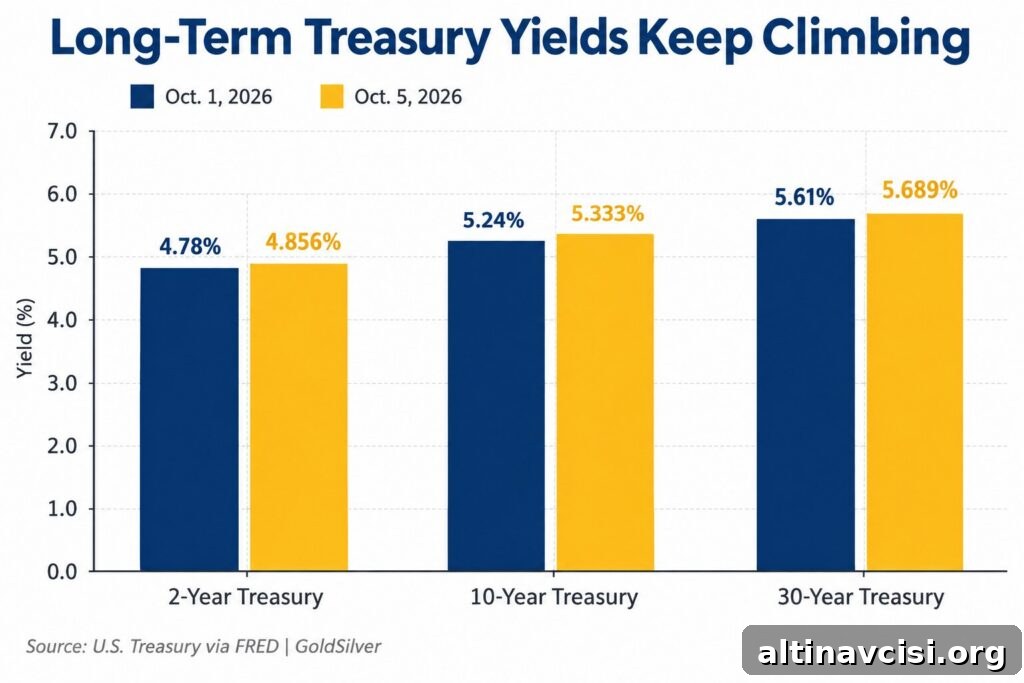
- The 10-year Treasury yield climbed to 5.333% on October 5, even as markets priced in a likely Fed hold.
- Higher real yields increase the opportunity cost of holding non-yielding assets like gold, creating near-term headwinds.
- Persistent long-term yields can also reflect inflation expectations, large Treasury supply, fiscal risk, or a higher term premium—factors that support gold over longer horizons.
Why Are Treasury Yields Rising If the Fed May Hold?
Long-term Treasury yields reflect much more than the Federal Reserve’s next move. While the Fed directly controls its short-term policy rate, the 10-year and 30-year yields respond to a wider mix of forces: growth expectations, inflation forecasts, Treasury supply dynamics, fiscal outlooks, and the term premium investors demand to hold longer-dated debt.
On October 5, the 10-year Treasury yield reached 5.333%, the 30-year hit 5.689%, and the two-year reached 4.856%, even as market tools showed a high probability of a Fed pause for the next meeting. That divergence matters: it means the bond market can keep borrowing costs elevated across the economy without an immediate additional Fed hike.
In practical terms, higher long-term yields lift mortgage rates, corporate borrowing costs, and other credit rates that are tied to the longer end of the curve. For investors and borrowers alike, the Treasury market’s behavior can tighten financial conditions independently of short-term policy.
Why Do Higher Treasury Yields Pressure Gold?
Gold does not pay interest or coupons, so its relative attractiveness depends in part on what holders give up to own it. When Treasury yields rise—especially real yields that are adjusted for inflation—the opportunity cost of holding gold goes up. That dynamic typically weighs on gold prices in the near term as investors shift toward yielding instruments.
A strong U.S. dollar compounds that pressure. Because gold is priced in dollars, a firmer currency raises the local-currency cost of gold for overseas buyers, reducing demand from international markets.
However, nominal yields alone do not tell the whole story. Real yields, which subtract expected inflation from nominal rates, are more directly relevant for gold. Rising real yields make gold less attractive versus inflation-protected returns. The Federal Reserve’s H.15 data showed the curve elevated in early October, with the two-year at 4.78%, the 10-year at 5.24%, and the 30-year at 5.61%—levels that represent a meaningful headwind for gold while they persist.
Why Is This Treasury Move Different From September?
September’s move showed that the entire Treasury curve can reprice sharply in a short window: headlines noted roughly a 50 basis-point rise in the 10-year during that month. That repricing was broad-based and rapid.
The current episode is different in tone. October’s market pricing has pared back the odds of an immediate Fed hike—at one point the implied probability of an October increase fell to around the mid-teens—yet long-term yields have remained historically elevated. In other words, a Fed pause does not automatically translate into easier financial conditions if the long end of the curve is still signaling tighter money.
This separation between short-term policy expectations and long-term borrowing costs means investors must watch both ends of the curve to understand the full picture for markets and the economy.
Could High Treasury Yields Strengthen Gold’s Longer-Term Case?
High yields are not inherently bullish for gold. In fact, higher real yields are usually a headwind. That said, the reasons behind persistently high long-term yields can create the conditions in which gold’s longer-term case strengthens.
If long-term yields stay elevated because inflation expectations are rising, or because fiscal pressures and heavy Treasury issuance force investors to demand more compensation for duration risk, then those same concerns can boost demand for monetary diversification. Gold often benefits when investors seek protection against inflation, currency depreciation, or fiscal uncertainty.
Thus, two forces can coexist: higher real yields can suppress gold in the near term, while rising inflation fears, weaker fiscal credibility, or a higher term premium can increase strategic demand for gold over longer horizons. Investors should separate the mechanical effect of yields on opportunity cost from the structural signals yields convey about the economic backdrop.
What Should Gold Investors Watch Next?
Focus on a few key indicators rather than a single data point:
- Two-year and 10-year yields together: If the two-year falls as Fed-hike expectations ease but the 10-year remains above 5%, that divergence signals persistent long-term forces keeping borrowing costs high.
- Real yields: Moves in real yields are especially important for gold. Rising real yields are likely to remain difficult for gold, while falling real yields reduce that pressure even if nominal yields stay elevated.
- Treasury demand and auction results: Weak auctions or ongoing selling of longer-dated debt would show investors require more compensation to hold duration, supporting a higher term premium.
- Inflation expectations and fiscal indicators: Any renewed pickup in inflation or signs of fiscal strain would increase the strategic case for gold as a hedge.
In short, the next Fed meeting is only one element of the story. The bigger question for gold investors is whether the Treasury market continues to tighten financial conditions even when short-term policy looks on hold. Monitoring both the curve’s shape and the forces driving yields will help investors distinguish between transitory pressure and structural shifts that matter for gold’s role in a diversified portfolio.
SOURCES
Federal Reserve Board – H.15 Selected Interest Rates – October 2, 2026; The Wall Street Journal coverage of U.S. Treasury yields – October 5, 2026; CME Group FedWatch tool – October 5, 2026; Reuters coverage of September Treasury moves – September 30, 2026.
Disclaimer: This article is for informational purposes only and does not constitute investment advice. Past performance is not indicative of future results. Consult a qualified financial advisor before making investment decisions.
You May Also Like:
- Who’s Actually Right About Gold Right Now? Five Signals, Five Answers
- Gold and Silver Are Rising Today. So Is the Dollar. That’s Rare.
- When Should a Central Bank Sell Its Gold? One Just Did. Most Won’t.
- September Payrolls Just Missed by 70,000. Gold and Silver Didn’t Wait to React.
- The ISM Number Barely Moved. The One Underneath It Just Jumped.
- Morgan Stanley Just Named Gold’s Floor. Here’s the Number.
- Gold Steadies Near $4,180. A GDP Upgrade Just Undercut the Inflation Miss.
- BlackRock Called It a Supercycle Today. The Mines and Vaults Already Agree.
- Gold Jumps as Core PCE Cools More Than Expected, Overshadowing the ADP Jobs Beat
Popular Topics
Picked from the archive
-
01
 Topics
Why Investors Choose the Vienna Philharmonic Gold Coin
-
02
Topics
Stablecoin Issuer Outspent Central Banks on Gold Last Year
-
03
Topics
Why Gold Prices Are Falling Amid the Oil War
-
04
Topics
How to Buy Gold in 2026: Step-by-Step Guide for Beginners
-
05
Topics
Silver Appears Weak, Silver-to-Gold Ratio Signals Accumulation
-
06
Topics
Why Gold Prices Are Falling: What Most Investors Get Wrong
-
07
Topics
Should You Still Hold Gold in Your Portfolio?
-
08
Topics
Gold Bars vs Jewelry: Why Investors Choose Bullion