Why One Central Bank Sold Gold and Why Most Haven’t

Gold is little changed today, trading in the mid-$4,100s — about 5% below the $4,370 peak reached in late September. Silver sits just above $60, down more than 10% from its September high near $67.50. Trading is quiet compared with recent volatility, but the larger story isn’t the intraday price action. It’s the debate OMFIF put to the market: when, if ever, should a central bank sell its gold reserves?
Key Takeaways:
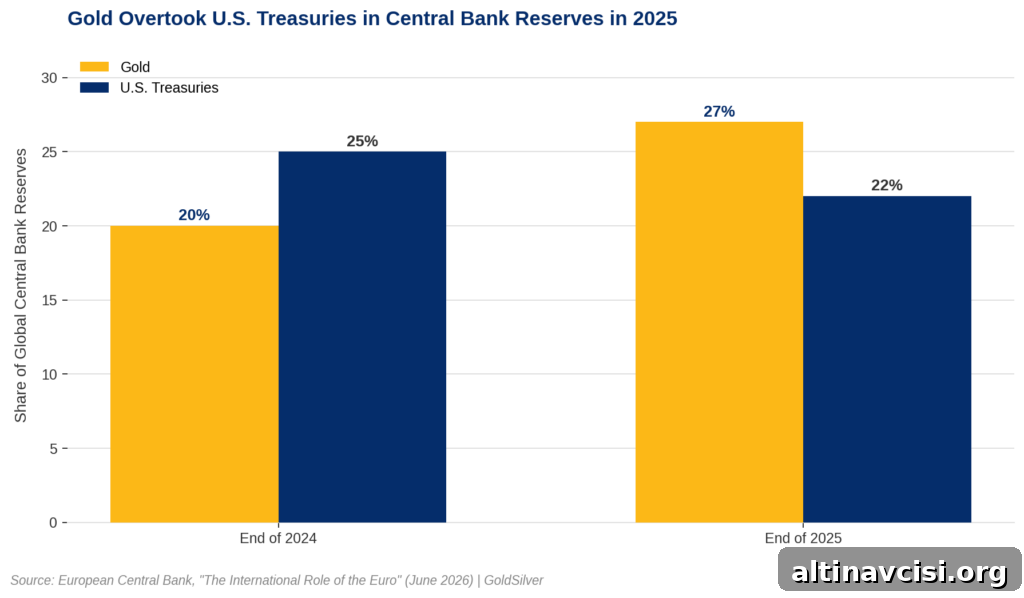
- OMFIF raised the question of central-bank gold sales. ECB data through June 2026 shows gold’s share of global reserves rose to 27% in 2025 and, in that measure, exceeded U.S. Treasuries at 22%.
- Turkey’s 130-tonne sale in early 2026 was a liquidity move made under severe currency pressure, not a signal of a broad shift away from gold. OMFIF’s 2026 survey found 82% of central banks hold gold (up from 71%), and a net 30% plan to add to holdings.
- Western central banks typically allocate roughly 60–70% of reserves to gold, while many emerging-market banks average 5–10%. If that gap narrows, global demand could require thousands of additional tonnes — several years of mine output.
Why Would a Central Bank Sell Gold?
The straightforward answer is liquidity. Central banks sell gold when they need cash quickly and gold is the most readily mobilized asset available. Turkey’s decision to sell or loan roughly 130 tonnes in early 2026 came amid extreme pressure on its currency and stressed public finances. That action followed a large accumulation — about 220 tonnes since 2022 — documented by the European Central Bank, which described Turkey’s moves as one of the larger reserve drawdowns in recent years.
Other examples include country-specific choices such as Russian sales earlier in the year and Poland’s announcement that it might sell some reserves to fund defense spending. Those moves reflect domestic policy decisions and acute funding needs rather than a widespread strategic retreat from gold. When a central bank sells because it must raise liquidity fast, it’s a tactical step, not necessarily a change in long-term reserve strategy.
Has Gold Really Overtaken the Dollar System?
The short answer is no — not in systemic terms. The ECB’s report noted that gold’s share of global central-bank reserves rose to 27% at the end of 2025, up from 20% the previous year, while the share allocated to U.S. Treasuries declined to 22% from 25%. Together, central banks now hold more than 36,000 tonnes of gold, a level the ECB compared with historical peaks like those seen during the Bretton Woods era.
Importantly, the ECB emphasized that dollar-denominated assets still make up roughly 42% of global reserves. That underlines the continuing dominance of the dollar while acknowledging a meaningful reshuffle within reserve portfolios: gold has gained share against one particular asset class (U.S. Treasuries) but not replaced the dollar’s central role in global reserves.
What Do the Actual Survey Numbers Say?
Surveys from OMFIF and the World Gold Council clarify the broader trend. OMFIF’s 2026 Global Public Investor survey, covering 90 public institutions that together oversee more than $10 trillion, found that 82% of central banks report holding physical gold — up from 71% a year prior. A net 30% of respondents plan to add to their gold allocations within the next one to two years. Additionally, 61% of surveyed managers expect gold to trade between $5,000 and $6,000 per ounce by June 2027.
The World Gold Council’s 2026 Central Bank Gold Reserves Survey, which drew a record number of respondents, showed shifting motivations. Only 46% of central banks cited historical legacy as a reason to hold gold, down from 62% the year before. That change suggests institutions increasingly view gold as an active strategic allocation — a tool for diversification and risk management — rather than merely a historical relic.
So, When Should a Central Bank Sell Its Gold?
A central bank should sell gold when it needs to raise liquidity quickly and gold is the best available resource to do so. Sales tied to currency defense, urgent fiscal needs, or the need to rebalance a stressed balance sheet are tactical responses to short-term pressures. Such sales do not, by themselves, indicate a long-term retreat from gold. In contrast, the majority of central banks appear to be increasing or maintaining their allocations.
What Should Individual Gold Owners Take From This?
For private investors, the main takeaway is about perspective and allocation, not timing the market. Western central banks — including the U.S., Germany, France, Italy and Switzerland — tend to hold an estimated 60–70% of foreign-exchange reserves in gold, while many emerging-market peers average closer to 5–10%. If emerging-market allocations rise even partway toward Western levels, the implied increase in demand would amount to thousands of tonnes, a material multiple of annual mine production.
Reserve managers who already hold gold are generally not the ones selling; many are adding. Individual investors should therefore consider whether their own portfolios reflect the strategic allocations used by institutions that hold significant gold positions. Watch forthcoming reports — including the World Gold Council’s periodic central bank buying updates and OMFIF follow-ups — for clearer signals from specific reserve managers about near-term intentions.
SOURCES
1. OMFIF – When Should a Central Bank Sell Its Gold? – October 2, 2026
2. OMFIF – Global Public Investor 2026 – June 30, 2026
3. European Central Bank – The International Role of the Euro – June 2, 2026
4. World Gold Council – Central Banks Set to Step Up Gold Buying Over the Next Year – June 16, 2026
Disclaimer: This article is for informational purposes only and does not constitute investment advice. Past performance is not indicative of future results. Always consult a qualified financial advisor before making investment decisions.
You May Also Like:
- September Payrolls Just Missed by 70,000. Gold and Silver Didn’t Wait to React.
- The ISM Number Barely Moved. The One Underneath It Just Jumped.
- Morgan Stanley Just Named Gold’s Floor. Here’s the Number.
- Gold Steadies Near $4,180. A GDP Upgrade Just Undercut the Inflation Miss.
- BlackRock Called It a Supercycle Today. The Mines and Vaults Already Agree.
- Gold Jumps as Core PCE Cools More Than Expected, Overshadowing the ADP Jobs Beat.
- Job Openings Missed Today. That’s Exactly Why Gold Caught a Bid.
- Gold Fell Again. Five Wall Street Desks Can’t Agree on Why.
- Gold Just Hit a Two-Month Low. Yields, Not Iran, Are Why.
Popular Topics
Picked from the archive
-
01
 Topics
Silver Eagle vs Maple Leaf vs Britannia: Which Has More Silver?
-
02
Topics
Why the Fed’s Dot Plot Shows 18 Dots and the Chair Withheld His
-
03
Topics
Gold Down 26%, Silver Down 51%: What Should Bullion Stackers Do?
-
04
Topics
Why Investors Choose the Vienna Philharmonic Gold Coin
-
05
Topics
Federal Reserve Goes Silent: Why Gold Investors Don’t Need It
-
06
Topics
Gold Surges Past Wall Street Targets, 4 Banks Split on Outlook
-
07
Topics
Rising Gas Prices? How to Protect Your Savings
-
08
Topics
How Powell’s Press Conference Affects Gold Prices