Treasury Chooses $967B Checking Account Instead of Rate Cut

America’s checking account received a $33.6 billion deposit in a single day. Treasury Secretary Scott Bessent may decide to spend part of the nearly $967 billion currently parked there. If he does, he could accomplish something the Federal Reserve cannot achieve by changing interest rates alone: buy back government bonds without issuing any new debt.
Gold sits at $4,592 an ounce this morning, essentially unchanged for the day. Silver trades at $70.42, roughly 1.7% higher than its open. Those price movements are notable but not the central development. The real story is the large balance in Washington’s checking account — the Treasury General Account — and why Treasury officials are discussing running it down.

The Edge Every Investor Needs
Smarter precious metals investing starts here. The Nuggets Newsletter brings essential market insights, Fed updates, global trends, educational videos, and more.
Newsletter signup removed from this version.
What Is the Treasury General Account, and Why Does It Matter for Gold?
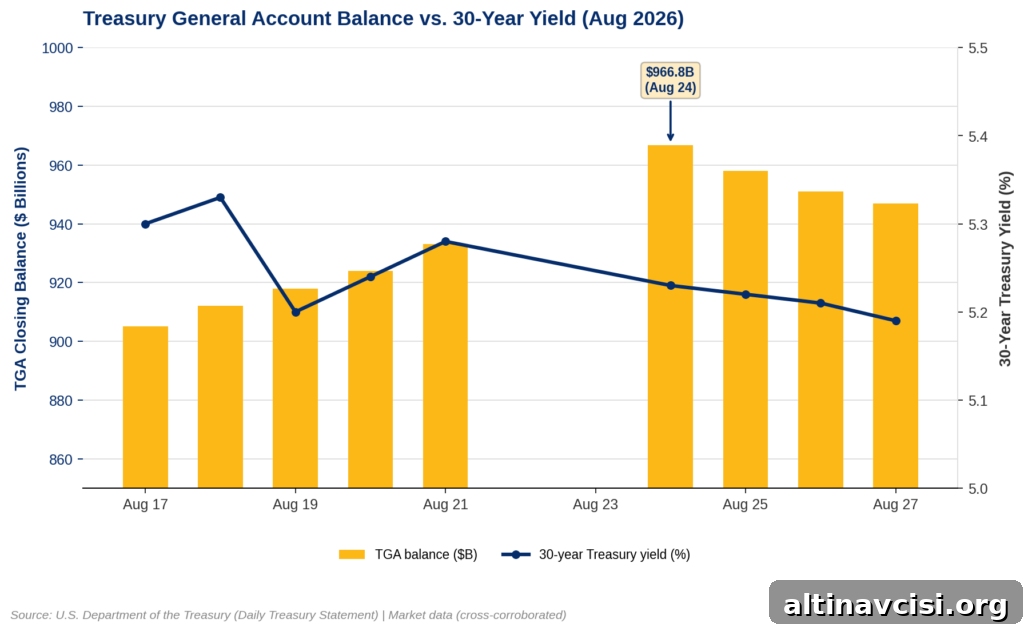
The Treasury General Account (TGA) is the federal government’s operating account held at the Federal Reserve. It is where tax receipts and other federal inflows land before the Treasury spends them. According to the Treasury’s own Daily Treasury Statement, the TGA closed at $966.8 billion on August 24, up $33.6 billion in a single session. That rise included $25.1 billion from withheld individual and payroll taxes and roughly $17.7 billion from customs duties.
Treasury officials have identified the TGA as a potential funding source for the bond buyback program the department announced on August 19. That program raised the cap on long-end buybacks from $2 billion to at least $4 billion per operation, with the change taking effect on September 9. If Treasury draws on the TGA to finance buybacks, it would not need to sell new Treasury securities to raise the cash for those purchases.
Why Does It Matter Where the Buyback Money Comes From?
The distinction between funding a buyback by issuing new short-term debt versus drawing on the TGA is important and often overlooked. Issuing short-term bills to fund a buyback is effectively rolling existing debt: the Treasury sells new paper to raise cash, then uses that cash to buy longer-dated securities. That route keeps the total amount of Treasury IOUs in the system about the same, but it replaces one maturity with another.
By contrast, using cash already held in the TGA moves liquidity in the opposite direction. When Treasury spends down the TGA to buy bonds, the cash flows back into the banking system via the Fed. This injects liquidity into banks and reduces the stock of Treasury securities outstanding without issuing new short-term debt at that moment. Mechanically, that action functions similarly to a Fed liquidity operation — increasing reserves in the banking system — but it is executed by the Treasury without creating fresh debt.
What Have Analysts Said About the Treasury General Account Plan?
Analysts differ on how significant tapping the TGA would be. Deutsche Bank’s Michael Hsueh wrote that the Treasury policy shift supports a constructive view on gold and could push bullion above his $4,800 target. UBS strategist Bhanu Baweja said the move is an important signal for gold and argued the dollar would ultimately absorb the cost of Treasury actions to manage borrowing rates. Others are skeptical. RBC Capital Markets’ Blake Gwinn described the idea as “very slapdash” and told Bloomberg he sees low odds the TGA will be used at meaningful scale. Treasury officials have not specified the amount or timeline; they only confirmed the option is on the table.
That range of reactions — from “a powerful new policy tool” to “mostly talk” — matters because market expectations can move yields and prices even before any actual operations occur. The 30-year Treasury yield briefly rose above 5.3%, a level not seen since 2007, and has eased modestly since the August 19 announcement. How yields respond once buybacks under the new size begin on September 9 will be the clearest test of whether the Treasury is serious about using cash from the TGA or will instead revert to issuing short-term bills.
What Does This Mean for the Sound-Money Case?
The central point is not whether $967 billion can move markets on its own. Against more than $31 trillion of US Treasury securities outstanding, even large sums can be incremental. The broader implication is political and fiscal: Treasury officials are choosing when and how to manage borrowing costs, sometimes by shifting cash between accounts rather than reducing borrowing overall.
Using tax receipts already in the TGA to support the bond market signals caution about how additional Treasury issuance would be received by investors. That discretion — officials deciding which accounts to draw down month to month — highlights a reliance on policy choices rather than an automatic, rules-driven stabilization mechanism. For investors concerned about currency and fiscal risk, that discretion underscores one reason physical gold and silver are seen by some as a hedge outside the financial system.
What Should Investors Watch Next?
September 9 is the date to watch. That is when the first buyback under the increased operation size is scheduled to execute. Investors should look for explicit Treasury announcements naming the TGA as the funding source, or for evidence that Treasury instead funds buybacks by issuing short-term bills. The market reaction in 30-year yields around that operation — not any single day’s move in gold or silver — will be the clearest indicator of whether the TGA-funded route has meaningful impact.
Stay On Top of Gold & Silver Prices
Get important market alerts sent straight to your inbox.
Live price widget removed from this version.
Subscribe form removed.
SOURCES
1. U.S. Department of the Treasury — Daily Treasury Statement, Operating Cash Balance
2. U.S. Department of the Treasury — Treasury announcement on increased long-end buyback sizes beginning September 9
3. CNBC reporting on possible use of the Treasury General Account to fund buybacks
4. CNBC coverage of Deutsche Bank’s commentary on gold
5. AdvisorHub coverage of Treasury comments on cash use
6. SIFMA — U.S. Treasury securities statistics
Disclaimer: This article is for informational purposes only and does not constitute investment advice. Past performance is not indicative of future results. Consult a qualified financial advisor before making investment decisions.
You May Also Like:
- Six Paper Claims, One Ounce of Silver: What First Notice Day Reveals
- Five Gold Signals Fired This Week. None of Them Are About Today’s Price.
- Gold Fell 9% the Last Time Warsh Spoke. He’s Back Tomorrow.
- Gold Ran Past Wall Street’s Own Price Targets. Four Banks Disagree on What Happens Next.
- Silver Beat Gold in August. Almost Nobody Said So.
- Americans Spent More in July. They Got Nothing Extra for It.
- The Fed Has Two Hike Numbers Right Now. Almost Everyone Quotes the Wrong One.
Popular Topics
Picked from the archive
-
01
 Topics
Fed’s September Shift: Impact on Gold Prices
-
02
Topics
5 Catalysts That Moved Gold and Silver This Week
-
03
Topics
Gold Price Tops $5,200, Silver $90 as Inflation Persists
-
04
Topics
Sound Money: Why the Dollar Has Lost 87% Since 1971
-
05
Topics
Gold Price Volatility Back to COVID-Era Levels
-
06
Topics
Gold Jumps 1% – Why July CPI Matters More Than the Headline
-
07
Topics
Why Gold Holds Value: The 5,000-Year Truth Investors Miss
-
08
Topics
Fed Decision Looms: Gold Poised for 8:30 AM Reaction