Why the Hormuz Blockade’s 2% Drop Makes Gold Bullish

KEY TAKEAWAYS:
- Gold’s roughly 2% drop reflected margin liquidations after an oil spike, not a shift in its fundamentals.
- The Strait of Hormuz blockade reintroduces energy-driven inflation into an already stagflationary backdrop (CPI 3.3%; rate cuts for 2026 now unlikely).
- Central banks continue to accumulate gold—China’s PBOC extended its buying streak; major banks have raised multi-year targets.
- The petrodollar’s defense required a naval blockade; gold, by contrast, needs no military enforcement to retain trust.
Gold fell about 2% in early Monday trading after President Trump ordered the U.S. Navy to blockade the Strait of Hormuz, a move that pushed oil above $100 per barrel for the first time in over a year. Silver dropped nearly 4% during the same session.
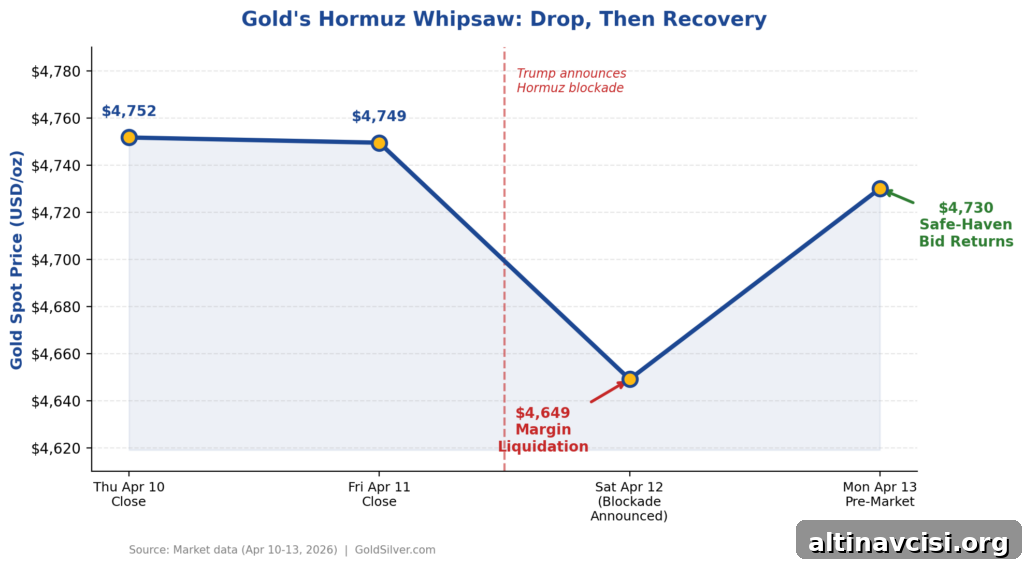
Critically, the decline in gold was short-lived. Spot gold began recovering within hours, reclaiming levels above $4,700 by mid-morning. That rapid rebound highlights the market drivers behind the initial selloff and points to where prices may go from here.
How 21 Hours of Failed Diplomacy Closed 20% of the World’s Oil Supply
The blockade announcement followed the collapse of 21 hours of U.S.-Iran nuclear talks in Islamabad. Reports say Vice President Vance returned without an agreement; the sticking point remained Iran’s nuclear program. In response, the president ordered the Navy to interdict “any and all ships” attempting to enter or leave the Strait of Hormuz—the narrow chokepoint that carries roughly 20% of the world’s seaborne oil. CENTCOM indicated enforcement would begin at 10 a.m. ET Monday.
Markets reacted predictably: Brent crude climbed more than 7%, energy stocks surged, and gold initially fell. That drop in gold, however, was driven largely by liquidity pressures in commodity markets rather than a sudden loss of safe-haven interest.
Why Did Gold Drop When Geopolitical Risk Rose?
The key mechanism was margin liquidation. A sharp oil spike forces leveraged traders in energy positions to post collateral immediately. The fastest way to raise cash is to sell the most liquid assets—often gold and other major commodities. That forced selling can produce a sudden dip that is unrelated to gold’s underlying demand or longer-term fundamentals.
The evidence that this was a liquidity event rather than a change in gold’s thesis is straightforward: the metal began recovering within hours as margin pressures eased and safe-haven buying reasserted itself. This pattern—an initial liquidity-driven fall followed by a structural rally—is common in geopolitically driven energy shocks.
The Structural Case Just Got Stronger
The Hormuz blockade alters the medium-term outlook for gold in several important ways. First, energy-driven inflation is back in force. U.S. CPI has already printed 3.3%, the hottest reading since May 2024. With oil above $100 and additional chokepoint risks such as potential disruptions at Bab el-Mandeb, the inflation impulse is lengthening and intensifying. That reduces the chance of aggressive rate cuts and keeps real yields pressured.
Second, central bank buying remains a steady source of demand. China’s central bank has reportedly added to its gold reserves for many consecutive months, and major Wall Street institutions have raised multi-year price targets. These are strategic reserve decisions, not short-term speculative moves, and they reinforce a structural bid under the metal.
Third, the geopolitical reaction highlights a broader monetary dynamic. The use of naval force to protect oil trade denominated in currencies other than the dollar underlines how geopolitical power can be deployed to preserve existing reserve arrangements. Alternatives that rely on bilateral settlement outside global dollar clearing face acute enforcement risks. Gold, by contrast, is a universally recognized store of value that does not depend on any single nation’s military backing.
What This Means for You
Yields have moved—10-year Treasury yields recently reached about 4.40%, up materially in recent weeks. On the surface that may make cash and bonds look attractive, but real returns are eroded when CPI runs above 3% and energy costs continue to climb. In a rising-inflation environment, the purchasing power preserved by non-yielding assets such as gold becomes more relevant.
Gold does not generate income, but it historically maintains purchasing power through periods of high inflation and currency stress. For savers weighing shrinking real returns on paper assets, gold offers an alternative that has preserved value across many monetary regimes.
The Hormuz blockade did not alter gold’s long-term thesis; it sharpened it. Gold closed the prior Friday around $4,749.46, dipped to roughly $4,649 in weekend trading, and was trading near $4,730 by Monday morning as the market absorbed the liquidity event and re-established safe-haven flows.
Stay On Top of Gold & Silver Prices
Get important market alerts sent straight to your inbox.
People Also Ask
Why did gold drop when the Strait of Hormuz was blockaded?
Gold initially fell because the oil price surge produced margin calls across commodity markets. Leveraged traders in energy positions needed quick collateral and often liquidate the most tradable assets—gold—causing a temporary price decline. This type of forced selling is liquidity-driven and typically reverses once margin pressures ease.
What is the Strait of Hormuz and why does it matter for gold?
The Strait of Hormuz is the narrow waterway between Iran and Oman that handles roughly 20% of global seaborne oil flows. Disruption there spikes energy prices, raises inflation expectations, and compresses real yields—factors that historically increase demand for gold as a store of value outside the traditional financial system.
Is gold a good hedge against stagflation?
Gold has frequently been effective in stagflationary periods, when inflation remains elevated while economic growth weakens. In those settings, real yields fall or go negative and the opportunity cost of holding gold declines. Given current CPI, rising energy costs, and a lower probability of rate cuts, gold fits the profile of an asset that many institutions are prioritizing as a hedge.
SOURCES
1. World Gold Council — China PBOC gold reserves data.
2. Goldman Sachs — gold price outlook and analysis.
3. JPMorgan — commodities and gold price forecasts.
4. U.S. Central Command — statement on Strait of Hormuz enforcement.
5. U.S. Energy Information Administration — analysis of oil transit chokepoints.
6. U.S. Bureau of Labor Statistics — Consumer Price Index data.
7. U.S. Department of the Treasury — 10-year Treasury yield data.
This article is informational only and does not constitute financial or investment advice. Consult a qualified financial advisor before making investment decisions.
You May Also Like
- $88 Billion a Month: Why U.S. Debt Is Driving Gold Prices
- CPI Hits 3.3%, GDP Stalls — Is Stagflation 2026 Here?
- War Risk, Stagflation Signals, and a $6,300 Gold Target
- Gold and Oil Brace for the Strait of Hormuz Deadline
- Iran War Deadline Puts Gold and Silver Prices on Edge
- Why Is Gold Falling When the World Is on Fire?
- Gold Jumps 2% as Trump Plans Iran War Address Tonight
Popular Topics
Picked from the archive
-
01
 Topics
Gold Prices Rise on Fed Policy, Debt Concerns and Asian Demand
-
02
Topics
How Gold and Silver Reduce Losses and Boost Portfolio Returns
-
03
Topics
U.S. Eyes Pakistan’s $6T Mineral Wealth in Economic Partnership
-
04
Topics
Silver Price Forecast 2026-2027: Bull and Bear Scenarios
-
05
Topics
Gold Price Surges Past $5,000 Amid Bond Market Turmoil
-
06
Topics
Paper Gold vs Physical Gold: Safety and Investment Risks
-
07
Topics
Record Gold Floods Shanghai as Traders Exploit Futures Arbitrage
-
08
Topics
Gold Price: What Could Drive It to $6,300?