Gold Price Forecast 2026: Will Fed & Iran Push Gold to $6,000?
Daily News Nuggets | Today’s top stories for gold and silver investors
March 17th, 2026 | Brandon Sauerwein, Editor
The gold price forecast for 2026 looks different than it did a month ago—not because the long-term drivers changed, but because the world did. Below is a concise look at the factors currently shaping gold and silver markets, how central bank moves and geopolitics interact with oil prices and inflation, and what investors should watch next.
What Will the Fed Actually Signal Tomorrow?
The Federal Reserve’s decision is due tomorrow. Markets are overwhelmingly certain on the headline outcome: futures imply roughly a 99% probability the Fed will hold the policy rate at 3.50%–3.75%. But the rate decision itself is less important than the guidance that accompanies it.
Investors will focus on the updated dot plot and Chair Powell’s press conference for clues about the Fed’s reaction function—especially how it plans to respond to a new wildcard: an oil-driven inflation shock stemming from the Iran conflict. The Fed’s tone and projections will determine whether markets expect cuts, a prolonged pause, or even the possibility of additional tightening if energy-driven inflation accelerates.
Expectations have shifted quickly. Where markets once leaned toward multiple rate cuts by mid-year, the calendar has been pushed out: April now looks unlikely, June is uncertain, and some economists are pricing only one cut—or none—during 2026. Conversely, some analysts argue higher energy costs could force the Fed to reconsider easing plans and even entertain hikes if inflation moves back toward 3.5% later this year.
That tension—slowing growth on one side and sticky, energy-fueled inflation on the other—creates the sort of environment that can lift gold. If oil continues to climb and keeps inflation elevated, the path to rate cuts narrows and demand for gold as an inflation hedge typically strengthens.
Why Isn’t Gold Reacting to the Iran Conflict?
Given the scale of recent geopolitical events, gold’s reaction has been surprisingly restrained. Prices are elevated compared with earlier in the cycle, but we haven’t seen the kind of sharp spike that might accompany a sudden, acute geopolitical shock.
The most plausible explanation is that much of this risk is already priced into the market. Investors have been navigating a multi-year backdrop of geopolitical tensions—from the war in Ukraine to repeated Middle East flare-ups—so the “shock factor” that drives dramatic rallies has been dulled. That sustained pressure keeps gold supported without producing a single explosive move.
Monetary conditions add another restraint. Elevated real interest rates and a relatively firm U.S. dollar reduce the immediate incentive to rotate heavily into gold. For now, the market sits between two opposing forces: geopolitical risk pushing prices higher, and tight financial conditions holding them back. A decisive shift on either side could trigger a substantial move in gold prices.
Can Silver Break Out After Lagging Gold?
Silver initially moved with gold during the Iran-related headlines, rising on the early news and then retreating as investors shifted toward the dollar and higher-yielding assets. But silver’s market dynamics differ from gold’s: it is both a monetary hedge and an industrial metal.
That dual role means silver’s near-term direction will depend heavily on global growth. If rising energy costs and disrupted trade slow industrial activity, silver demand from manufacturers could soften and weigh on the price. Conversely, structural demand drivers—solar panels, electrification, and limited productive supply—could turn temporary pullbacks into buying opportunities.
Historically, silver can lag gold in the early stages of a rally and then outperform once the broader move broadens. If inflation re-accelerates or monetary policy shifts meaningfully, silver could transition from follower to leader, producing a sharp upside move in a relatively short window.
How Much Does Gold Really Back U.S. Debt Today?
A long-term view of gold’s role versus U.S. government debt is revealing. In the 1940s, U.S. gold reserves covered a substantial share of government liabilities. Today, the ratio is a small fraction of that level—on the order of a few percent—reflecting how the global financial system has moved away from hard-asset backing toward confidence in fiat currency.
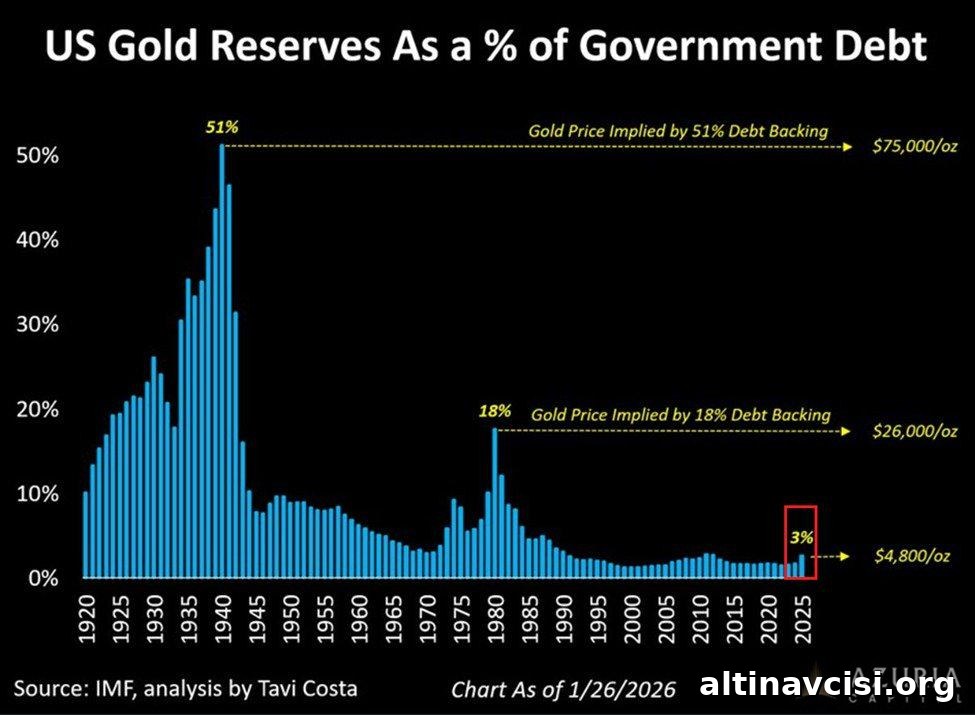
Source data: IMF / Tavi Costa / Azuria Capital (@TaviCosta).
That divergence between debt and reserves highlights a broader shift: gold today acts more as informal insurance than formal backing. Translating past ratios into hypothetical prices—for example, comparing current reserves to 1980s-era backing levels—produces very large theoretical numbers. Those comparisons are not forecasts; they simply illustrate how much public debt has grown relative to tangible reserves.
The takeaway: gold’s primary role has evolved into a hedge against the risks of an increasingly leveraged and confidence-dependent monetary system.
Where Do the Big Banks See Gold Going by End of 2026?
Despite recent pullbacks, major Wall Street forecasts for year-end 2026 remain broadly unchanged and bullish. These institutional targets generally view current levels more as a floor than a ceiling, citing central bank buying, ETF inflows, and structural pressures on the dollar and Treasuries.
Major banks have published year-end targets in the mid-to-high $6,000s per ounce range, driven by similar arguments: growing global debt, diminishing confidence in fiat currency, and ongoing central bank purchases. Importantly, many of these forecasts were issued before the recent oil spike above $100 per barrel, which adds a new geopolitical and inflationary premium to the existing structural case.
Gold has retreated from about $5,200 to near $5,000. Historical patterns in sustained bull markets suggest these pullbacks are often viewed differently with the benefit of hindsight—frequently as buying opportunities within a larger upward trend.
You May Also Like
- Gold and Silver Prices Today: Stagflation, the Fed, and What Comes Next
- Gold Supply Outlook: As Prices Rise, Producing Nations Want a Bigger Share
- Why Oil Is Surging and Gold Isn’t (Yet)
- Gold Price Rises as Iran War Escalates
- February 2026 CPI Report Shows Inflation Calm Before Oil Shock Hits
Popular Topics
Picked from the archive
-
01
 Topics
How COMEX Sets Gold Prices and Moves Global Markets
-
02
Topics
UBS Warns Investors: USD Unattractive After 10% Annual Drop
-
03
Topics
Dollar Hits Multi-Year Low as $3.3T Trump Budget Spurs Debt Risk
-
04
Topics
Trump Targets Powell Over Fed Spending, White House Tensions Rise
-
05
Topics
How to Invest in Silver: A Practical Guide to Growing Wealth
-
06
Topics
Tariff Burden Shifts to Consumers, Could Push Inflation to 3.2%
-
07
Topics
Silver Could Double in 2025 as Dollar Dominance Fades
-
08
Topics
Market Update: Gold Steady, Shoppers Cautious, Nvidia Scrutinized