Gold Revaluation: What It Means for the U.S. Dollar and Economy
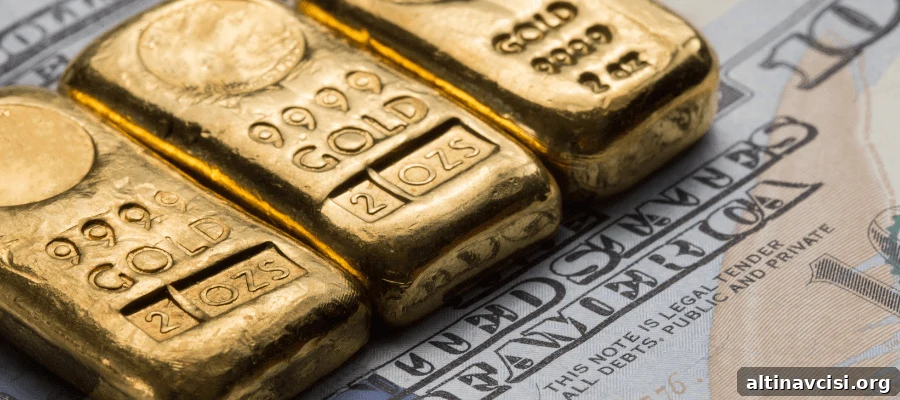
The U.S. government is the custodian of the world’s largest official gold reserve, holding over 8,100 tonnes of gold. Despite this vast holding, U.S. accounting practices still value official gold at the historical statutory price of $42.22 per troy ounce, a figure that dates back to the 1970s. On paper, that valuation places the reserve at about $11 billion; at contemporary market prices — which have traded above $3,000 per ounce in recent years — the same holdings would be valued nearer to $765 billion. The gap between the book value and market value is therefore immense, and it raises important questions about accounting conventions, monetary policy signaling, and national balance-sheet transparency.
Why has the U.S. not adjusted that official valuation to reflect market realities? The answer is primarily political and symbolic. A formal gold revaluation — that is, resetting the official accounting price for gold — would send a clear message that the purchasing power of the U.S. dollar has shifted since the 1970s. A revaluation would effectively recognize accumulated inflation and currency depreciation in a single accounting move. Policymakers have largely avoided that step because it would be tantamount to acknowledging a significant loss of dollar value relative to the past, and because it could have broad fiscal and monetary implications.
There have been occasional discussions about revisiting this outdated policy. For example, during the Trump administration some Treasury and political circles debated the potential fiscal benefits of a revaluation. In accounting terms, revaluing the gold at current market prices would produce a one-time gain on the Treasury’s balance sheet, increasing reported net worth and potentially creating room for fiscal maneuvers. Yet such a move also carries risks: it could be interpreted domestically and internationally as a sign that the dollar has depreciated substantially, which might affect confidence in the currency and influence financial markets.
Beyond the U.S., the idea of gold revaluation invites comparison with other resource-rich countries. Australia, for instance, is known for its abundant mineral endowment and has large reserves of gold both mined and unmined. Estimates often put Australia’s undeveloped gold resources in the multiple thousands of tonnes; one commonly cited figure is roughly 9,500 tonnes of gold in the ground, representing a significant share of global underground reserves. If that quantity were extracted, refined and held as bullion, it would materially increase Australia’s stock of gold and could shift the balance of official and private holdings at a global level.
From an economic perspective, mining gold is not costless. The mining industry uses a comprehensive metric called the all-in sustaining cost (AISC), which captures the full range of expenses required to produce an ounce of gold: operating costs, sustaining capital, site reclamation, corporate overhead and other expenditures necessary to keep production ongoing. Across many operations worldwide, a representative AISC is roughly $1,200 per ounce. This metric matters when assessing the profitability of bringing new resources into production and when projecting the net economic value of an undeveloped deposit at prevailing market prices.
Using a conservative modern gold price of $3,000 per ounce, the raw arithmetic illustrates the scale of potential value beneath Australia’s surface. If 9,500 tonnes were converted to marketable ounces and sold or held as bullion at that price, the in-ground resource could translate into an estimated value around $600 billion U.S. dollars (approximately $940 billion in Australian dollars using typical exchange relationships). That is a rough, illustrative calculation and does not account for extraction costs, taxes, environmental requirements or the time and capital needed to develop deposits. Nonetheless, it highlights the substantial potential wealth represented by mineral reserves and why discussions about resource valuation attract attention from policymakers and investors alike.
A hypothetical gold revaluation — whether undertaken by the U.S. or by countries with large gold reserves — would therefore have multiple layers of consequence. On one level it would reshape national balance sheets and fiscal indicators. On another, it would generate political debate about what such a revaluation implies for currency strength and inflation history. For mineral-rich nations, expanding the share of gold held as bullion rather than sold into the market could change how national wealth is perceived and managed.
Ultimately, the gap between statutory accounting prices and market values underscores a broader truth: the official numbers on a balance sheet do not always reflect market realities. Whether governments will choose to close that gap — by revaluing gold holdings or by changing disclosure practices — depends on a mix of political will, economic priorities and the perceived trade-offs between transparency and market signaling.
Investing in Physical Metals Made Easy
Get Gold & Silver Insights Direct to Your Inbox
Join thousands of informed investors who receive expert analysis, market updates, and curated offers every week.
Popular Topics
Picked from the archive
-
01
 Topics
Metal Prices Jump as Dollar Weakens Before US-China Talks
-
02
Topics
China Abandons US Oil, Canada Gains Amid Trade War
-
03
Topics
700,000 Zimbabwe Miners Strike Gold Amid Record-Breaking Prices
-
04
Topics
Profit-Taking Pauses Gold Near $3,380 Amid Trade Policy Fears
-
05
Topics
How Central Banks Shaped Gold Demand in Q1 2025
-
06
Topics
Gold and Silver Drop as Currencies React to Strikes in Iran
-
07
Topics
China Outlines Plan to End US-China Trade War
-
08
Topics
Long-Term US Treasury Yields Hit 10-Year High