
The Federal Reserve has signaled that it anticipates at least one rate increase before the end of next year. In its June projections the Fed expected a quarter-point rise by the close of 2026. At the same time, market-implied odds for a September move have been fluctuating around a roughly one-in-three chance. Both the Fed’s projections and the market odds are valid, but they answer different questions. Importantly, only market pricing ultimately affects the value of the physical metal in your possession.
What Are the Fed Rate Hike Odds Right Now?
Through mid-August, the CME Group’s FedWatch tool showed the odds of a rate increase at the September 15–16 meeting in the low-to-mid 30 percent range. The same tool placed the probability of at least one hike by December at roughly twice that level. That difference is not a contradiction between forecasters; it reflects how the tool aggregates probabilities. A later meeting’s reading counts any hikes already priced in at earlier meetings, so the December number includes the odds assigned to September.
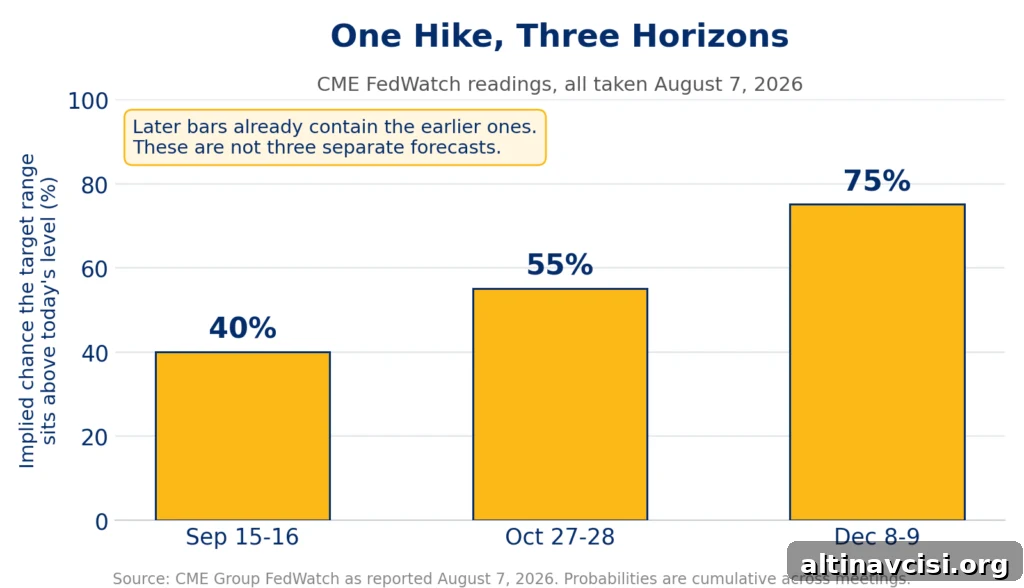
To illustrate, after a softer-than-expected July jobs report on August 7, FedWatch indicated roughly a 60 percent chance the Fed would hold in September, implying about a 40 percent chance of a hike. On that same day, the tool showed about a 55 percent chance of a hike by October and nearly 75 percent by December. By August 18 the probability for a September hike had eased to about 30 percent. These readings shift as new economic data arrive and as traders update their views of the Fed’s likely path.
Meanwhile, gold traded in the mid-$4,600 range, about 17 percent below the record set in late January, while silver hovered near $69, roughly 18 percent higher on the month.

The Edge Every Investor Needs
Smarter precious metals investing starts with reliable information. The Nuggets Newsletter delivers market insights, Fed updates, global trends, and educational content to help you make more informed decisions.
Why Do Fed Rate Hike Odds Differ From One Meeting to the Next?
The FedWatch probabilities are sequential rather than independent. A later meeting’s probability reflects the chance that the policy rate will be higher than today’s level by that date, and that includes all hikes already priced at earlier meetings. Because of that structure you cannot simply add the probabilities across meetings or treat them as competing forecasts. The December reading, for example, is a cumulative chance that captures any hikes anticipated for September and October as well.
There are only three remaining Federal Open Market Committee meetings in 2026: September 15–16, October 27–28, and December 8–9. A 75 percent year-end probability implies a high chance of at least one hike across those three meetings; a 30 percent September reading compresses that single expected hike into the first opportunity. Short-term swings in the September figure can therefore appear dramatic even when the underlying year-end outlook remains largely unchanged.
What Does a Rate Hike Actually Do to Gold?
Gold does not yield interest. Its opportunity cost is the real return available from safe, interest-bearing assets. Short-term policy rates anchor the front end of the yield curve, and a 25 basis point move at a single meeting shifts that anchor. But investors who plan to hold gold for months care about the expected path of rates, not only a single decision. Market pricing across future meetings determines the effective yield comparison for precious metals.
The headline narrative that lower September odds should immediately lift gold is overly simplistic. If year-end expectations still imply tighter policy, that longer horizon keeps pressure on gold’s carry relative to cash and bonds. Beyond monetary policy, fiscal dynamics matter as well: higher levels of government debt raise the interest burden and influence market expectations for future policy and yields. Those fiscal realities help explain why markets continually reprice the likelihood and timing of hikes even as a definitive move seems elusive.
July’s FOMC meeting illustrated this tension. The Committee voted to hold rates, but three members dissented in favor of a hike—the most dissenters in that direction since 2016—highlighting an internal debate about the balance between inflation risks and growth concerns.
Where Could This Reading Be Wrong?
Some major banks and research teams argue markets remain too hawkish. For example, one prominent firm cautioned that the Fed is likely to hold the policy rate in a range through the rest of 2026 and that meaningful rate cuts may not arrive until 2027. If that view proves correct, much of the year-end tightening priced into futures would unwind, which would relieve upward pressure on real yields and be supportive for gold. Other firms prefer to treat each meeting as a probability range rather than a binary event, expecting the odds at each meeting to fluctuate within a band rather than cluster at one number.
Importantly for metal holders, a move toward lower priced odds generally reduces the opportunity cost of owning gold. That dynamic means the position of market probabilities can benefit metals investors whether the odds shift gradually across meetings or unwind more abruptly.
What Should Metals Holders Watch This Week?
Key data and speeches will drive short-term market pricing. The Bureau of Economic Analysis releases July personal consumption expenditures (PCE) data on Wednesday, August 26 at 8:30 a.m. Eastern. Consensus forecasts expect a 0.2 percent monthly increase for core PCE; a stronger 0.3 percent print would lift the probability of hikes across the September, October, and December horizons simultaneously. Later in the week, a Fed official will speak at Jackson Hole on Friday; with the Committee’s statement offering limited forward guidance, market-implied futures prices remain the primary tool for gauging the Fed’s likely path. For anyone holding precious metals, understanding and correctly interpreting those futures prices is essential.
Stay On Top of Gold & Silver Prices
Receive timely market alerts delivered to your inbox.
SOURCES
1. Federal Reserve Board — FOMC calendar and official communications (October 2026).
2. U.S. Bureau of Economic Analysis — Personal Consumption Expenditures price index release schedule and data.
3. Reporting from major financial news outlets on Fed meeting odds and market reactions in August 2026.
4. Institutional summaries and commentaries on the July 2026 FOMC statement and voting patterns.
5. Market research notes and commentary from major banks and investment firms on rate expectations and futures pricing.
6. Real-time precious metals price feeds and historical charts.
Disclaimer: This article is for informational purposes only and does not constitute investment advice. Past performance is not indicative of future results. Consult a qualified financial advisor before making investment decisions.
You May Also Like:
- Gold and Silver Pulled Back Today. The Treasury’s Plumbing Explains Why.
- A Stablecoin Issuer Bought More Gold Last Year Than Any Central Bank.
- Two Investors Ran the Debt Math Separately. Both Landed on 15% Gold.
- Gold Nears $4,700, Silver Holds Above $69. Why Is Everyone Waiting on One Friday Speech?
- Gold Hits 3-Month High as Oil Falls Ahead of Sanctions Announcement.
- Gold’s Speculative Crowd Hit a 60-Week High. Almost Nobody Bought.
- Gold Hit a Three-Month High. Silver Hit a Two-Month High. One Story Connects Them.