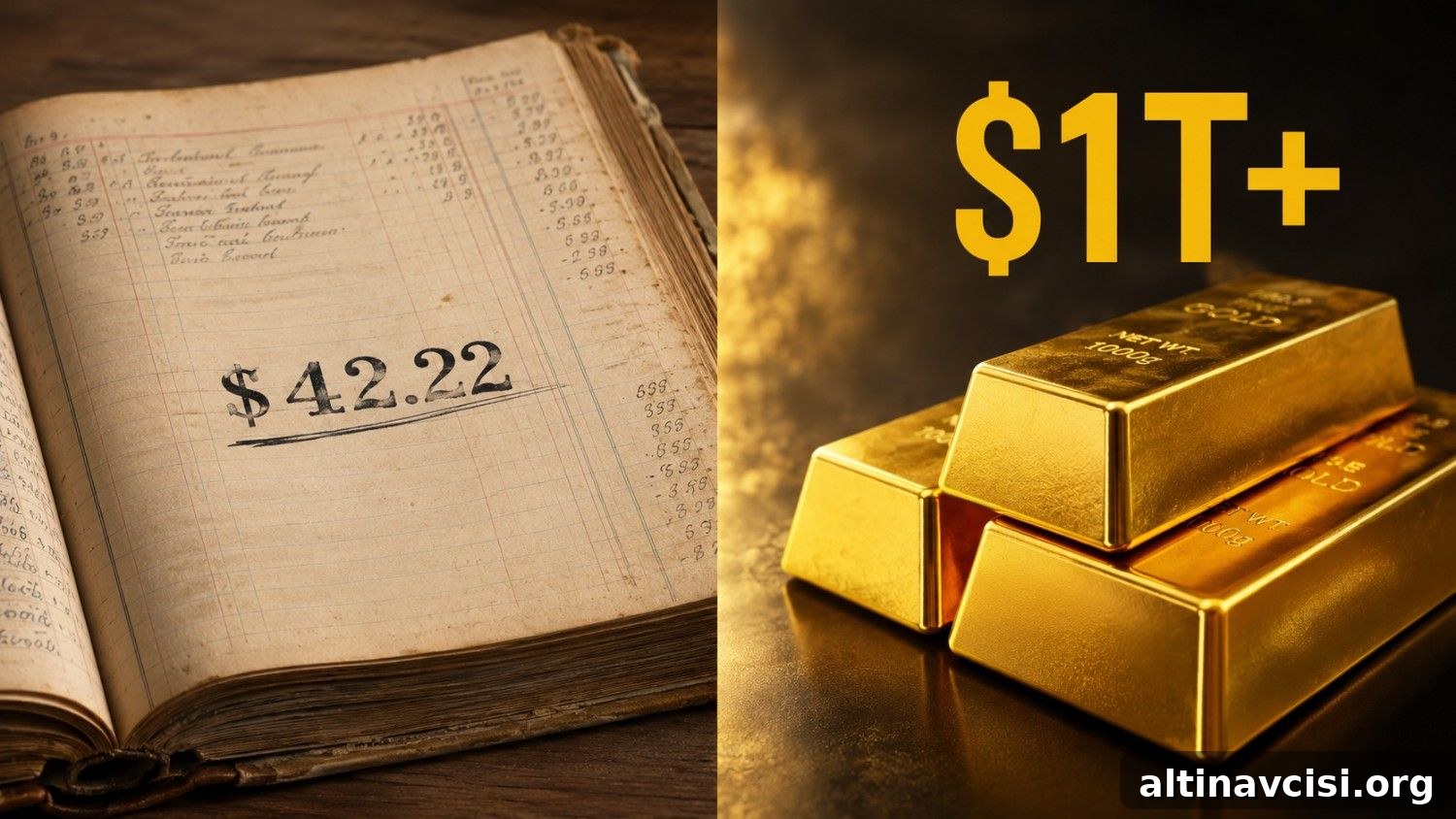
Scott Bessent stated clearly on July 15 that the United States holds more than $1 trillion in gold. That figure is accurate when measured at current market prices. At roughly $4,050 per troy ounce, the nation’s official holding of about 261.5 million fine troy ounces of bullion is worth approximately $1.06 trillion on the open market.
Yet on government accounting books the same gold is recorded at a much lower value: about $11 billion.
Federal law requires the United States to value its gold at $42.2222 per fine troy ounce. That statutory price was set in the early 1970s and has not changed since 1973. As a result, the world’s largest official gold stockpile sits on the government balance sheet at a fraction of its market worth — effectively less than one cent on the dollar of its current market value for more than fifty years.
Why Is US Gold Valued at $42 an Ounce?
The simple explanation is that Congress has not changed the statute. The $42.2222 figure dates back to the end of the Bretton Woods system. After President Nixon closed the gold window on August 15, 1971, the United States revised its statutory gold price through legislation in 1972 and 1973 and fixed the price at $42.2222 per troy ounce. That number has remained unchanged on the books even though market prices have increased dramatically.
Fort Knox holds roughly 56 percent of the total US bullion reserves, about 147.3 million fine troy ounces. At the statutory rate that portion carries a book value near $6.2 billion. At today’s market prices, the same gold is worth roughly $597 billion. The U.S. Mint explicitly notes that Fort Knox gold is recorded at the statutory book value of $42.22 per ounce and that the statutory price does not fluctuate with market prices.
Other government holdings are distributed across West Point, Denver, and the Federal Reserve Bank of New York. The New York Fed stores a portion of US government gold as well.

The Edge Every Investor Needs
Smarter precious metals investing starts here. The Nuggets Newsletter brings essential market insights, Fed updates, global trends, educational videos, and much more.
What Does the $42 Valuation Mean for the Dollar?
Bessent emphasized a key historical shift: the United States moved from systems backed by precious metals toward fiat currency in the 1970s. Under fiat, the dollar is not convertible into a fixed quantity of gold or silver; reserves no longer anchor everyday monetary operations the way they once did.
The implication is clear. The government owns a very large, valuable asset in gold, but in the official monetary accounting that asset carries virtually no contemporary weight. The statutory book value reflects the world as it was in 1973; market reality today is very different.
Inflation metrics make the contrast more obvious. Over the same period since the statutory price was fixed, the dollar has lost a substantial portion of its purchasing power. Data from long-run consumer price indexes show that amounts of money in the early 1970s buy far less today. Put another way, while gold has appreciated many thousands of percentage points in nominal terms, the dollar has steadily declined in buying power.
Those two trends — a soaring gold price and a weakening dollar — are related and reflect the long-term shift away from gold-backed currency toward fiat money.
What Would Happen If the US Revalued Its Gold?
As of now there is no active government plan to revalue the statutory price. In public comments, industry figures have discussed revaluation hypothetically, but revaluation remains a policy question rather than a formal proposal.
If the United States chose to revalue its gold on the books, the process would not require selling the metal. Revaluation simply updates the recorded book value to reflect current market levels. At roughly $4,050 per ounce, the unrealized gain on the US gold reserve compared with the statutory book value would approach $1 trillion. That unrealized gain is not visible on the government’s official balance sheet today, though the metal itself resides in secure depositories.
To summarize: the US government owns more gold than any other entity, but on its financial statements that gold is recorded at an outdated statutory price that understates market value by a large margin. The national debt and other fiscal figures are measured within the framework of fiat accounting that does not reflect unrealized market gains on bullion holdings. This is not a prediction of collapse; rather, it highlights the difference between market valuations of physical assets and statutory accounting conventions.
That gap between book value and market value belongs to the market and to anyone who holds physical metal directly. For policy makers, the question of whether to formally revalue gold on government books is political and technical, and it would have accounting consequences even if it did not involve any physical transactions.
SOURCES
U.S. Mint — Fort Knox Bullion Depository: official holdings and statutory valuation; U.S. Treasury Bureau of the Fiscal Service — status reports on government gold reserves; U.S. Treasury — international reserve position data; Federal Reserve Bank of Minneapolis — historical consumer price index tables; public interviews and commentary by financial figures discussing gold valuation.
Disclaimer: This article is for informational purposes only and does not constitute financial or investment advice. Always consult a qualified financial adviser before making investment decisions.
You May Also Like:
- 187,000 Jobless Claims. The Lowest of 2026. Here Is What It Means for Gold.
- A War Just Expanded Into a New Shipping Lane. Gold Fell. Here Is Exactly Why.
- Gold Is About to Trade 24/7. A Prediction Market Just Filed to Make It Never Expire.
- Gold Hit a Two-Week High This Morning. Three Forces Arrived at Once.
- The Fed Meets July 29. Gold Says Hold Is Already Priced In. Silver Says Something Else.
- Silver Is Up Nearly 5% This Morning. Here Is Exactly Why.