HSBC (The Hongkong and Shanghai Banking Corporation) revised its gold price outlook on July 9, cutting its 2026 average forecast by $304 per ounce while leaving its year-end target unchanged. That contrast — a lower average but an intact year-end projection — reveals more about the bank’s view of gold markets in 2026 than the headline reduction alone.
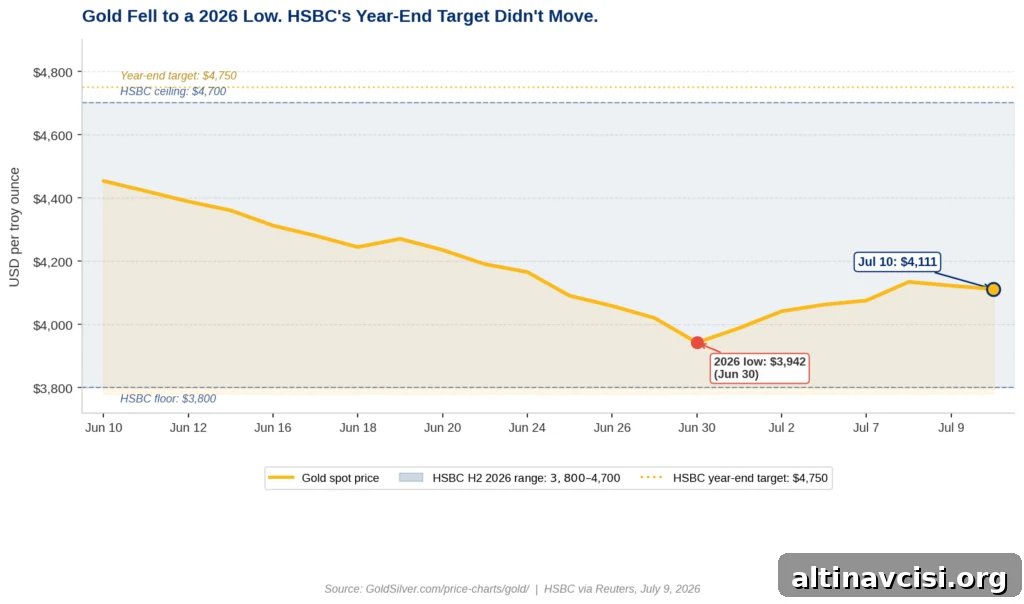
As of Friday, July 10, gold was trading near $4,103 per ounce, down roughly 0.5% for the day and about 27% below the January 28 record high of $5,589.38.
What Did HSBC Change About Its Gold Forecast?
James Steel, HSBC’s Chief Precious Metals Analyst, lowered the bank’s 2026 average gold forecast to $4,560 per ounce from $4,864. The 2027 average was likewise trimmed to $4,925 from $5,000. Despite those reductions to average forecasts, HSBC left the 2026 year-end target at $4,750 and the 2027 year-end target at $5,025. Longer-term projections for 2028 and 2029 remained at $5,200 and $5,300 respectively.
HSBC now expects gold to trade within a $3,800–$4,700 range for the remainder of 2026 before closing the year around $4,750.
The bank attributed the near-term revision mainly to changing expectations about U.S. monetary policy and its effect on the dollar. A hawkish tilt from the Federal Reserve increases the opportunity cost of holding a non-yielding asset like gold, while a stronger dollar makes bullion more expensive for buyers who use other currencies, which can reduce demand.
Stay On Top of Gold & Silver Prices
Get important market alerts sent straight to your inbox.

Why Does the Average-vs-Year-End Gap Matter?
Most headlines emphasized the cut to HSBC’s average forecast. Yet the more revealing detail is what the bank did not change: the year-end target. By lowering the average while keeping the year-end projection largely intact, HSBC signals that it expects gold to spend extended time at lower levels through the middle of the year and then recover later in the year to near its previously stated destination.
Put another way, the reduction to the average reflects anticipated weakness or consolidation across many trading days, while the unchanged year-end target shows continued confidence in a recovery toward the bank’s longer-run valuation by year end.
HSBC also left its forecasts for central bank demand unchanged, projecting 680 tonnes of official sector buying in 2026 and 850 tonnes in 2027. Analyst James Steel noted that heavy ETF liquidation in the first half of 2026 could partially reverse during the second half as more structural supports reassert themselves. Those supports include growing fiscal deficits around the world and ongoing pressure in sovereign debt markets. Steel also suggested that current geopolitical tensions are unlikely to be a permanent drag on prices, which limits downside risk compared with what the headline cut might imply.
What Does This Mean for Gold’s Structural Case?
HSBC’s revision reads as a timing adjustment rather than a rejection of the broader structural thesis that supported the recent bull market in gold. The same structural factors that pushed gold from roughly $2,600 in late 2024 to a record in January 2026 — large fiscal deficits, central bank diversification away from U.S. Treasuries, and ongoing de-dollarization trends — remain part of HSBC’s long-term rationale.
Several major institutions have made similar near-term cuts while preserving their longer-term outlooks, signaling a consistent message: the path to higher prices has become more uncertain and uneven, but the underlying direction remains intact. In this light, the HSBC update is better read as a temporary reassessment of near-term timing, not as a reversal of the bullish case for gold over the medium to long term.
Today, real yields sit higher than they were earlier, and that raises the immediate opportunity cost of holding bullion. Yet the U.S. fiscal picture requires substantial Treasury issuance over time, which constrains how long truly restrictive real rates can be sustained before they create problems for broader markets. Gold’s role as an asset outside the traditional interest-bearing financial system continues to support its structural case.
Two Dates Will Decide Which End of HSBC’s Range Gold Tests
Two near-term events will be particularly important in determining whether gold moves toward the lower or upper edge of HSBC’s $3,800–$4,700 range. First is the June consumer price index (CPI) report, due on Monday, July 14. A cooler-than-expected CPI print would reduce market expectations for an imminent Fed rate increase and would lower the opportunity cost of holding gold, supporting higher bullion prices.
The second key date is the Federal Open Market Committee meeting on July 28–29. Policymakers’ language and any indication of future policy moves will shape rate expectations into the autumn. Together, the CPI reading and the July FOMC meeting will largely determine whether gold tests the lower part of HSBC’s range or rebounds toward the bank’s unchanged year-end target of $4,750 — roughly 16% above prices reported on July 10.
SOURCES
1. Reuters — HSBC lowers 2026-27 gold price forecasts on hawkish Fed tilt, July 9, 2026
2. World Gold Council — Gold Demand Trends Q1 2026, April 29, 2026
3. CME Group — FedWatch Tool, September 2026 rate probabilities, accessed July 10, 2026
4. GoldSilver.com — Live Gold Price Charts, July 10, 2026
Disclaimer: This article is for informational purposes only and does not constitute financial or investment advice. Consult a qualified financial adviser before making investment decisions.
You May Also Like:
- The Fed Named AI Its Top Inflation Risk. Gold Noticed.
- Five Days From Now, Two Numbers Will Decide Gold’s Second Half
- Bank of America Cut Its Gold Forecast. The Reason Is More Bullish Than It Looks.
- The Fed Is Split 9 to 8. Gold and Silver Are Paying the Price — Until July 14.
- Gold Is Sitting on $4,000. The World Gold Council Has a Model for What Happens Next.
- Trump Called the Deal Dead. Oil Jumped 6%. Gold Fell. Here Is Why Both Moves Make Perfect Sense.