Why Tariff News No Longer Moves Stock Prices

Markets Growing Less Reactive to Tariff Announcements as Stocks Climb
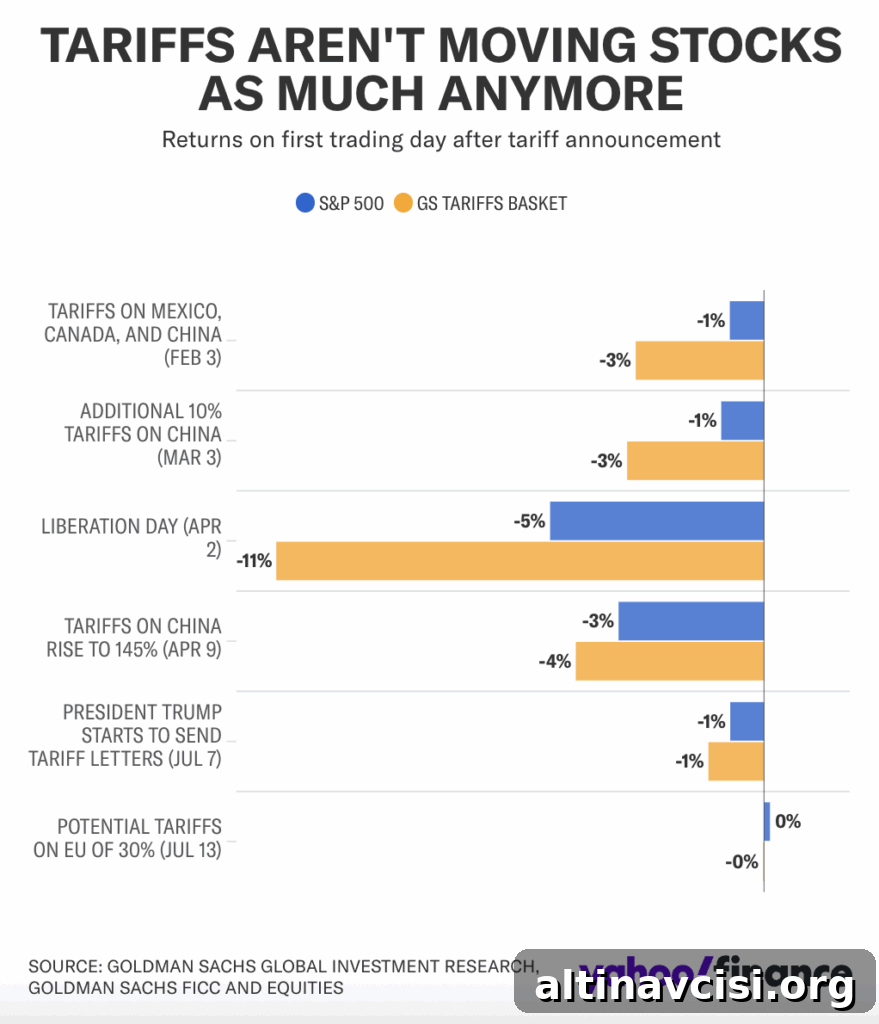
Financial markets are showing a reduced sensitivity to tariff announcements compared with earlier this year. Even as tariff threats remain in the headlines — most notably from President Trump — equity markets, including sectors traditionally most vulnerable to trade policy shifts, have registered more muted responses and continued to push to new record highs.
Investors appear to be treating tariff headlines as part of the broader political noise rather than as immediate drivers of market direction. That shift in market behavior reflects several converging factors: expectations that announced tariff plans will be scaled back or altered before they are enforced, the resilience seen in key economic indicators, and an intense focus on corporate fundamentals such as profit margins and earnings momentum.
Goldman Sachs strategist David Kostin has emphasized that market participants generally expect tariffs to settle at lower levels than initially announced. This expectation dampens the shock value of tariff headlines. In addition, recent economic data has not shown the kind of near-term disruption that many feared would result from an immediate and comprehensive tariff rollout. As a result, the net market effect of tariff chatter has diminished.
Stocks that are most exposed to trade risks — including certain industrials, consumer goods companies, and technology firms with global supply chains — have nonetheless continued to reach fresh highs. That has been driven in part by investor confidence that companies can adapt through pricing, supply-chain adjustments, or strategic sourcing. Market participants also note that many corporations have already taken steps to mitigate trade-related risk, whether by adjusting inventory, diversifying suppliers, or hedging exposure, which reduces the likelihood of sudden earnings shocks tied directly to tariff announcements.
Beyond corporate adjustments, investors are increasingly weighing multiple drivers of returns rather than reacting to single-policy headlines. Monetary policy expectations, interest rate trajectories, and projected earnings growth for the coming years have become key anchors for market sentiment. Optimism for the S&P 500 remains elevated, with market strategists pointing to the prospect of solid earnings growth in 2026 as an important underlying support for equity valuations.
That focus on earnings is central to why markets have shown resilience. When investors believe corporate profits will expand over the medium term, they are more willing to look past short-term policy noise. The implication is that headlines about potential tariffs are more likely to influence individual stock volatility and sector rotation than to derail the broader market trend, provided the macroeconomic backdrop remains constructive.
It is important to recognize, however, that reduced sensitivity does not mean immunity. Tariff policy can still have meaningful consequences if measures are implemented at large scale or if they trigger significant retaliatory responses. The market’s current stance — treating most tariff announcements as manageable risk rather than market-altering events — depends on continued evidence of healthy baseline economic activity and steady corporate performance.
In practice, investors have been repositioning portfolios to balance exposure to trade-sensitive sectors while maintaining participation in the broader market rally. This approach includes tilting toward companies with resilient margins, strong balance sheets, and the ability to pass higher costs onto consumers. Many portfolio managers are also monitoring forward earnings guidance closely, since confirmed downward revisions would be a faster and clearer signal that tariffs or other policy shifts are impacting corporate profitability.
Overall, the evolving market response suggests a maturing appreciation for the complex interplay between trade policy and corporate fundamentals. While tariff rhetoric may continue to surface, the marketplace increasingly prioritizes earnings trajectories, monetary conditions, and real economic indicators when setting prices — a dynamic that has helped push major indices to new records despite ongoing policy uncertainty.
Popular Topics
Picked from the archive
-
01
 Topics
Gold Drops to One-Month Low as Geopolitical Risks Ease
-
02
Topics
US Presses Allies to Cut China from Supply Chains by July
-
03
Topics
Moody’s Warning Rocks Bond Market, Investors Turn to Gold
-
04
Topics
Investors Doubt U.S. Bond Market: What It Means for Yields
-
05
Topics
Tariffs vs Treasuries: What’s Driving Gold Prices Now
-
06
Topics
Trump to Impose Tariffs on Trade Partners Without Negotiations
-
07
Topics
Tariffs Drive Gold Premium Over $100 Between New York and London
-
08
Topics
CBO: GOP Tax Plan Adds $3.3T to Federal Deficit in 10 Years