Why Silver Jumped 6% Before Trump Xi Summit

Gold and silver market update — May 11, 2026
Key Takeaways
- Silver rose 6.15% on Monday, May 11, 2026 to $85.36/oz while gold gained 0.39% to $4,734/oz — silver is outpacing gold by roughly 16x, driven by positioning ahead of the Trump–Xi meeting in Beijing (May 13–15).
- Why this matters: about 60% of silver demand is industrial — solar panels, electric vehicles, electronics and semiconductors — much of it tied to US–China supply chains. Improved trade conditions are directly bullish for silver in ways they are not for gold.
- Gold–silver ratio compressed to 55.46, down from above 61 in mid-April, signaling this is an industrial-demand move rather than a safe-haven rush into precious metals.
Silver climbed sharply on Monday, May 11, 2026, trading near $85.36 per ounce, while gold moved modestly higher to about $4,734. Both metals gained, but silver’s advance was substantially larger. The market reaction reflects investors pricing potential improvements in US–China trade ahead of the first US presidential visit to Beijing in nearly nine years.
Gold and silver serve different roles. Gold primarily reacts to monetary risk and geopolitical uncertainty; silver reacts to those forces too, but it also carries a large industrial component. Roughly 60% of silver demand comes from manufacturing — solar photovoltaic panels, EV components, electronics and semiconductor production — and many of those supply chains are closely linked to China. Any sign that trade frictions ease tends to boost industrial activity and, with it, silver demand more directly than gold.
The Edge Every Investor Needs
Smarter precious metals investing starts with timely, concise market analysis. Subscribe for market updates, Fed coverage, and industry trends.
We respect your privacy. This form is a placeholder; subscribe through the site to receive email alerts.
Why Is Silver Rising Ahead of the Beijing Summit?
Silver’s advance is driven by its large industrial footprint: about 60% of global silver demand comes from manufacturing sectors such as solar photovoltaic panels, electric vehicles, electronics and semiconductor fabrication. The Silver Institute’s World Silver Survey 2026 and related industry analyses show that many of these supply chains are closely tied to China. When trade relations improve, manufacturers can plan, invest and ramp production — which raises industrial metal demand, including silver.
To illustrate, solar PV manufacturing alone accounted for 29% of silver’s industrial demand in 2024, up from roughly 11% a decade earlier. EVs, semiconductors and data center hardware are expanding markets, and most are integrated into cross-border supply chains. If the May 13–15 meeting signals a reduction in trade friction or a formalized trade framework, manufacturers may accelerate orders and inventories, creating a direct boost to silver consumption that gold does not share to the same extent.
Markets view the summit as the most significant chance to stabilize trade since the tariff truce extended in November 2025. Analysts expect the leaders to either extend the current arrangement or outline a managed-trade framework that clarifies tariff timelines and sector-specific commitments. Even a credible signal of progress would improve the manufacturing outlook and, accordingly, the silver demand narrative.
What Does the Gold–Silver Ratio Tell Us About This Move?
The gold–silver ratio fell to about 55.46 on May 11, down from above 61 in mid-April. That shift means fewer ounces of silver are required to buy one ounce of gold, and the ratio compressed materially in a short period. A rapid compression like this typically reflects stronger expectations for industrial demand rather than a sudden surge in monetary or safe-haven buying.
On this date gold was essentially flat, rising under 0.5%, while silver jumped more than 6%. That divergence points to manufacturing-driven positioning. Major research teams have noted silver’s sensitivity to trade flows and production outlooks: an improvement in China’s manufacturing trajectory affects silver’s demand profile in ways gold’s monetary-driven price action does not.
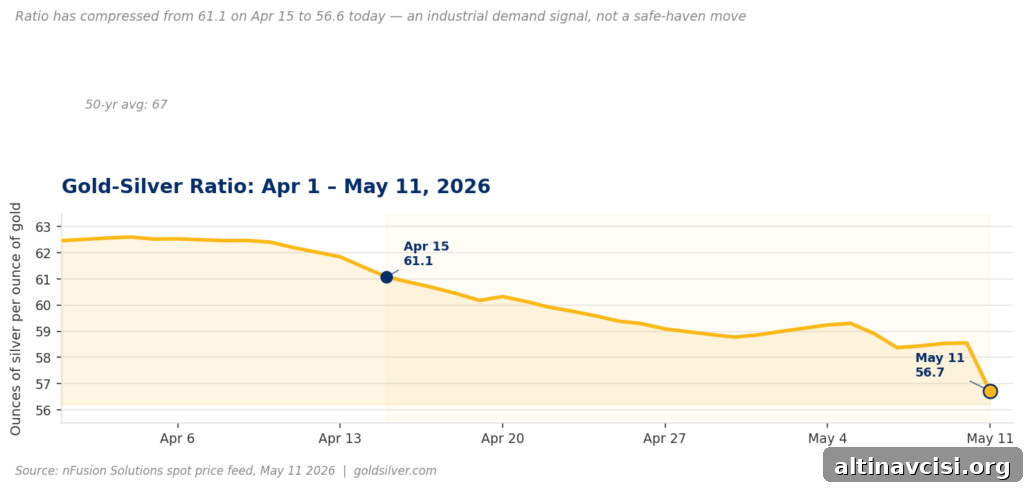
For readers tracking long-term signals, the ratio is a useful indicator of how much of silver’s move is structural versus event-driven. A durable decline below key thresholds suggests lasting repricing; a quick reversal would indicate a short-lived position ahead of political noise.
Which Three Summit Outcomes Matter Most for Silver?
Three items on the agenda could directly influence silver’s industrial demand and the risk premia priced into metal markets:
Tariff trajectory. If the existing truce is extended or formalized, manufacturers gain clarity, which supports investment and production in sectors that consume silver.
Controls on rare earths and critical minerals. Any rollback or easing of restrictions on key inputs would lower supply risk for high-tech manufacturing and reduce the risk premium embedded in industrial metal prices.
Technology sector restrictions. Policies that limit separation in chipmaking and AI hardware supply chains lift a significant tail risk for industries that use silver extensively in fabrication and assembly.
Isn’t This Just a Summit Bet That Could Easily Unwind?
Yes, event risk is real. A limited outcome — a brief truce extension or a noncommittal statement — could leave markets disappointed and prompt a pullback in silver’s premium. If the summit fails to produce tariff clarity, rare-earth commitments or a credible trade framework, much of today’s move could reverse quickly.
That said, the summit is an accelerant to an existing structural story rather than the origin of it. Silver rallied strongly in 2025 amid persistent supply deficits and rising industrial consumption; analysts projected another supply deficit for 2026. The meeting can speed a shift already underway, but the underlying supply-demand dynamics remain important regardless of the summit’s immediate outcome.
In short: the summit is a catalyst, not the whole investment thesis.
What to Watch This Week
May 13–15 (Beijing summit). Look for any joint language on tariff timelines, rare-earth policies or a managed-trade framework. Those are the items most likely to move industrial demand expectations.
Gold–silver ratio. The ratio sits near 55.46. A sustained move below 54 would indicate a broader structural repricing; a reversal above 58 would suggest the move was largely event-driven.
Silver’s session close. On the day silver opened near $80.39 and ran to $85.36. A close above $85 would reinforce the session’s strength; a close below $83 would make the spike look less durable.
Stay On Top of Gold & Silver Prices
Get timely market alerts and concise analysis delivered to your inbox.
SOURCES
1. Silver Institute — World Silver Survey 2026
2. Silver Institute & Oxford Economics — Silver: The Next Generation Metal (December 2025)
3. J.P. Morgan Global Research — How Will Silver Prices Fare in 2026?
4. Council on Foreign Relations — What to Expect Ahead of Next Week’s Trump–Xi Summit (May 8, 2026)
5. Council on Foreign Relations — At the Trump–Xi Summit, China Will Have the Upper Hand (May 10, 2026)
6. nFusion Solutions — Live Spot Price Feed (May 11, 2026)
Disclaimer: This article is for informational purposes only and does not constitute financial or investment advice. Always consult a qualified financial adviser before making investment decisions.
You May Also Like:
- April Jobs Beat 115K. Gold Held. The Dollar Didn’t. Here’s Why
- Jobs Beat, Ceasefire, Deficit: What It Means for Gold
- Gold Price Outlook: Oil Futures Disagree With Stock Markets
- Why Silver Hit $82 Today: Iran, Oil, and the Fed
- Gold Hits $4,746 as Oil Crashes. Here’s Why That’s Bullish
- Gold Price and Nonfarm Payrolls: Why the Fed Is Trapped
- Gold Is Decoupling From Geopolitics. Here’s the Proof
- The Fed Is Frozen. The Debt Is Growing. Gold Is Watching.
Popular Topics
Picked from the archive
-
01
 Topics
Why Gold Hit $5,100: What’s Driving the Rally Next
-
02
Topics
Market Update: Gold Steady, Shoppers Cautious, Nvidia Scrutinized
-
03
Topics
Gold and Silver Prices Swing as Ceasefire Falters
-
04
Topics
Gold Prices Jump as Fed Rate-Cut Odds Climb to 74 Percent
-
05
Topics
How Real Interest Rates Drive Gold Prices: Investor Guide
-
06
Topics
When the Fed’s $2 Trillion Liquidity Buffer Reaches Zero
-
07
Topics
5-Year Silver Price Forecast: Data-Driven Scenarios
-
08
Topics
Gold and Silver Hold Ground as Bitcoin Falls Below USD 95K