Gold and Silver market update – April 21, 2026
Key Takeaways
- Gold is down ~10% since February 28 — not because the sound-money case failed, but because the war pushed oil sharply higher, destroyed near-term rate-cut expectations, and suppressed paper gold via the real-yield channel.
- Paper and physical diverged. Paper gold (futures, ETFs) fell on macro repricing, while physical premiums widened and physical demand remained firm, according to USAGOLD. The spot decline reflects market structure and portfolio flows, not a loss of intrinsic value.
- The fiscal case is intact. A roughly $1.9 trillion annual deficit and about $1 trillion in annual debt service (CBO) remain unchanged by any ceasefire. Fiscal dominance — the structural cap on real yields — is the principal multi-year driver for gold.
- The suppression reverses when oil falls. Lower oil would ease CPI, revive rate-cut expectations, compress real yields and allow paper gold to recover. Natixis estimates the war’s drag on gold at as much as $750/oz — a gap that will begin to close when energy-driven pressure abates.
- Silver is leading the recovery. Silver has outperformed, rising roughly 31% from the March war low near $61 to about $79.90 on April 21 (TradingEconomics). The gold-silver ratio moved from roughly 90x toward 60x, closer to its long-run average.
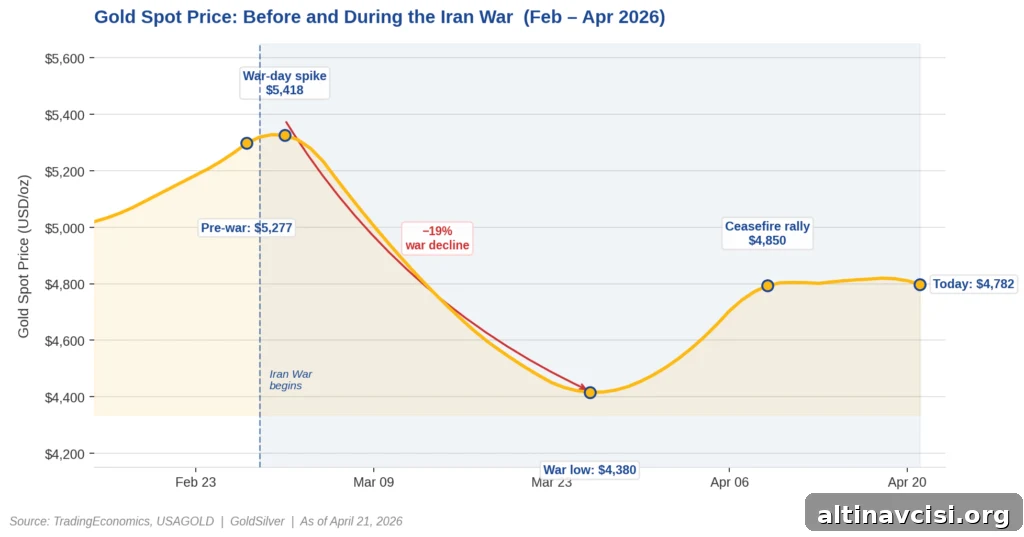
Since the Iran War began on February 28, 2026, gold has declined by roughly 10% while oil has surged nearly 60%. Conventional logic would expect a gold rally amid higher commodity-driven inflation. The fact that gold fell instead is important because it reveals how macro dynamics and market structure interact to temporarily overwhelm the usual inflation-driven impulses.
Why Is Gold Falling During an Inflation Shock?
Gold’s drop stems from a clear chain reaction set off by the Iran War. The conflict drove oil sharply higher, reviving inflation concerns and killing near-term rate-cut expectations. The Federal Open Market Committee held policy at 3.50–3.75% in March, and CME FedWatch showed a very high probability of another hold at the April meeting. Gold pays no yield, so when rates stay elevated it carries an opportunity cost and becomes less attractive to yield-sensitive institutional portfolios.
The decisive factor is real yields — nominal bond yields minus inflation expectations. Gold correlates more with real yields than with headline inflation alone. When an energy-driven inflation spike forces the Fed to remain restrictive, real yields can stay elevated and paper gold can be sold aggressively. This is not a refutation of the sound-money thesis; it is a temporary outcome of a macro regime in which energy-driven inflation and a restrictive policy stance coexist.
The Edge Every Investor Needs
Smarter precious metals investing starts here. The Nuggets Newsletter brings essential market insights, Fed updates, global trends, educational videos, and more.
What Is the Difference Between Paper Gold and Physical Gold?
Paper gold — COMEX futures and large ETFs such as GLD and IAU — behaves like a financial asset. It is sensitive to rate expectations, margin requirements and institutional portfolio signals. When the war changed the rate outlook, large funds and trading desks reduced exposure and pushed paper prices lower.
Physical gold reacted differently. Dealer premiums — the markup above spot for coins and bars — widened as paper prices dropped, according to USAGOLD’s market reports. Physical demand held up: retail and private buyers who purchased coins or bars were not compelled to liquidate when futures desks repriced risk models. That divergence underscores the importance of ownership type for investors.
In short, paper prices reflect short-term macro repricing and liquidity flows; physical prices reflect real-world demand and supply dynamics.
Does the Iran War Change the Long-Term Case for Gold?
No. Over a three- to five-year horizon the dominant drivers for gold are fiscal rather than purely geopolitical. The U.S. runs an annual deficit near $1.9 trillion and faces roughly $1 trillion a year in interest costs, according to CBO estimates. Those structural budget pressures are unaffected by short-term ceasefires or geopolitical developments.
The mechanism to watch is fiscal dominance: a large and growing debt burden that restricts how high the Fed can sustainably push real interest rates without triggering debt-service stress. That constraint tends to cap real yields over time, supporting gold’s long-term case. While a prolonged period of relatively high policy rates would pose a near-term headwind for paper bullion, record Treasury issuance and rising debt-service demands narrow the window for persistently restrictive real yields.
What Happens to Gold When the War Ends?
History provides useful parallels. The 1973–74 oil embargo produced an energy shock, higher inflation and a period when bullion lagged the inflation narrative until the rate environment changed and the metal caught up. Today the fiscal backdrop is considerably different: the U.S. is operating with much larger deficits than in the 1970s.
Analysts at Natixis estimate the war’s downward pressure on gold could be as much as $750 per ounce. Once oil prices retreat and rate-cut expectations reappear, real yields should compress and paper gold has room to recover. That recovery would then interact with long-term fiscal pressures that remain supportive for precious metals over time.
Silver is already signaling part of that rebound. From a war low near $61 in late March, silver rose to approximately $79.90 by April 21 — a roughly 31% gain that outpaced gold and tightened the gold-silver ratio from about 90x to near 60x, closer to its historical norm.
Near-term catalysts to watch include the ceasefire status, the April 28–29 FOMC meeting (Powell’s final meeting as chair) and the University of Michigan inflation expectations print on April 24. A sustained ceasefire and falling oil prices present the clearest path for gold to recover toward pre-conflict levels.
Stay On Top of Gold & Silver Prices
Get important market alerts sent straight to your inbox.
SOURCES
1. CME Group — CME FedWatch Tool
2. Congressional Budget Office — The Budget and Economic Outlook: 2026 to 2036
3. Congressional Budget Office — Director’s Statement on the Budget and Economic Outlook: 2026 to 2036
4. Kitco News — Daily Gold Market Reports
5. TradingEconomics — Gold Spot Price Historical Data
6. U.S. Energy Information Administration — Crude Oil and Petroleum Product Prices Increased Sharply in Q1 2026
By the GoldSilver Editorial Team — helping investors understand sound money since 2005. This article is for informational purposes only and does not constitute financial, investment, or tax advice. Consult a qualified financial advisor before making investment decisions.
You May Also Like:
- What the Warsh Hearing Means for Gold Prices
- IMF Says Treasuries Aren’t Safe Anymore. Gold Noticed First.
- Gold Price After Ceasefire Violation: The Floor Has Moved
- Oil Crashed 11%. Gold Went Up. That Tells You Everything.
- $1 Trillion in Debt Interest Is Why Gold Keeps Climbing
- 5 Signals That Say Gold’s Bull Case Just Got Stronger
- The Largest Gold ETF Outflow Ever – But China Disagrees
- Silver Market Deficit 2026: Six Years and Getting Worse