
Key Takeaways
- Gold is down roughly 22% from its January 2026 all-time high of $5,589 — a decline comparable in size to the 2022 Fed hiking cycle, which delivered 525 basis points of increases.
- Central banks purchased 244 tonnes in Q1 2026 — the strongest first quarter on record, according to World Gold Council and Metals Focus estimates — a category of buyers that does not react to monthly jobs data.
- Two events dominate the week ahead: May CPI on June 10 and the first FOMC meeting chaired by Kevin Warsh on June 16–17. Neither alters the structural sovereign demand supporting gold.
The last time gold fell this quickly, the Federal Reserve raised rates by 525 basis points over 16 months.
Today, markets are pricing roughly a 43–50% chance of a single 25-basis-point hike — an outcome still uncertain. Gold has declined about the same percentage from its peak, but the drivers are different and the underlying support is not the same. Here’s what those differences mean.
Why Is Gold “Supposed” to Be Lower Right Now?
The standard relationship is simple: higher interest rates raise the appeal of yield-bearing assets, which can weigh on non-yielding assets like gold.
At present, the fed funds rate stands at 3.50–3.75% following the April 29 decision. Markets are pricing an increased chance of at least one 25-basis-point hike by year-end. The 10-year TIPS real yield — a benchmark many gold traders watch — remains positive, and the dollar strengthened after a stronger-than-expected May jobs report. Those factors are textbook headwinds for gold.
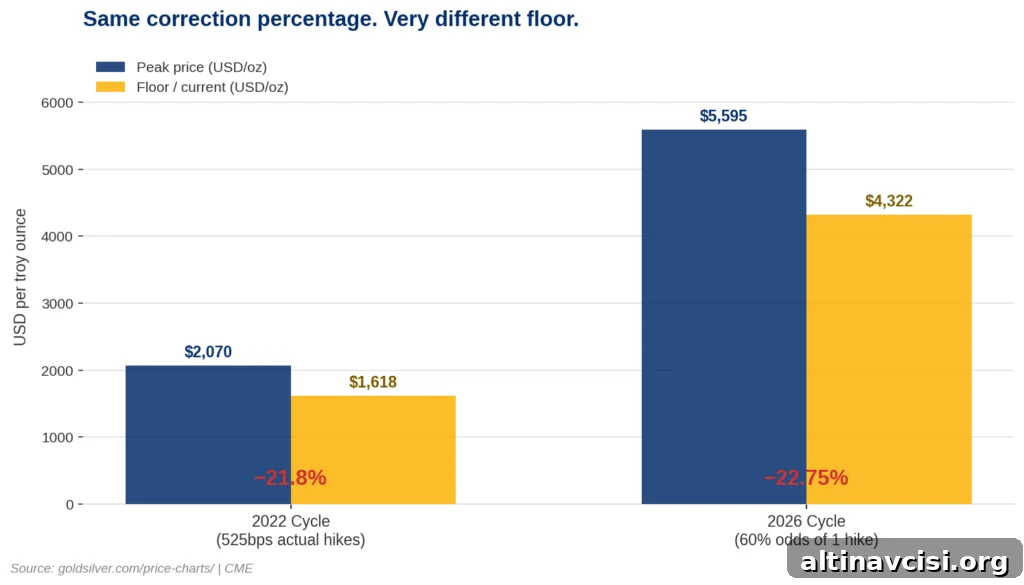
By contrast, in 2022 the Fed raised rates 525 basis points over 16 months and gold fell from about $2,070 to $1,618, roughly a 22% drop. Today, gold is down about 22% from its record $5,589 high on January 28, 2026. But this decline reflects fear of a single speculative hike rather than a prolonged tightening campaign.
Same percentage drop, different underlying forces.
The Edge Every Investor Needs
Smarter precious metals investing starts here. The Nuggets Newsletter brings essential market insights, Fed updates, global trends, educational videos, and much more.
Why Hasn’t Gold Followed the Real Yields Playbook?
The traditional model overlooks a key shift in who drives gold demand.
From about 2010 to 2021, Western ETF flows were a dominant influence: rising real yields saw ETF holders sell, falling real yields saw them buy, and the correlation was strong. That dynamic changed after 2022.
Russia’s invasion of Ukraine and the freezing of roughly $300 billion in Russian dollar reserves signaled geopolitical risk in holding foreign dollar reserves. Emerging-market central banks accelerated diversification away from US Treasuries into gold. That move was not a short-term trade but a policy decision — a structural change in demand that does not react to monthly macro prints.
This explains why gold can be down 22% on the prospect of a single speculative hike: the market now contains buyers whose mandates and time horizons differ from momentum-driven ETF investors.
What Is Actually Keeping Gold Above $4,300?
Sovereign demand — central banks buying for reserve diversification and national security — is the principal support, and it operates independently of short-term market moves.
Central banks bought more than 1,000 tonnes annually for three consecutive years: 1,136 tonnes in 2022, 1,051 tonnes in 2023, and 1,045 tonnes in 2024, per World Gold Council data. Even as purchases eased to 863 tonnes in 2025, that remains far above pre-2022 averages. Q1 2026 showed a rebound, with estimated purchases of 244 tonnes — a record first quarter.
Individual central bank programs add to this structural demand. Poland aims to reach 700 tonnes and added 102 tonnes in 2025, currently holding about 550 tonnes. The Bank of Korea began a new gold-related reserve allocation in Q1 2026. These buyers follow mandates and long-term plans rather than reacting to payroll reports.
Economists call this price-insensitive demand: whether gold falls 22% or 5%, mandated reserve accumulation continues. That demand does not vanish if the new Fed chair signals a hawkish stance.
Is Gold Down 22% for the Same Reason as 2022?
Largely yes, but the composition of support differs.
In 2022, the 525-basis-point tightening cycle set a floor near $1,618. Today, gold is testing support around $4,300–$4,340 after a much smaller prospective tightening. The key difference is that current structural support is driven by sovereign reserve buying tied to geopolitical considerations rather than by short-term yield-sensitive flows.
Technically, gold has been trading between its 200-day moving average near $4,340 and a 50-day average around $4,730, with brief intraday moves below the former around June 5 after the jobs report before a recovery. Analysts point to near-term rate-hike concerns limiting sentiment, while still expecting recovery later in the year.
What Do May CPI and the Warsh FOMC Meeting Mean for Gold?
Two events will influence short-term price action.
May CPI, due Wednesday, June 10: a hotter-than-expected print could push gold toward $4,250–$4,270 as rate-hike odds rise. A softer reading or signs the Hormuz-related oil spike is easing could move gold back toward $4,500.
The FOMC meeting on June 16–17 will be the first chaired by Kevin Warsh. His early decisions and communication will shape short-term expectations about policy direction, but they do not alter the longer-term structural demand from sovereign buyers.
Central banks are not selling gold because of a single CPI print. Physical gold holders retain the same share of a finite global supply that sovereign institutions continue to compete for, and that competition underpins many institutional price forecasts.
This is not alarmism — it is an explanation of portfolio mechanics and the changing composition of demand in the gold market.
Stay On Top of Gold & Silver Prices
Get important market alerts sent straight to your inbox.
SOURCES
1. CME Group — FedWatch Tool
2. US Treasury — Daily Treasury Real Yield Curve Rates
3. Bureau of Labor Statistics — May 2026 Employment Situation Summary
4. CBS News — Highest Gold Price in History
5. World Gold Council — Central Banks Resume Net Buying in April
6. World Gold Council / Metals Focus — Gold Demand Trends Q1 2026
7. JPMorgan coverage of gold outlook
8. Coverage of gold reaching fresh highs in early 2026
9. Live gold price charts and market data sources
10. Federal Reserve — Kevin Warsh Takes Oath as Chairman
11. Morningstar — May Jobs Report analysis
12. Coverage of Fed hike odds and prediction markets
13. Reporting on Fed decision dynamics in June 2026
14. Reuters — Gold falls as strong jobs data boosts rate-hike fears
15. FRED / St. Louis Fed — Gold fixing price series
Disclaimer: This article is for informational purposes only and does not constitute financial or investment advice. Always consult a qualified financial adviser before making investment decisions.
You May Also Like:
- Silver Falls 6% on Jobs Beat. The Six-Year Deficit Didn’t.
- Gold Rate Hike Fears Are Weighing on Prices. Here’s the Full Picture.
- Gold at $4,480: Physical Demand Hits a 50-Year Milestone
- Gold Holds $4,481 With Rate Hike Risk Rising. Here’s the NFP Decision Map.
- Gold Surges 1.5%: ADP, ISM, and Beige Book Trap the Fed
- Gold at $4,454 Says the Fed Is Trapped. Here’s Why.
- Central Banks Picked Gold Over Treasuries. Should You?
- Central Banks Just Crossed a Line Not Seen Since 1996
- Factory Costs Hit 82.1. That Number Is Now Working for Your Gold.
- Gold at $4,500: What Fort Knox, China, and Silver Are Telling You
- Silver Has Two Engines. Stagflation Is the One Condition That Fires Both at Once.