
Gold and silver market update — April 24, 2026
Key Takeaways:
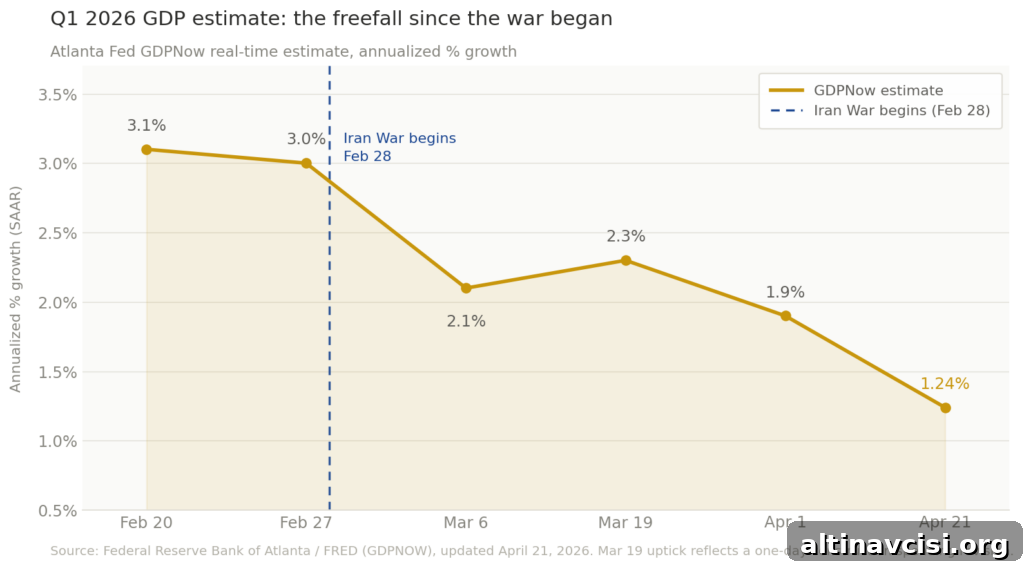
- GDPNow (April 21): The Atlanta Fed’s GDPNow model projects Q1 2026 GDP at 1.24% annualized, down from 3.1% in late February.
- GDP release date: The BEA’s advance estimate for Q1 GDP is released April 30 at 8:30am EDT — the day after Chair Powell’s final FOMC press conference.
- The stagflation setup: GDP around 1.24% combined with CPI at 3.3% (BLS, April 10) and Brent crude near $106 (April 24) creates a stagflationary backdrop that constrains Fed policy and lowers gold’s opportunity cost.
- Both scenarios favor gold: A weak GDP print confirms financial repression; a stronger print leaves structural drivers — deficits, central bank buying, geopolitical risk — intact.
- Watch the PCE deflator: If growth is weak while the PCE deflator is hot in the same report, stagflation shifts from theory to confirmed data.
Markets are focused on the April 29 FOMC meeting and Chair Powell’s press conference — a widely expected hold. The more consequential datapoint for precious metals arrives the next morning.
On April 30 at 8:30am EDT the Bureau of Economic Analysis will publish its advance estimate for Q1 2026 GDP. The Atlanta Fed’s GDPNow tracker, updated April 21, shows annualized growth of 1.24%. That’s a steep decline from the 3.1% reading in late February, and it captures much of the economic impact of recent geopolitical and energy shocks in one indicator.
Measured alongside a 3.3% CPI and oil prices above $100 per barrel, this combination reads as stagflation: slowing growth with persistent inflation. That environment limits the Fed’s options and strengthens gold’s case whether growth proves weak or surprisingly resilient.
What does weak Q1 GDP mean for the gold price in April 2026?
Q4 2025 GDP slowed to 0.5% annualized, a notably weak print. Q1 was expected to rebound; in late February GDPNow was tracking 3.1%. After the conflict that began February 28 and a jump in oil prices, the growth estimate steadily fell to 1.24% by April 21.
The April 30 BEA release will be the first official gauge of how recent events affected the US economy. That print will settle the ongoing debate over a soft landing versus stagflation by replacing estimates with hard data.
There are two plausible scenarios — and both support gold.
Scenario A: GDP prints near 1.24% or weaker. That outcome confirms the stagflation narrative and leaves the Fed trapped. Cutting rates risks reigniting inflation when CPI is still elevated; raising rates risks deepening an already slowing economy. The result is financial repression: real yields on cash become negative or negligible, making non-yielding assets that preserve purchasing power, like physical gold, more attractive. Historically, gold has outperformed during stagflationary episodes because cash yields lose value in real terms.
Scenario B: GDP surprises higher, toward 2% or more. A stronger print would revive the soft-landing story and support Fed patience, but macro structural forces remain unchanged. The Congressional Budget Office’s large projected deficit, ongoing central bank gold purchases, and elevated geopolitical risk still underpin demand for gold. In short, a better growth print does not eliminate the drivers that benefit precious metals.
The Edge Every Investor Needs
Smarter precious metals investing starts here. The Nuggets Newsletter brings essential market insights, Fed updates, global trends, educational videos, and more.
Why is the Fed trapped — and what does that mean for savers?
The core of the stagflation risk is a policy bind: when inflation remains elevated and growth slows, the central bank has limited safe options. Financial repression arises when nominal interest rates are lower than inflation, transferring purchasing power away from savers toward borrowers and the government.
If the Fed cannot cut without risking higher inflation, and cannot hike without choking growth, real yields on cash will stay negative or near zero. That reduces the opportunity cost of holding gold, an asset that preserves purchasing power without generating yield. This arithmetic — not just investor fear — explains why gold typically benefits in such periods.
Official-sector buying reinforces the picture. The World Gold Council forecasts roughly 850 tonnes of central bank purchases in 2026, close to the 863 tonnes recorded in 2025. Several countries are adding to reserves to diversify away from fiat exposure on a multi-decade timeline. Together with a large fiscal deficit and elevated geopolitical risk, these trends point to a persistent erosion of fiat purchasing power and continued structural support for gold.
What should gold holders watch in the April 30 release?
Until now the stagflation narrative has relied on models, surveys, and nowcasts. The BEA’s advance GDP release on April 30 will replace estimates with official figures and move the discussion to solid data.
The headline GDP figure matters, but the release also includes the PCE price deflator — the Fed’s preferred inflation measure and broader than the CPI. A weak GDP print combined with an accelerating PCE deflator would confirm stagflation in one report and be a significant catalyst for gold.
Key items to monitor on April 30:
- Headline GDP: Below 1.5% would support the weak-GDP narrative; above 2.0% would challenge it.
- PCE price deflator: Any acceleration from Q4 2025 would deepen the stagflation case.
- Real final sales to private domestic purchasers: This removes volatile inventory swings and gives a clearer read on underlying demand.
Market odds already price a nearly certain hold at the April 29 FOMC meeting. That makes the April 30 BEA report especially asymmetrical in impact: the Fed decision is largely expected, but the GDP and PCE outcomes are not fully priced in and could meaningfully influence precious metals.
Stay On Top of Gold & Silver Prices
Get important market alerts sent straight to your inbox.
SOURCES
1. Federal Reserve Bank of Atlanta — GDPNow Q1 2026 Real-Time Tracking
2. U.S. Bureau of Economic Analysis — Q4 2025 and Q1 2026 GDP releases
3. U.S. Bureau of Labor Statistics — Consumer Price Index, March 2026
4. Congressional Budget Office — Budget and Economic Outlook: 2026 to 2036
5. World Gold Council — Central Bank Gold Statistics
6. Reporting on oil prices and geopolitical risk, April 2026
7. CME Group — FedWatch Tool
By the GoldSilver Editorial Team — helping investors understand sound money since 2005. This article is for informational purposes only and does not constitute financial, investment, or tax advice. Consult a qualified financial advisor before making investment decisions.
You May Also Like:
- Gold Price Today: What to Watch Before the April 29 FOMC
- What’s Driving Gold Prices? Oil, PMI, and Newmont
- Dollar Weakens, Gold Falls — and That’s Actually Bullish
- Why Chinese Silver Imports Hit a Record in 2026
- What Drives Gold Prices? 5 Forces Investors Are Watching Now
- The Gold-Silver Ratio Signal: What Silver’s Lead Means
- Gold Drops to $4,681 — Iran Ceasefire Expires Today
- The Real Reason Gold Is Down During an Oil War